UT Austin Lets Field Crews Plug New Payloads Into Spot in Minutes
Most field robots ship as a sealed stack. A University of Texas at Austin team wants the opposite: plug in a USB drive and a camera the robot has never seen, and have it plan with that gear in minutes. The paper, “Deployment Is Not Destiny,” posted to arXiv on August 11. The project page has the two demo videos.
Payloads the robot did not know at ship time
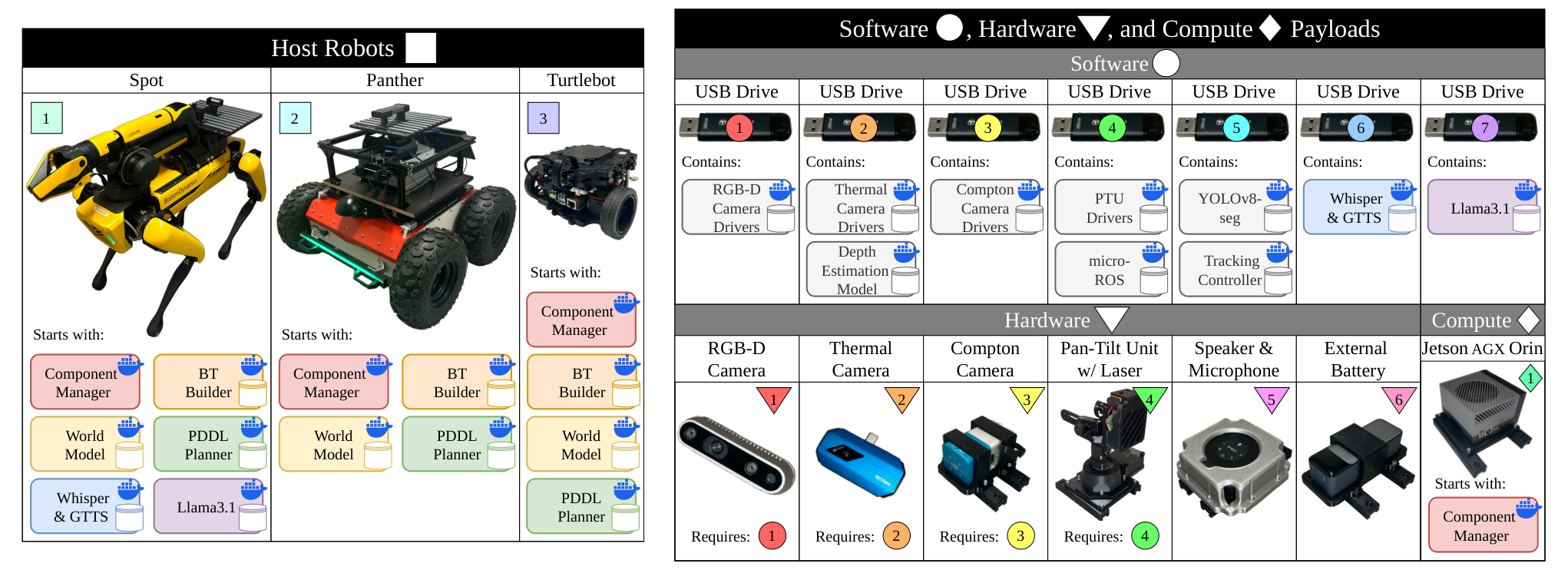
The authors call new modules nondum visum payloads: software, hardware, or compute that did not exist in the robot’s original configuration. Each software payload is a container plus a database of behaviors and PDDL fragments. Hardware rides USB on a rail mount. Extra compute joins over Ethernet or Wi-Fi, swaps databases, and lets a weak robot use a remote GPU.
A Component Manager watches udev events, new device nodes, and peer discovery. A system-level behavior tree rebuilds a task plan from whatever is plugged in. The teammate talks to it: speech-to-text in, text-to-speech out, a local LLM mapping language to a PDDL goal.
Two disaster-style runs
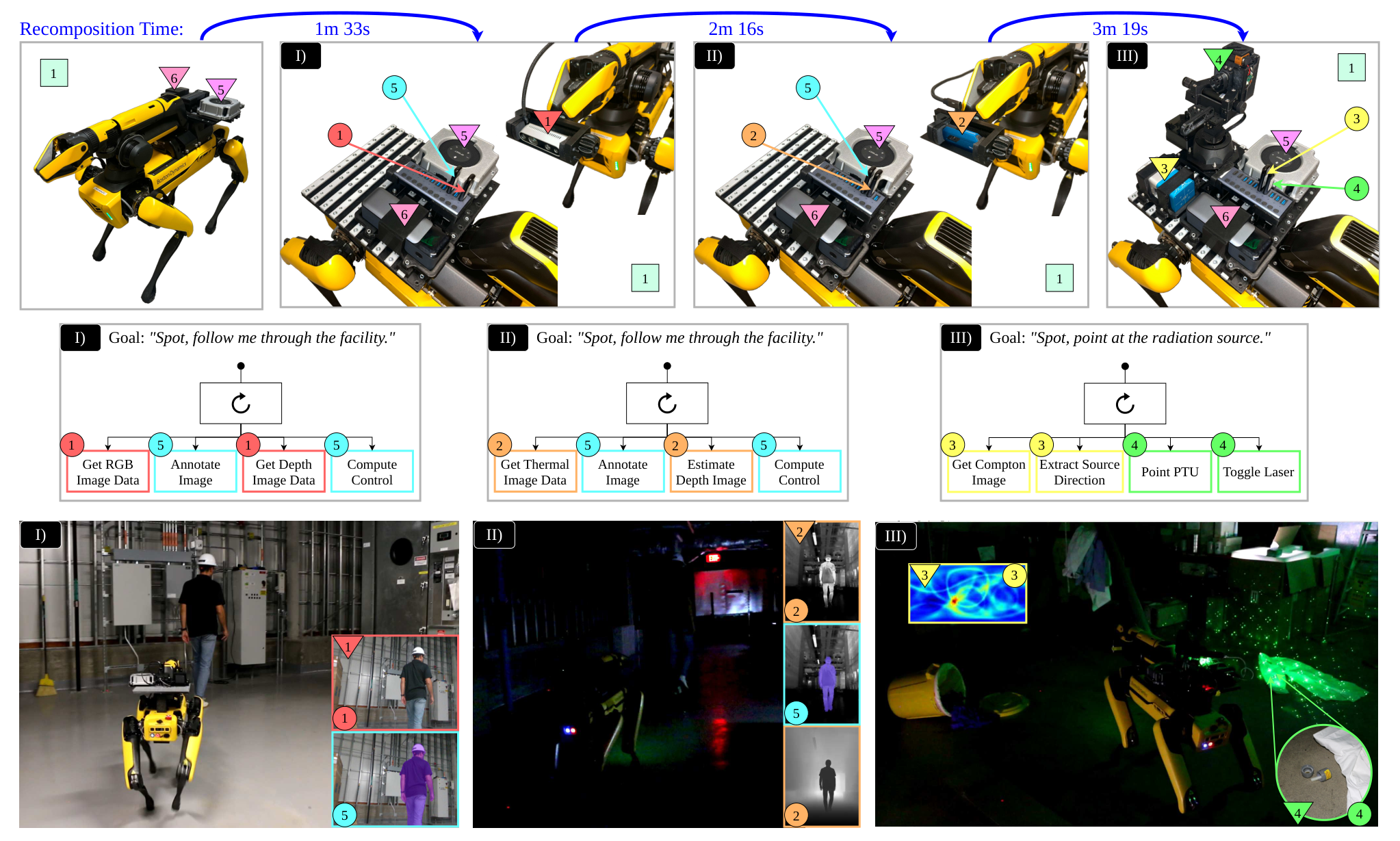
Demo 1 is a mock blackout at an operational nuclear reactor. Real radioactive material is hidden off the obvious line of sight. A Boston Dynamics Spot (Jetson AGX Orin, 64 GB, 1 TB) starts with a speaker, mic, and battery.
- Plug RGB-D + YOLO + tracker. Goal: “follow me through the facility.” 1 min 33 s to recompose.
- Lights die. Swap to thermal + monocular depth. Same goal. 2 min 16 s.
- In the room, swap to a Compton camera and a pan-tilt laser. Goal: “point at the radiation source.” 3 min 19 s.
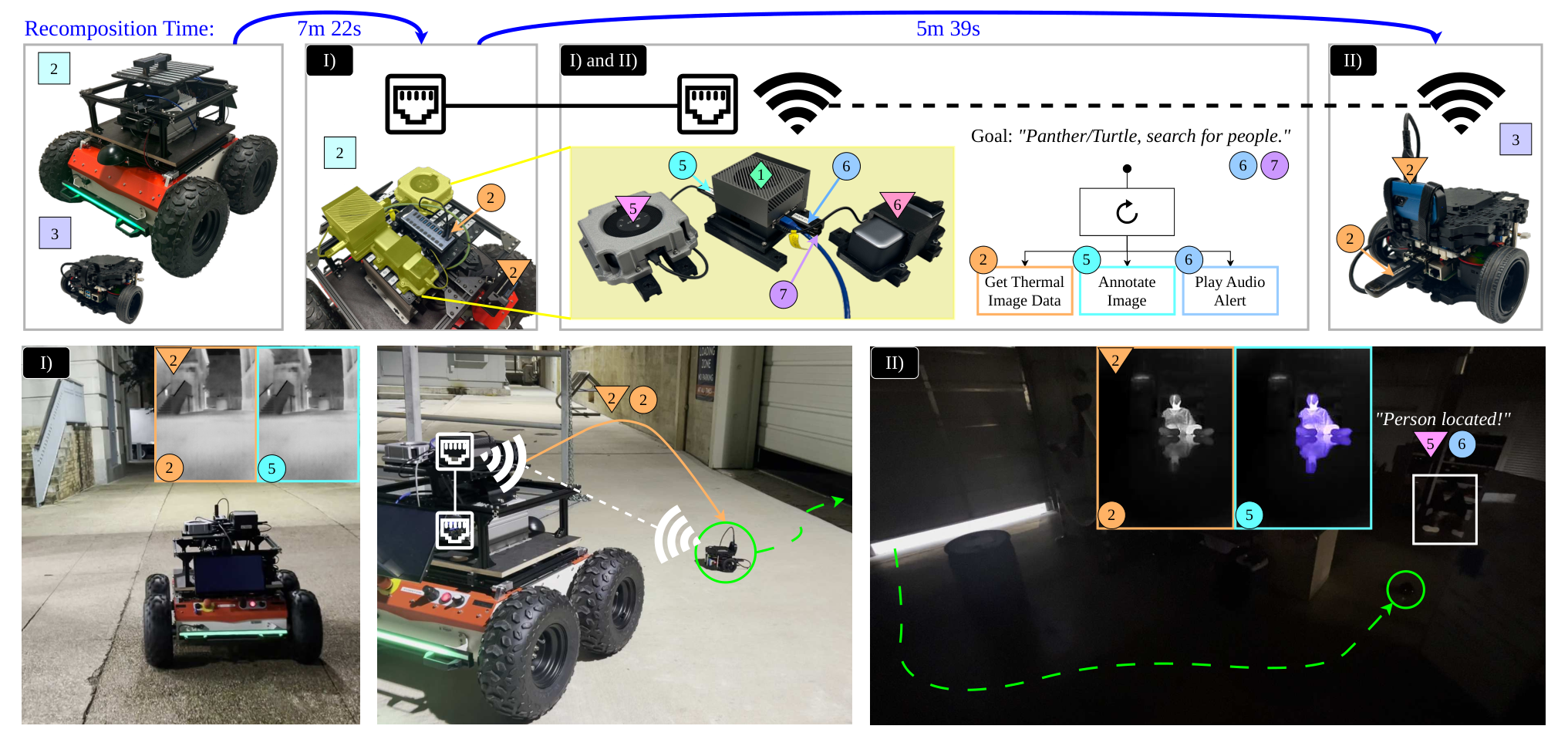
Demo 2 is a thermal person search. A Husarion Panther (i9-13900, no GPU) uses a borrowed Jetson over Ethernet outdoors. It cannot fit a small opening, so a Robotis Turtlebot (Raspberry Pi 4, 2 GB RAM) takes the thermal camera and the same remote compute over Wi-Fi. Recomposition: 7 min 22 s then 5 min 39 s. The Turtlebot enters the dark interior and calls out a person.
The teammate still picks which payload to mount. Mounts are not proprioceptive. Plans are classical PDDL, not a reactive behavior-tree synthesizer. Funding note on the paper: U.S. Army Futures Command contract W911NF-24-C-0067. Open-source software is promised at camera-ready.
A Human’s Take
Minutes versus a developer weekend is the claim that matters, and they put clocks on the figures. I care that the same thermal pack moved from a Spot follow, to a Panther survey, to a Pi-class Turtlebot without rewriting launch files. I also care that a human still has to know which dongle to grab. That is fine. I would rather have a field tech with a labeled USB kit than a 200-pound “generalist” that cannot take a new camera.