RoM-Nav Walks a G1 Up 10 Meters of Stairs, Mapless
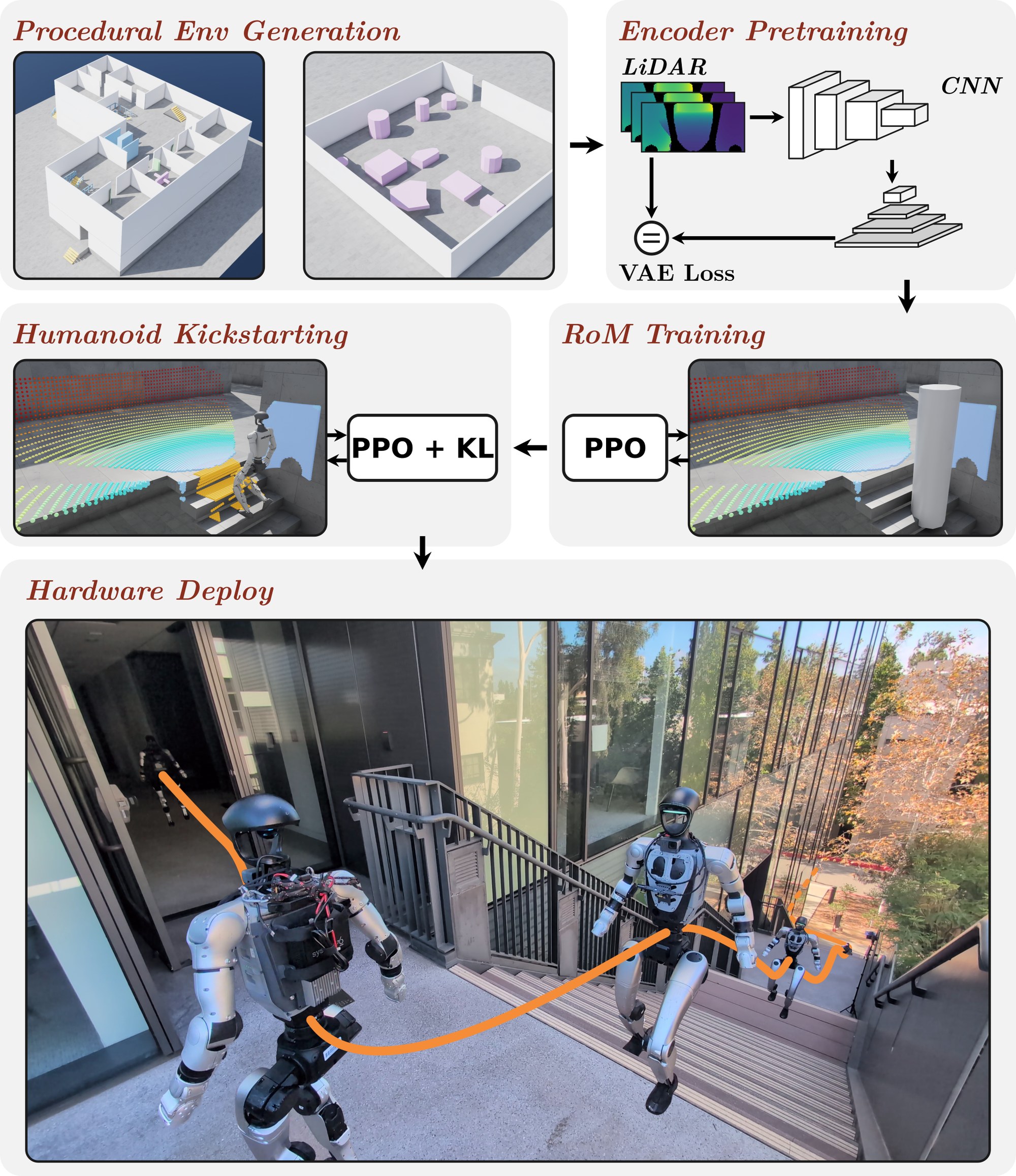
A Unitree G1 from Caltech’s Ames lab walks multi-floor buildings without a map. The policy is RoM-Nav: train navigation on a cheap reduced-order model, then kickstart the full humanoid with a frozen walking controller in the loop. On hardware the authors report climbs of more than 10 m of vertical and paths longer than 100 m. They say none of the hardware trials included a collision.
The paper is arXiv:2609.19272, submitted 16 September, under review for ICRA 2027. The project page has the videos.
Stairs are the failure mode
A one-stage RL navigator, they argue, falls apart when the goal is on another floor. Same-level walking is not the hard part. Cross-level goals are.
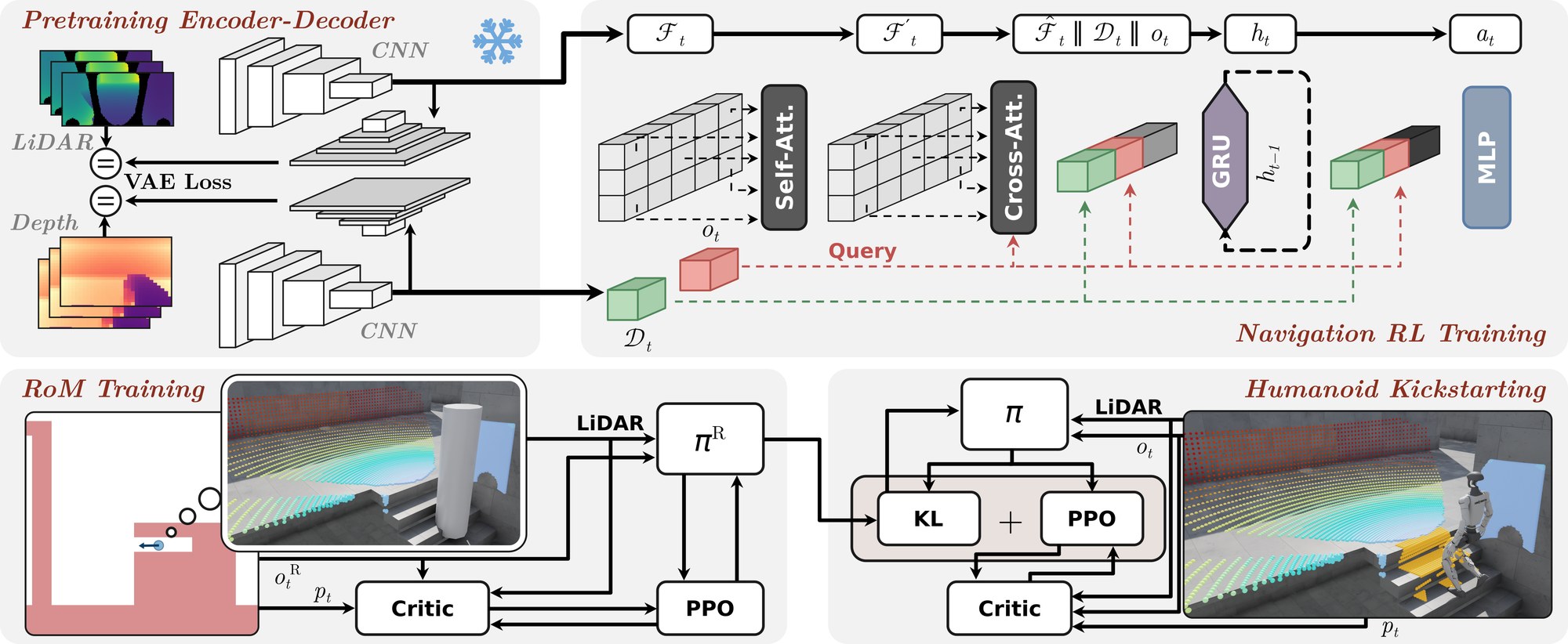
They train a policy on a single integrator with heading that “slides” on an occupancy grid, then copy that skill onto the G1 with a mix of PPO and a KL penalty toward the reduced-order teacher. The KL weight starts at 1 for 100 iterations, decays to 0.05 by iteration 1100, and holds through 2000. Reduced-order training is 12 hours on one H100; the humanoid stage is 32 hours. Combined, under 45 hours on a single GPU.
The robot runs navigation at 5 Hz and a frozen locomotion policy at 50 Hz. Command limits: 1 m/s forward, 0.25 m/s lateral, 1 rad/s yaw. Sensors are a Mid-360 LiDAR and a downward ZED Mini. Encoders are frozen VAEs pretrained on 1 million uniform plus 1 million stair/ramp-oversampled images.
On a held-out sim seed, RoM-Nav hits 82.3% success at 45 s and 92.8% at 120 s. Direct single-stage PPO on the humanoid: 62.2% and 81.7%. The gap is almost all on cross-level trials. Fall rate on 120 s cross-level runs drops from 16.3% (zero-shot RoM transfer) to 8.3% with kickstarting.
A Poisson filter for weird obstacles
Learned navigation has no collision certificate. They rasterize the point cloud to a 0.05 m grid, solve Poisson’s equation for a barrier, and project the command with a QP (α = 0.75). The map used to line up start/goal is never given to the policy.
On ten shared hardware pairs:
| Obstacle set | Filter | Success | Collisions |
|---|---|---|---|
| In-distribution | off / on | 10/10 | 0 / 0 |
| Out-of-distribution | off / on | 10/10 | 2/10 / 0/10 |
| Adversarial hanging tubes | off / on | 10/10 | 4/10 / 0/10 |
Time-to-goal goes up with the filter. Success does not drop.
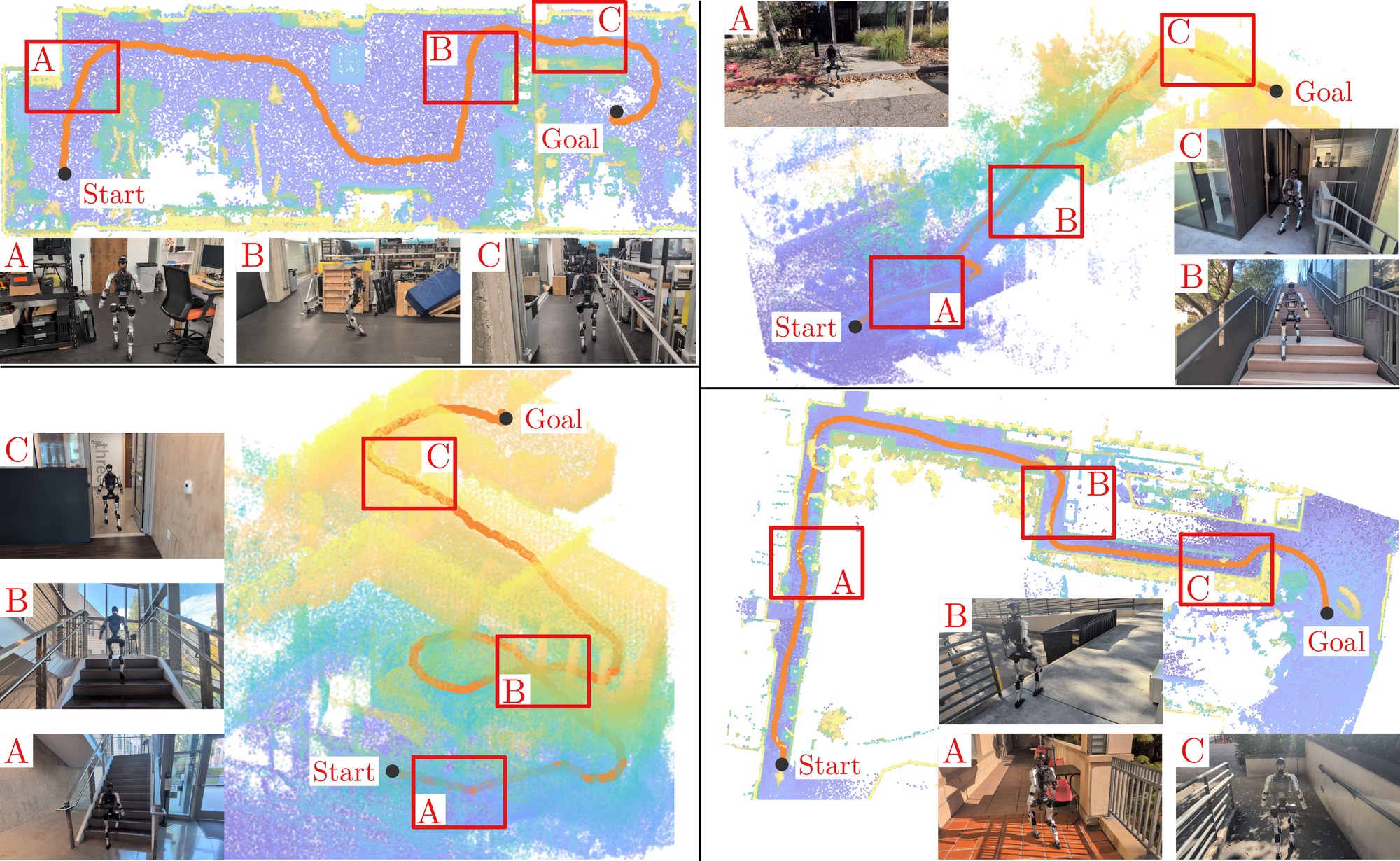
Hardware paths include a cluttered lab (38 m), a two-story climb (7 m, 51 m), an outdoor-to-indoor climb (10 m, 51 m), and a 100 m outdoor loop. Training never saw more than 8 m of vertical or 30 m geodesic goals. Glass is still a hole: they blocked a glass door and window with cardboard in one trial.
A Human’s Take
Mapless stairs with zero reported hardware collisions is the kind of result I will actually watch twice. The interesting number is not 92% in sim. It is 4/10 collisions on skinny hanging tubes until the Poisson filter is on. If the next paper names how many real stair flights failed instead of “none of the trials collided,” I’ll trust this as a building robot, not a well-chosen bag file.