RotateIt Spins a Shirt Open With One Arm, No Fling
Most dynamic cloth unfolding looks like two arms stretching a towel and hurling it. Zeqing Zhang, Zuokun Xie, Ao Fang, and colleagues at Nanyang Technological University posted arXiv:2609.19817 on 17 September 2026 with a different primitive: grab one point, lift, and spin.
RotateIt! is, they write, the first unfolding framework that uses dynamic axial rotation as its main move. One arm. Compact workspace. No second grasp.
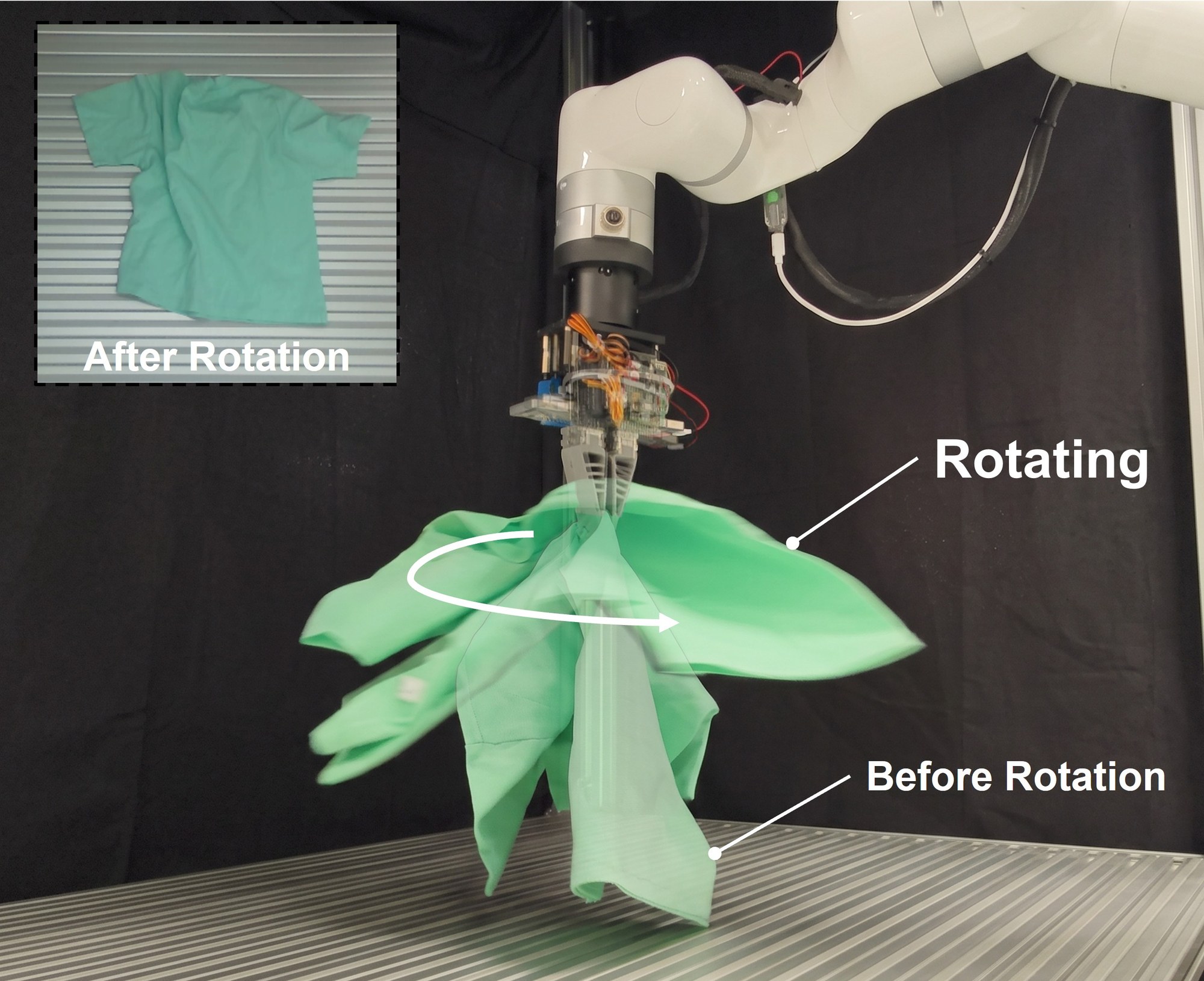
Grasp first, then change speed and how far you go
Stage I scores visible grasp candidates from RGB-D. The label is not “looks like a corner.” It is settled coverage after the same nominal spin in simulation. Stage II is a residual policy on the suspended garment: it nudges rotation extent and angular velocity over K = 4 chunks. Release time falls out of that schedule.
Both stages train in Isaac Sim on a Franka, then run unchanged on an xArm 7 with RealSense D435 and D405. No real-world fine-tune.
A rollout succeeds at coverage ≥ 0.8, or it gets two more attempts. 20 rollouts per garment–method pair.
Not pick-and-place, and not a fling
Against a quasi-static pick-and-place baseline trained in the same sim, on the same five seen garments:
| Setting | RotateIt S@3 | P&P S@3 | First-attempt coverage |
|---|---|---|---|
| Seen sim | 66.0% | 5.0% | 0.755 vs 0.612 |
| Unseen sim | 79.0% | 35.0% | 0.745 vs 0.673 |
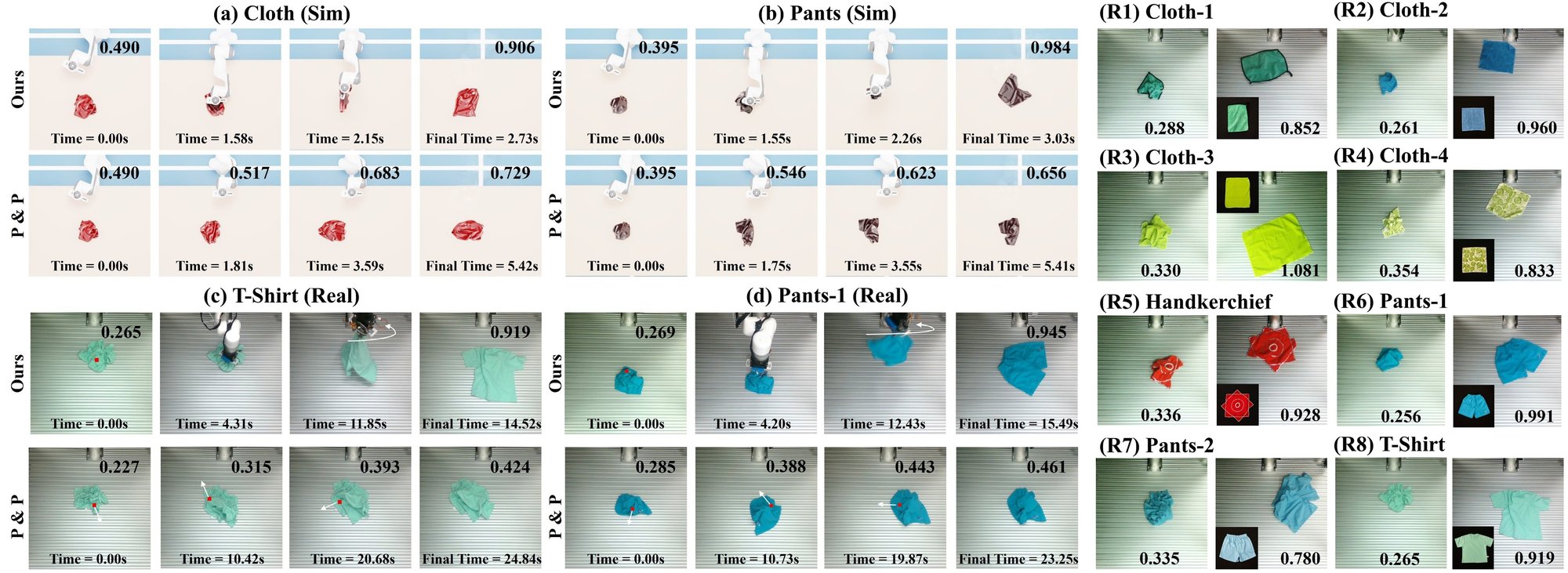
| Unseen real (8 garments) | 75.6% | 31.2% | 0.712 vs 0.505 |
That real first-attempt coverage is 41% higher than P&P. Final coverage is 0.860 vs 0.684. Attempts drop from 2.69 to 1.93.
The eight real garments include cloths, handkerchief, two pants, a T-shirt. Four of them average final coverage above 0.90. Pants-2 and T-shirt are harder (S@3 60% and 55%): hanging limbs stay folded.
Ablations on seen-sim rollouts: random grasps drop S@3 from 70.0% to 18.0%. Freeze Stage II at the nominal spin: 32.0%. Extent adaptation does more for first-attempt coverage; speed adaptation is what lifts rollout reliability.
They then fold two unseen real garments from RotateIt’s settled state with a two-step keypoint policy, no human tidy-up, in 24.56 s and 26.29 s.
A Human’s Take
Flinging is a party trick that needs two hands and a clear table. Spinning around a single pinch is the version that fits a home arm. I like that they shipped the policy with no real fine-tune and still beat pick-and-place by forty-plus points on clothes the sim never saw. The branched pants remaining at 55% is the receipt: rotation unfolds a sheet. Sleeves are still a second problem.