RynnValue Turns Timestamps Into Robot Rewards at 7,000 Hours Scale
Robot reinforcement learning is often starved of usable rewards. Hand-tuned scores do not travel between tasks, and sparse success labels give almost no gradient on long horizons. Preference labels scale even worse.
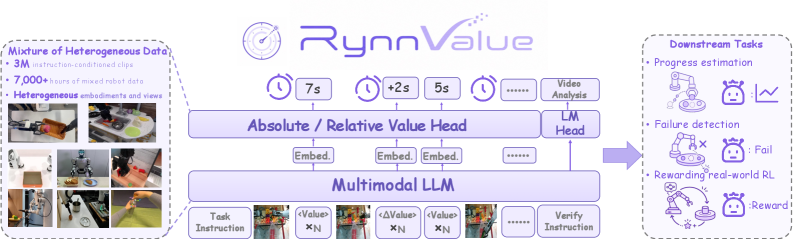
RynnValue, posted to arXiv on Aug 10, 2026 (arXiv:2608.09853) by researchers at Alibaba’s DAMO Academy and Hupan Lab, reframes the problem. Instead of scoring preferences or normalized progress inside a single trajectory, the model predicts temporal distance: how many seconds remain until a language-specified goal is done. Timestamps supply the labels, so the team can train without preference pairs.
What they trained
The training mix is large and messy on purpose. After preprocessing, the authors report more than 7,000 hours of trajectories and roughly 3 million instruction-conditioned clips, drawn from real robots, simulation, and egocentric sources such as AgiBot, EgoDex, Open X-Embodiment, RoboCOIN, RoboMIND, and others. Episodes are segmented and given completion cutoffs so remaining time is well defined.
RynnValue builds on RynnBrain, inserts repeated absolute and relative value-query tokens per sampled frame, and reads continuous distances through distributional heads (256 symlog bins). Training deliberately breaks shortcuts: irregular frame sampling, temporal-order shuffling, and value-isolation attention so one frame’s value query cannot peek at another’s. A language branch still does video description, instruction match, and success checks, but those outputs do not feed the value heads.
Benchmark and real-robot numbers
On the RBM-EVAL-OOD trajectory-ranking suite (976 OOD trajectories across six institutions and embodiments), RynnValue-8B reaches average Kendall’s τ_a of 0.675. That beats the fully preference-supervised Robometer baseline at 0.655 and more than doubles Robometer’s progress-only ablation (0.292). A 4B variant is close at 0.670.
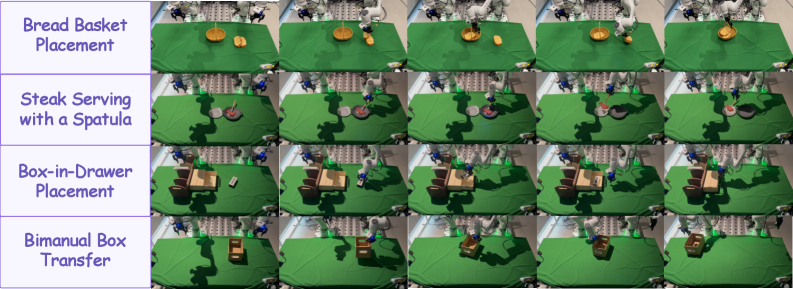
As a dense reward via potential-based shaping (potential = negative remaining time), the paper reports real dual-arm Franka results on four tasks (bread basket, spatula steak transfer, box-in-drawer, bimanual box transfer). Average success moves from 52.5% to 72.5% online and from 63.8% to 82.5% offline versus the strongest baseline under the same shaping interface. Models and collections are linked from the project page, GitHub, Hugging Face, and ModelScope.
A Human’s Take
Preference farms were always going to lose to anything you can stamp from a clock. Temporal distance is an old control idea, and the contribution is the engineering that makes it work across heterogeneous robots without inventing a progress scale per dataset. The ablations matter more than the logo: kill order shuffling or isolation attention and the ranking score collapses, which is exactly what you want from a paper that claims it fixed shortcuts. What I will watch is whether labs outside DAMO can drop the 8B checkpoint in as a zero-shot reward annotator on their own cells without a week of κ tuning.