SAM, a One-Motor Maple-Seed Flyer, Tracks Tighter Paths
A flying robot with one moving part is easy to build and miserable to steer. Researchers at the Singapore University of Technology and Design put a predictive controller on SAM — Samara Seed-Inspired Single-Actuator Monocopter — and report tighter paths than their previous inversion-based stack.
TechXplore carried the work on 18 September. The paper is in IEEE Transactions on Robotics: “Nonlinear Model Predictive Control of Single-Actuator Monocopters using Hybrid Rotational Dynamics and INDI,” DOI 10.1109/tro.2026.3731495. Lead author is Emmanuel Tang. Foong Shaohui, associate head of SUTD’s Engineering Product Development pillar, is quoted on the design brief.
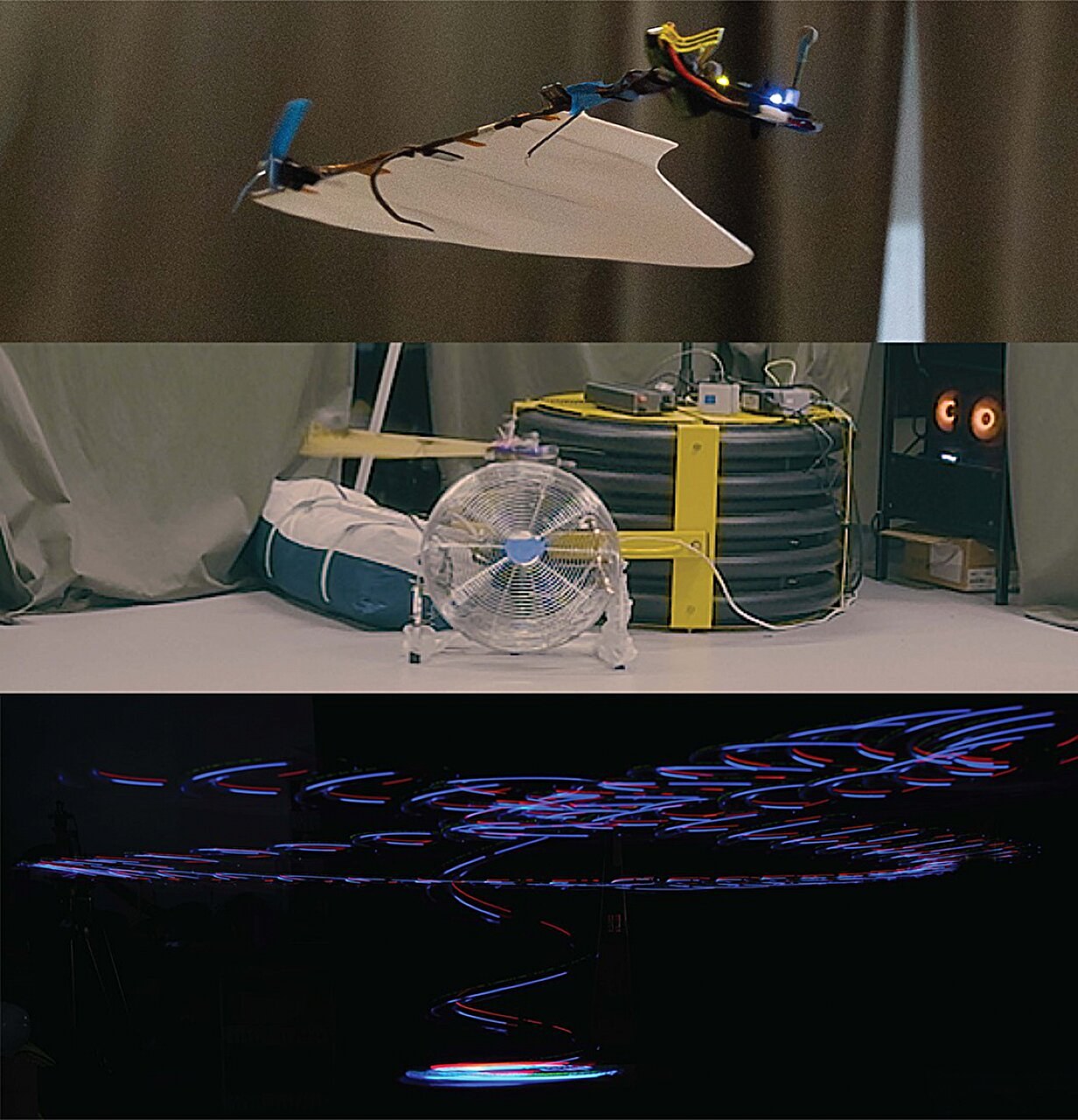
One actuator, a planning horizon
SAM spins like a falling maple seed. That spin makes lift. The same motor has to aim. There is no second rotor to cancel a mistake.
The new stack is nonlinear model predictive control (NMPC) plus Incremental Nonlinear Dynamic Inversion (INDI). NMPC looks a few steps ahead. INDI patches disturbances. A hybrid rotational model is supposed to capture the coupling between fast spin and tilt.
They flew three airframes: short-wing and long-wing wood wrapped in yellow tape, and an ultralight foam wing. Short and long wings ran circles, figure-eights, and elevated circles, including paths that asked for more motor than the platform could give, plus fan-blown wind. The foam wing flew a circle and carried a 5 g payload.
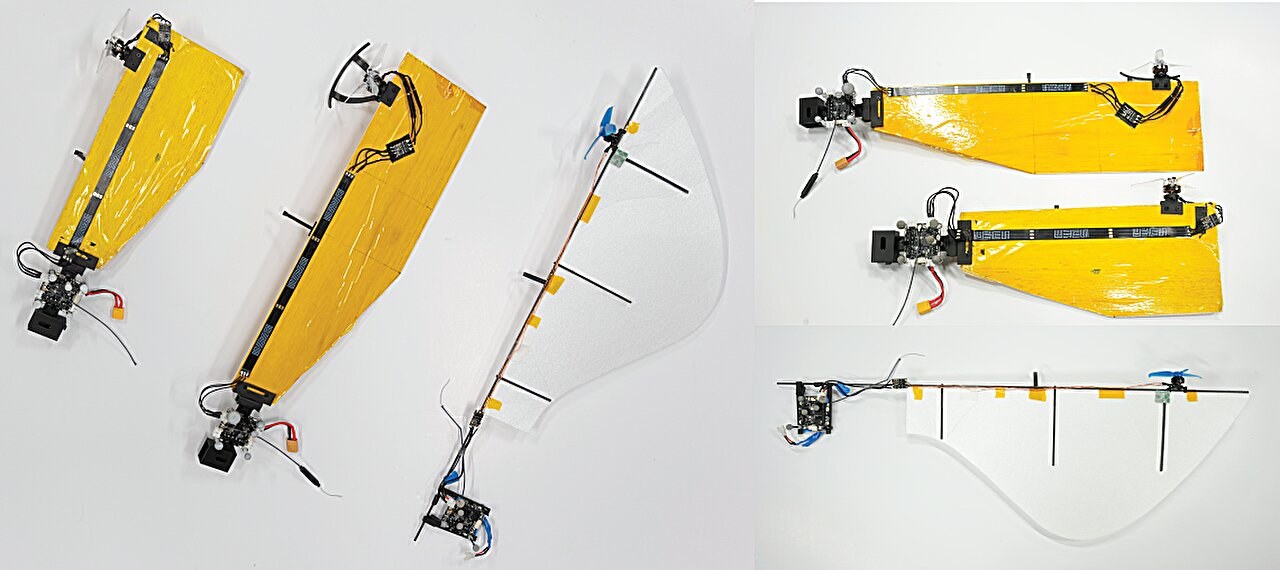
The error drops, the lab stays in the loop
Against a Differential Flatness-Based Controller with INDI:
- Long-wing positional RMSE down up to 39.5%
- Short-wing positional RMSE down up to 37.2%
- Ultralight velocity error down up to 43.5%
Those are the authors’ numbers, via TechXplore. Flights were indoors, with OptiTrack motion capture and offboard compute. Tang’s quote in the same piece is the constraint: every motor command has to be timed, because there is only one.
Foong points at environmental sensing and climate monitoring as a longer-term use if the platform can leave the motion-capture hall. The article is explicit that it cannot yet.
A Human’s Take
I like one-motor flyers because they fail honestly. If the controller is late, the seed just walks off the circle. A 39% RMSE cut on the long wing is a real control result. It is also still a room with OptiTrack and a PC in the loop. The next demo that matters is the same figure-eight with the estimator on the wing, in wind that is not a desk fan.