Two Wheeled Humanoids Assist a Goat-Liver Gallbladder Demo
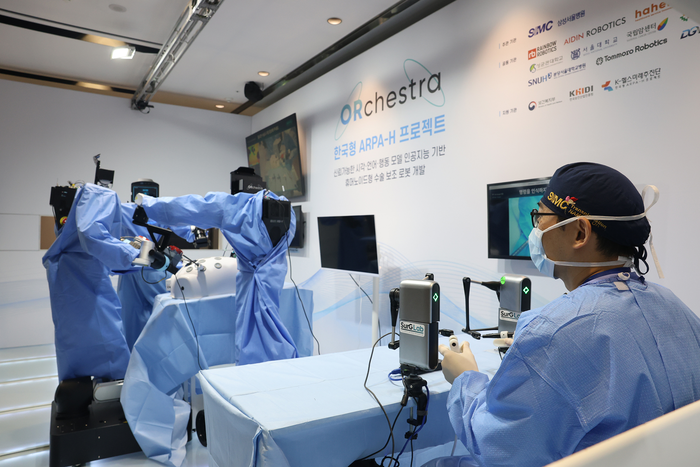
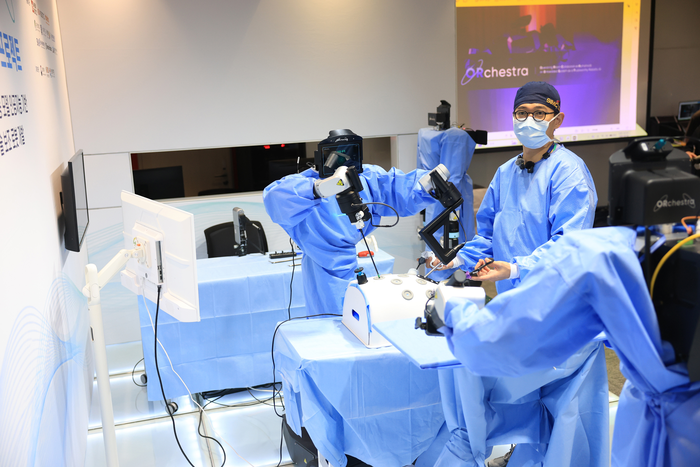
On 16 September, transplant surgeon Oh Nam-ki of Samsung Medical Center in Seoul ran an endoscopic cholecystectomy on goat liver tissue with two humanoid surgical-assistant robots at the table. Maeil Business Newspaper and The Kyunghyang Shinmun both clock the demo at about 10 minutes. Usual assistant staff were not in the circle.
The robots come from ORchestra, a Korean ARPA-H (KARPA-H) consortium led by Samsung Medical Center with Rainbow Robotics, Aidin Robotics, Haehaeho, the National Cancer Center, Seoul National University, and Jeonbuk National University Hospital.
What the two robots did
Kyunghyang describes a split of labor that is closer to OR staffing than to a da Vinci console:
- Robot No. 1 acted as a scrub nurse. It took voice commands, picked instruments from a mixed tray, handed them so the surgeon could grasp them, then put used tools back.
- Robot No. 2 held the laparoscopic camera with one hand and retracted tissue with forceps in the other.
MK reports that when Oh asked for a grasper, the left robot scanned the tray, identified the tool from vision, and presented the handle. When he pushed an instrument into a simulated abdominal wall about as thick as a ballpoint pen, the right robot used remote-center-of-motion (RCM) so the outer arm moved opposite the inner tip and did not tear the mock skin.
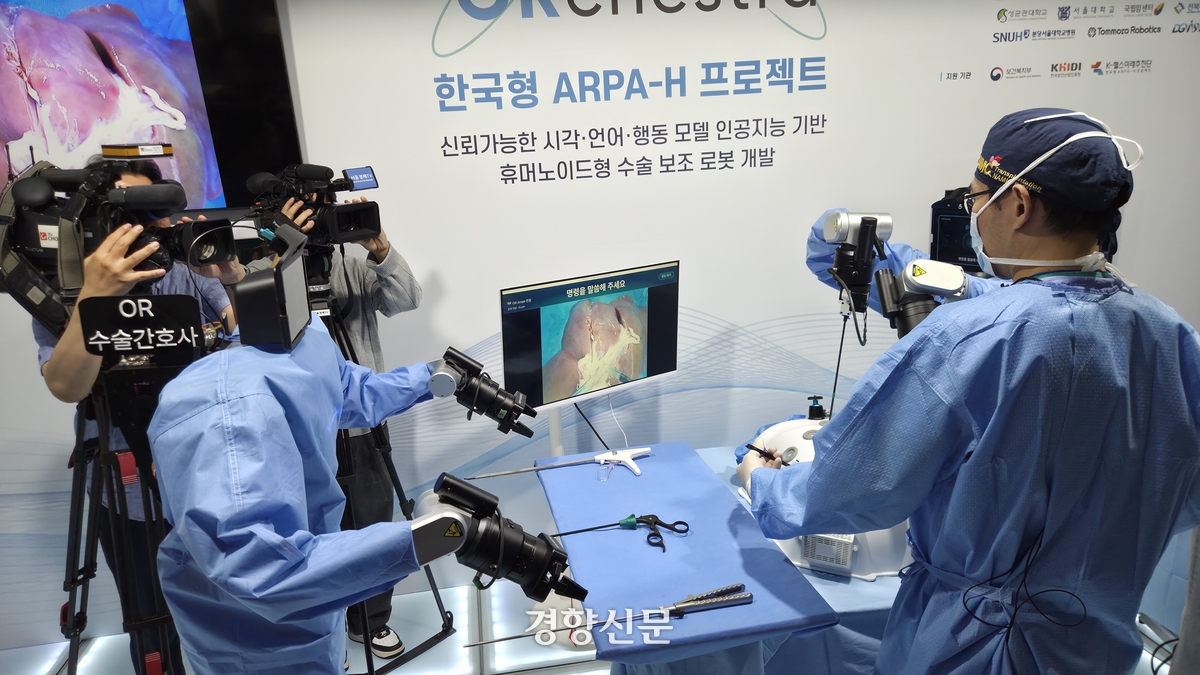
This is year two of a five-year proof-of-concept. MK cites 100% identification of five surgical tools and a 98.7% handoff success rate. Voice or foot-pedal emergency stop dumps joint torque so a person can push the arms aside. If a command is unclear, the system stops and asks.
Wheels, not legs
Rainbow Robotics CTO Huh Jung-woo told MK the team put both arms on a wheeled base instead of a biped. “Both-legged robots are at risk of falling due to external shocks,” he said. “The wheel type is the safest considering the support and stability required for precise work.”
Project leader Jeong Yong-gi (otolaryngology, Samsung Medical Center) told Kyunghyang the system is not judging patients or operating on its own. The pitch is night, emergency, and small-hospital coverage, where holding an endoscope for hours is the job nobody wants. K-Health Future Promotion Team PM Lee Chang-hyun put the same split in MK: existing surgical robots copy a surgeon’s hands; this one is meant to fill an assistant slot.
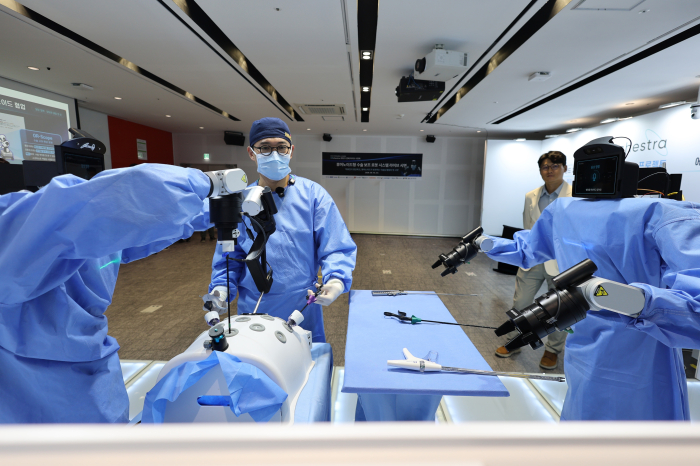
Kyunghyang says the team has 13.835 billion won in government R&D support and wants a clinically usable assistant by December 2029 if it clears a first-stage review this year. First trials on real patients are aimed at 2029, per MK. The paper also notes Korean medical law still does not assign responsibility if an OR robot fails.
A Human’s Take
Passing a grasper by voice and holding a scope without a resident in the room is the part I care about. The wheeled-base choice is the honest engineering: if you need RCM through a 5 mm port, you do not also need a biped that can eat the floor. Ten minutes on goat tissue is a demo. 98.7% tool delivery is a number. Clinical work in 2029 is still a calendar, not a shift.