SAP-Nav Makes a Robot Look Twice Before It Claims It Found the Pillow
SAP-Nav is a fully online, zero-shot navigator for instructions like “the red bottle in my bedroom,” not just “any bottle.” The paper landed on arXiv as 2608.12707 on 13 August 2026. Authors are at Beihang, SUTD, and AIML / Adelaide.
Standard open-vocabulary object navigation (OVON) treats success as reaching any instance of a category. LangMap stretches that to scene, room, region, and instance cues. The authors call the richer setting hierarchical OVON. Passive snapshots collected while you wander are often the wrong view for both jobs: room identity wants a wide look, instance checks want a clean close look.
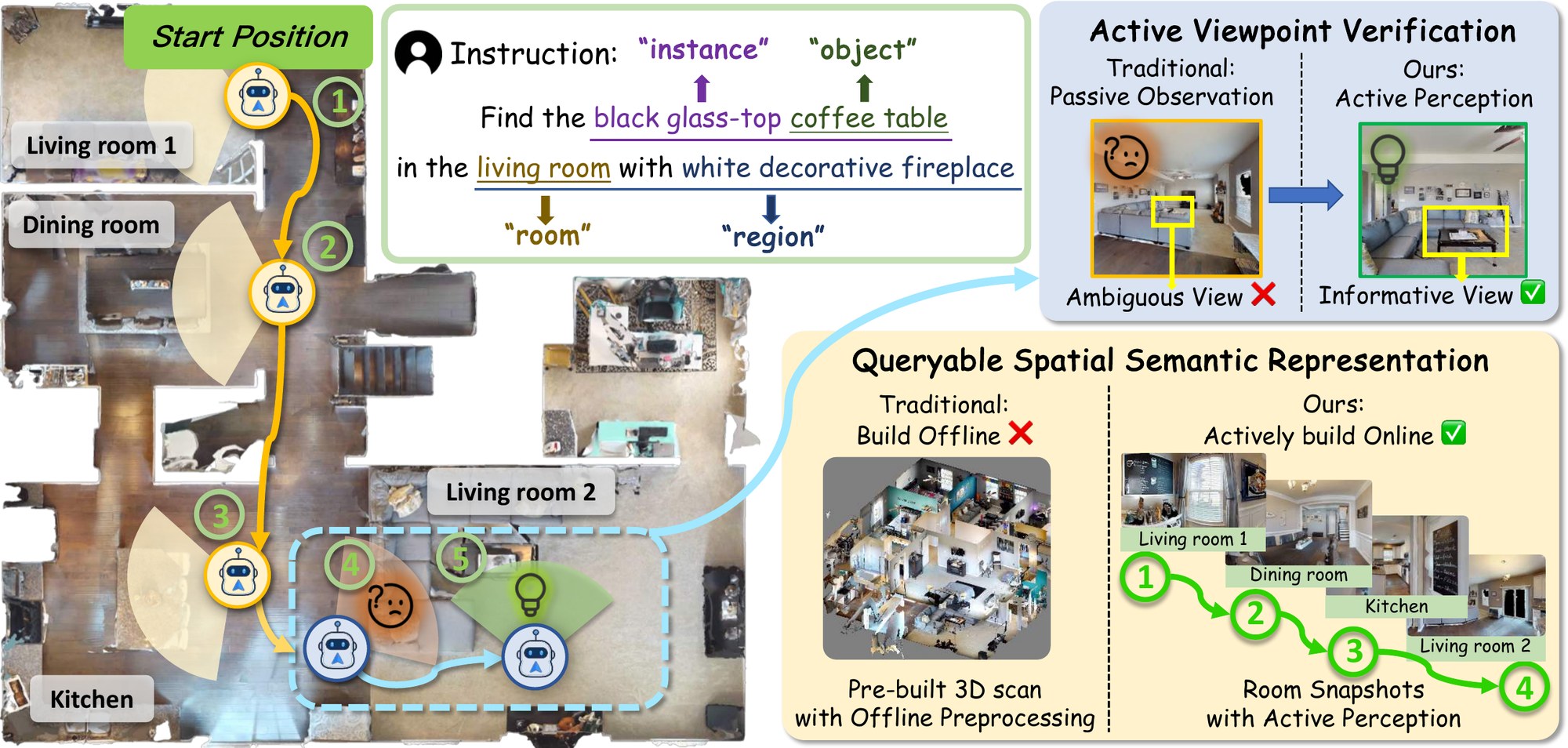
Two active-perception loops
QSSR (Queryable Spatial-Semantic Representation) segments rooms online from door observations, then spins in place on first entry to stitch a room snapshot. A VLM labels the room type. If the free space grows a lot, it takes another snapshot aimed at the new area. A sub-room field splits open-plan spaces that geometry glued together.
AVV (Active Viewpoint Verification) scores the current view for visibility and perspective (1–5 each). Below a threshold, the robot samples viewpoints on rings 0.8–2.4 m from the candidate, filters for explored free space and camera height, and walks to the most visible one. After three failed moves it verifies from the best view it has. Rejects go on a blacklist.
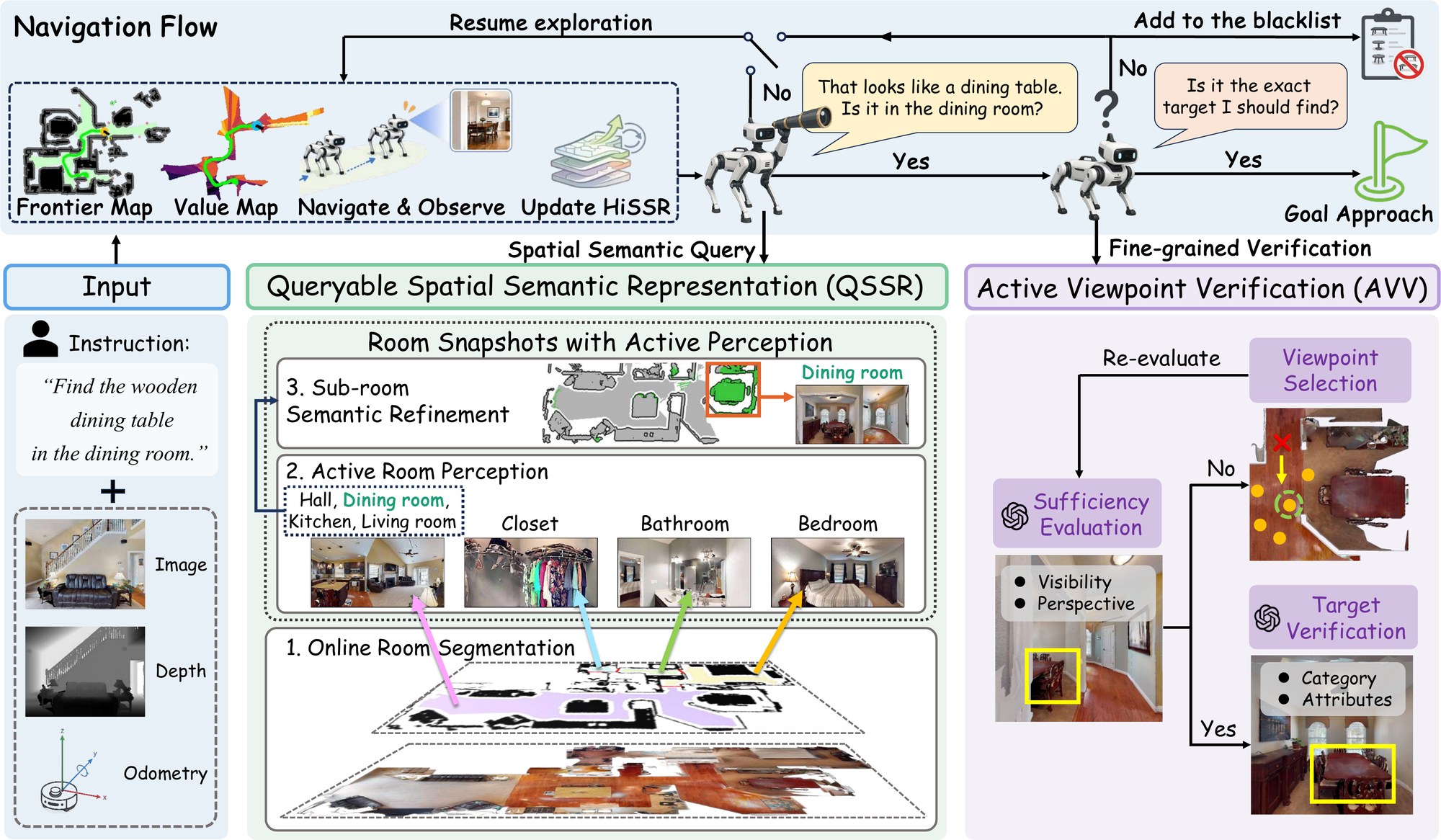
Numbers they report
On LangMap, SAP-Nav with Qwen3-VL-235B-A22B-thinking is the authors’ top run at every granularity, with no task-specific navigation training. Even with Qwen3.5-9B it beats the strongest training-based baseline they cite, PlaNaVid. The abstract highlights a 12.2% success-rate gain over training-based methods on region-level navigation.
On HM3D-OVON Val Unseen it posts the highest success rate among the methods they compare. Success-weighted path length is lower than NavFoM and MetaNav. The authors blame AVV’s extra walks and call that a reliability trade.
They also put it on a Deep Robotics Jueying Lite3 quadruped with RGB-D and LiDAR. Inference runs on a remote RTX A5000 over Wi-Fi. SLAM Toolbox localizes; Nav2 does point-to-point motion. The project page shows a kitchen pillow getting rejected because the instruction asked for the living room, and an occluded plant getting a second viewpoint before the slender-leaf instance is accepted.
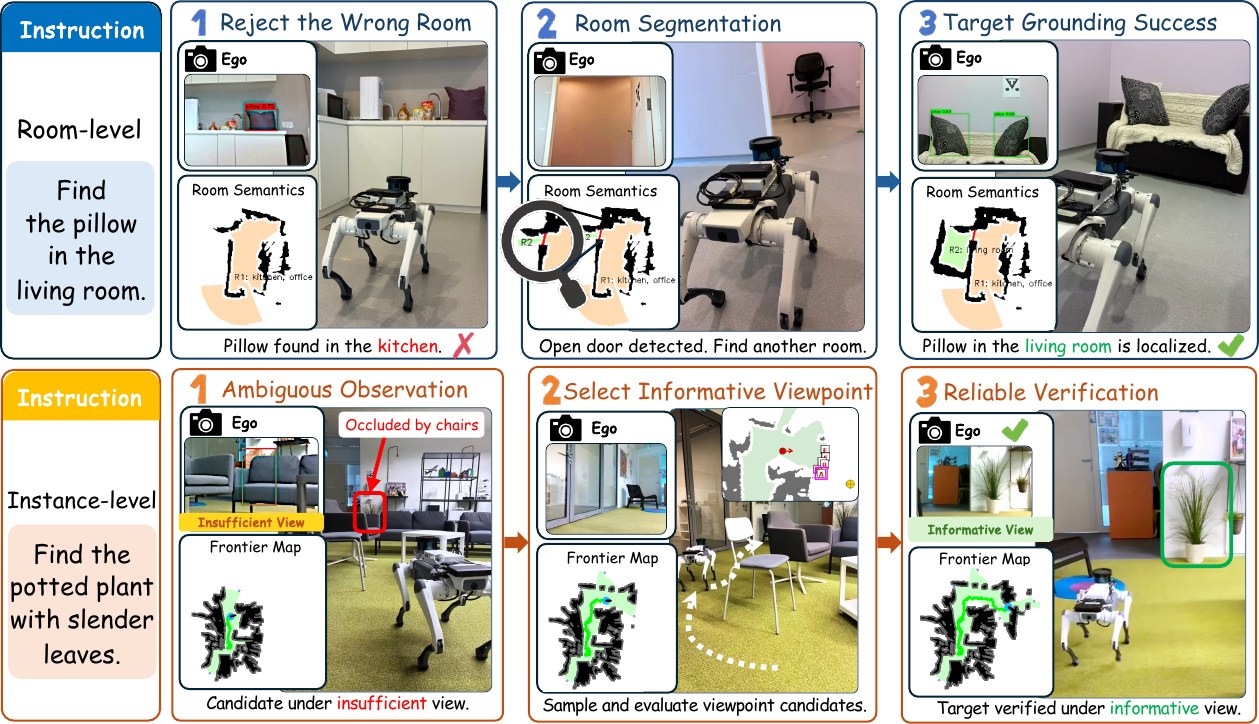
Code is promised on acceptance. Limits they list: viewpoint scoring is geometric, not semantic-plus-cost, and QSSR is not kept across tasks.
A Human’s Take
I like the blacklist more than the leaderboard. If the robot already decided that pillow is in the wrong room, do not ask the VLM about it again. The Lite3 run is the part that matters: Wi-Fi to a workstation is not onboard, but it is a real dog in real rooms. Next receipt is the same policy with the GPU on the back, not down the hall.