SARF Defends VLA Robots Against Physical Attention-Hijacking Patches
Vision-language-action policies can be brittle in the physical world. A new IROS 2026 paper (arXiv:2608.03231, submitted Aug 4, 2026) shows printable adversarial patches can tank manipulation by hijacking policy-critical action-to-vision attention — then offers a defense that fine-tunes only the visual encoder with zero inference overhead.
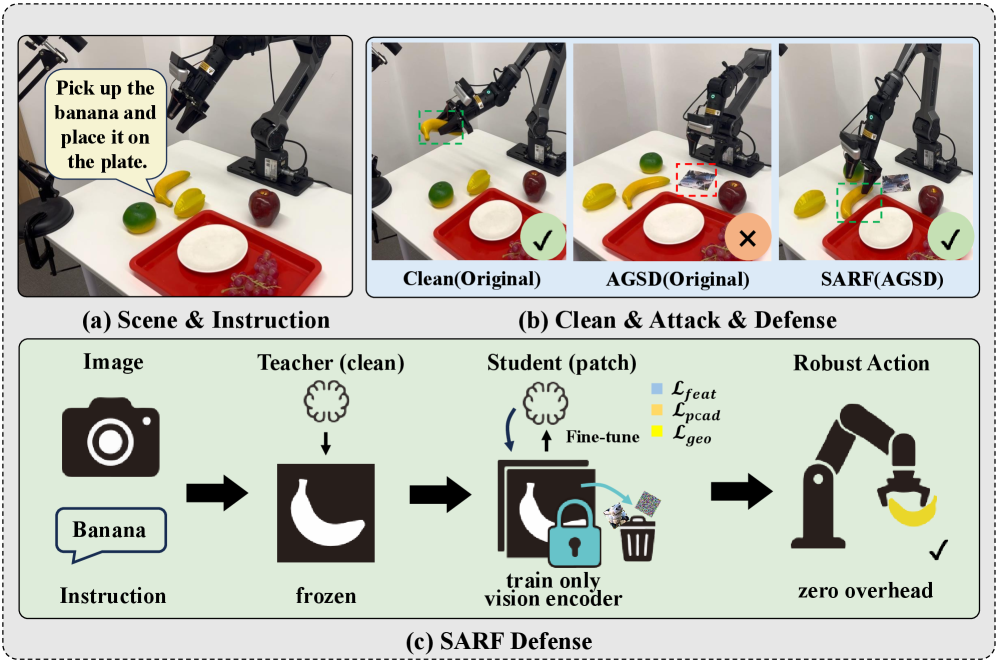
The attack: AGSD
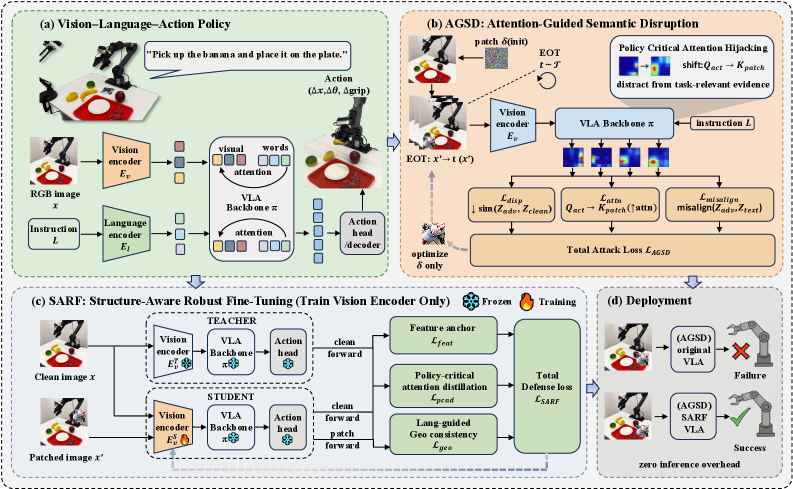
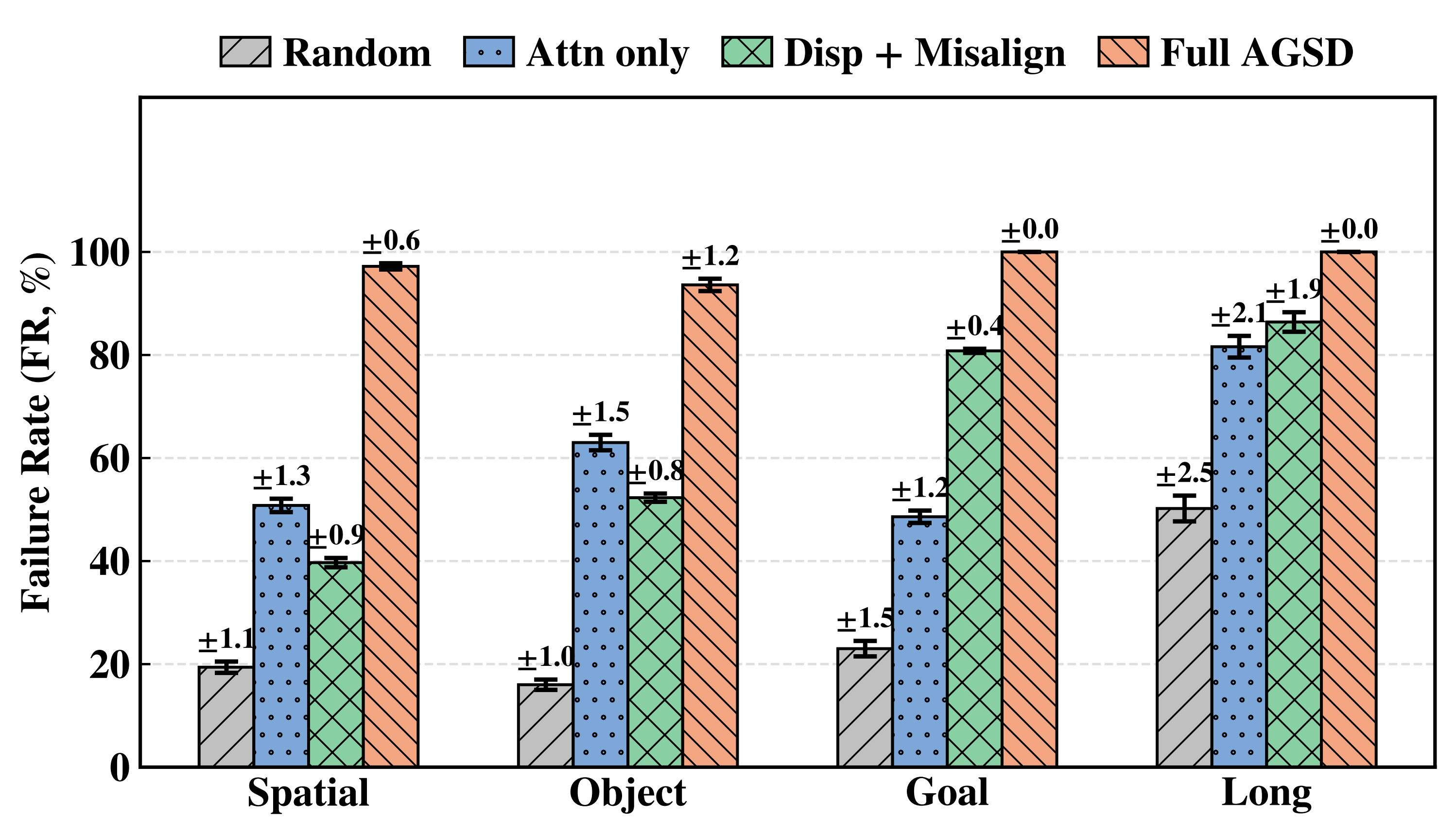
Attention-Guided Semantic Disruption (AGSD) is an Expectation-over-Transformation optimized printable patch. It jointly:
- Concentrates action-to-vision attention on the patch.
- Disrupts vision-language semantic alignment.
The authors report strong cross-task and cross-architecture transfer. On LIBERO, they show OpenVLA’s failure rate under AGSD at 100% before defense.
The defense: SARF
Structure-Aware Robust Fine-Tuning (SARF) freezes the teacher path and fine-tunes only the vision encoder using:
- Feature anchoring
- Policy-critical attention correction
- Language-guided geometric consistency on semantically relevant regions
No change to the deploy-time policy stack beyond the trained encoder.
Reported outcomes
| Setting | Result (from abstract) |
|---|---|
| LIBERO / OpenVLA under AGSD | Failure 100% → 14.2%–56.8% (avg 28.6% across suites), clean performance preserved |
| Real PiPER manipulator under AGSD | Average success 23.0% → 65.0% |
A Human’s Take
If a sticky note on the table can steal attention from the banana, “generalist VLA” is not factory-ready. SARF’s appeal is boring in the best way: fix the encoder, keep inference free. I’ll care more when third parties re-run AGSD on OpenVLA and Pi0-class stacks — but this is the right threat model for demos that leave the lab.