Illinois Fine-Tunes π0.5 With the Robot’s Own Failed Rollouts
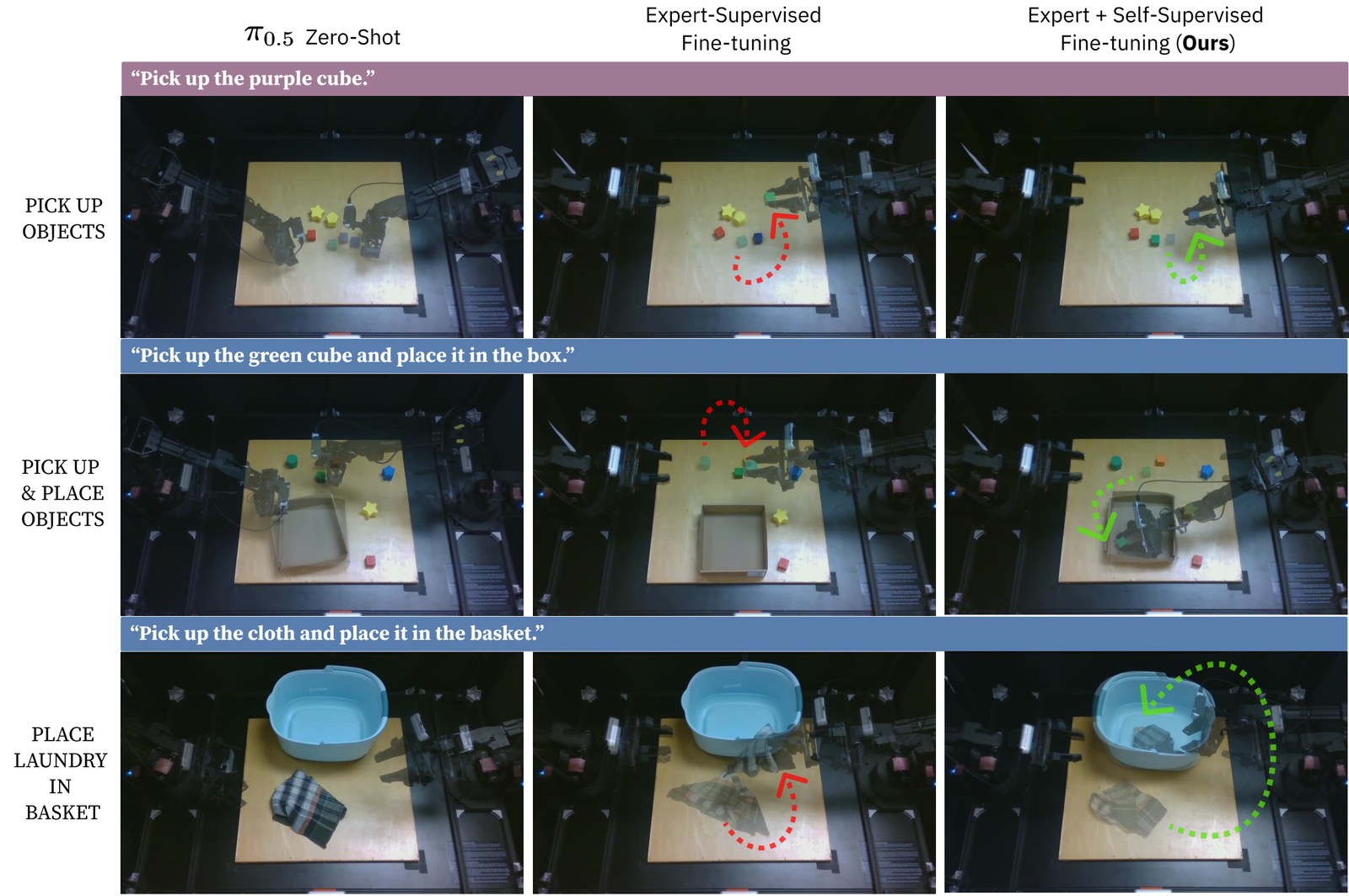
When you drop π0.5 onto a new ALOHA pair, UIUC researchers found a familiar mess. Zero-shot, the policy walks toward the right object and then misses the grasp. Fine-tune on expert “pick up” demos and the grasp comes back, but the robot starts grabbing the wrong cube and forgets how to place.
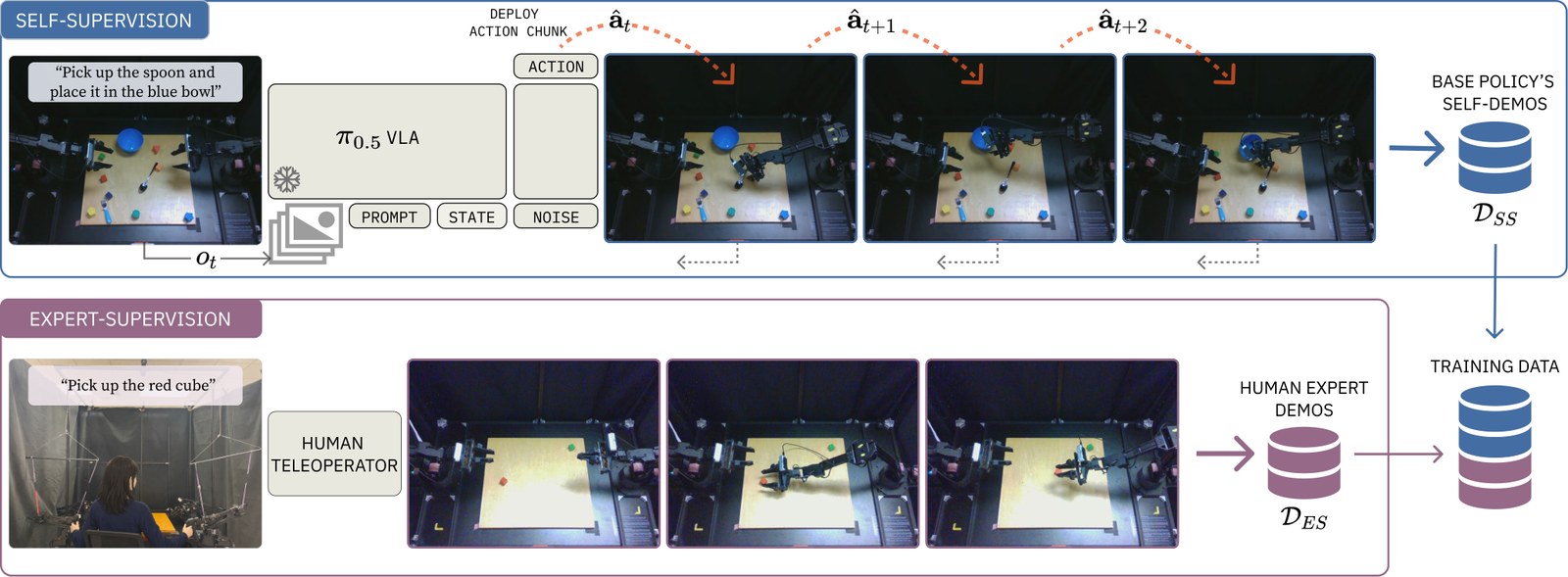
Prachi Garg, Steve Xing, Prahit Yaugand, Saurabh Gupta, and Derek Hoiem posted a fix on arXiv August 19: roll out the frozen base policy on the target robot, keep those (often failed) trajectories, and train on them next to a small expert set. They call it self-supervised generative control. No access to π0.5’s original pretraining mix required.
Fourteen minutes of teleop
On the real ALOHA, expert data is 14 minutes of teleop for “pick up.” Self-demos cover pick-and-place, including laundry into a basket. Table 2 in the paper (20 trials unless noted):
- Expert cubes: instruction-following 100%, success 90% (expert-only was 65% success)
- Novel objects: 55% success
- Pick-and-place: post-grasp instruction-following 90% and 55% success. Expert-only was 0% on both place metrics
- Laundry: 40% partial success vs 10% for expert-only
A contact-rich caterpillar gear-insertion task, which the authors say sits outside π0.5’s pretraining, went from 30% success with expert-only to 90% with the mix, and hit 100% pre-grasp instruction-following on unseen gear colors.
Sim check, then a held-out push
In RoboTwin they first mid-train on 10 planner tasks (90.8%). Fine-tune on new stacking with expert data only, and old-task success falls to 16.6%. Add self-demos of the old tasks and it recovers to 70.6%, while new-task success rises from 93% to 98%.
The mean part is Table 7. They test “push objects,” a skill in neither fine-tune mix. Expert-on-everything pushes on 10% of rollouts and often picks instead. The self-demo policy pushes on 70% and succeeds 60%. Instruction-following is tied at 85%. Extra expert data on every trained task overwrote the prior. Failed self-rollouts left it intact.
The authors filter unsafe self-demos by hand. They also note a stop-timing bug: because neither dataset shows the scene after a successful place, the policy sometimes hovers and repeats.
A Human’s Take
Training on failures sounds sloppy until you remember the alternative is re-collecting every pretrained skill on your specific cameras. Fourteen minutes of teleop plus the robot’s own bad habits is a practical recipe. I would not ship a policy that does not know when to stop placing. I would ship the idea.