A Go2 With a Local 3D Gaussian Map Stops Grabbing Banana Photos
A Unitree Go2 Edu with a 6-DoF arm will happily reach for a banana on a tablet if all it has is a 2D VLA. A paper accepted to ACM Multimedia 2026 (arXiv, August 11) from HKUST(Guangzhou) and Midea builds a tiny, refreshable Semantic-3DGS from four wrist shots, then uses that field to pick a stance and condition the arm policy.
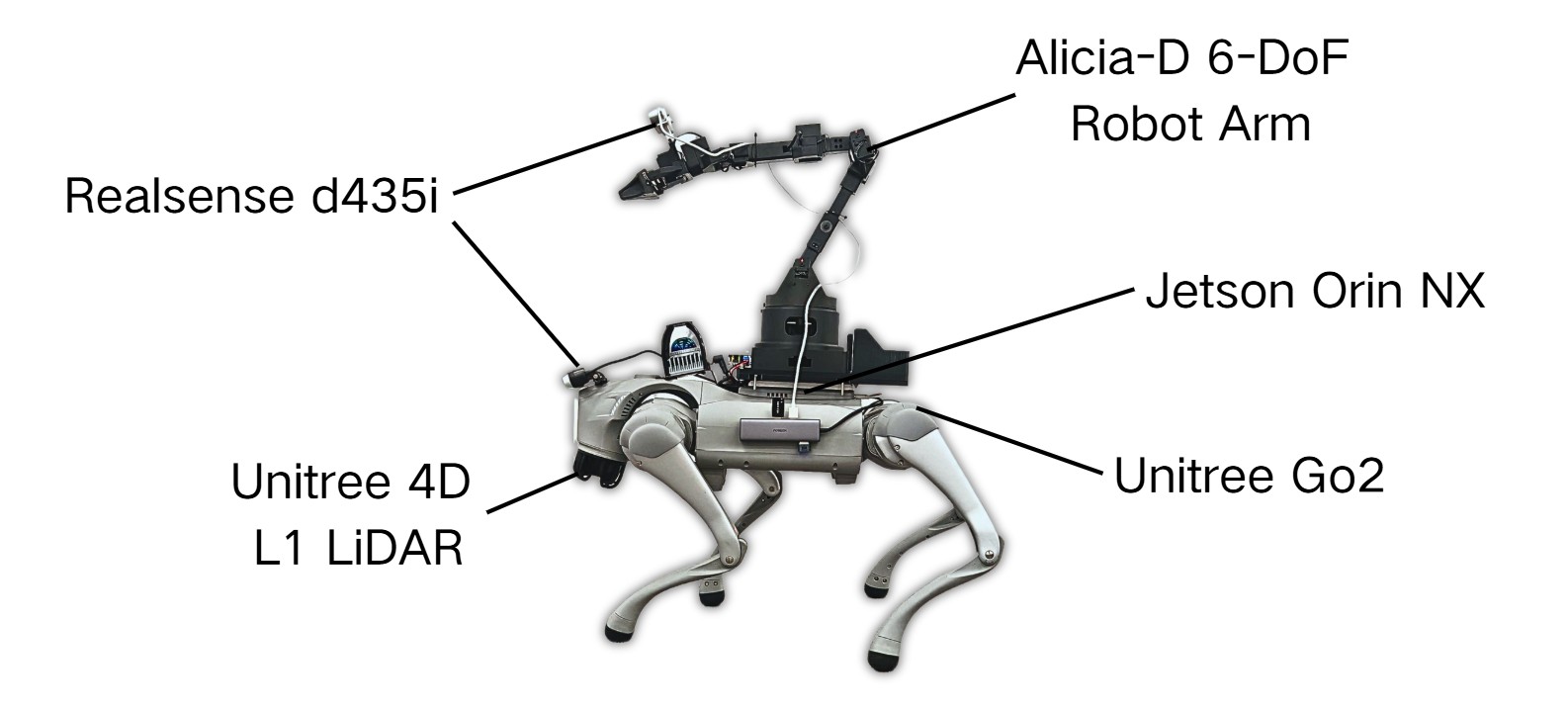
The platform is a Go2 Edu with stand/crouch modes, a Unitree 4D L1 LiDAR, an onboard Jetson Orin NX, and an Alicia-D arm with a gripper camera. Semantic reconstruction and VLA inference run off-board on an RTX 4090. Joint commands stream at 30 Hz over ROS.
Four views, then move the base
After a language command, the robot grabs four inverse-kinematics-feasible wrist views scored for target coverage, diversity, and motion cost. VGGT initializes geometry. CLIP and DINOv2 features, plus SAM masks, get distilled into a local Gaussian field. Language relevance scores pick the object Gaussians; PCA (and optional ICP) give a 6D pose.
The base then parks at a reachability stance: 0.35 m back, 0.20 m to the side, yaw toward the object, crouch if the target is under 0.30 m. That posture policy is PPO-trained in Isaac Lab. The arm policy is a DexVLA-style diffusion VLA (Qwen2-VL + ScaleDP). 3D semantic tokens go only into the last five action-expert blocks so the pretrained prior stays intact. Fine-tuning uses 10 real demos per task and 15-step action chunks.
Where 2D policies break
On 50-trial expansions:
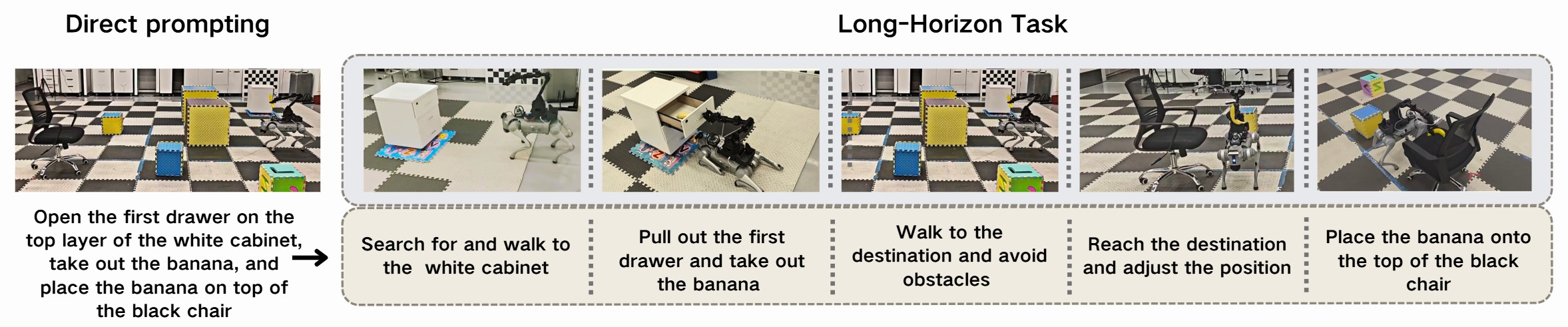
- Long-horizon (open drawer, fetch banana, close, walk, place): 30/50 (60%) vs 20/50 (40%) PointVLA and 14/50 (28%) DexVLA. Drop the base-RL module and it falls to 11/50 (22%).
- Cluttered banana-to-bowl: 37/50 (74%) vs 26/50 (52%) single-view and 23/50 (46%) PointVLA. Collision-free rate 88%; false grasps 6%.
- Height shift of 75 cm: 75% success with stance selection; the no-base-RL variant is 0% if it keeps the original pose.
- Photo banana on a tablet: the full system reports 0% photo false-grasps. DexVLA and the single-view ablation grab the screen a lot.
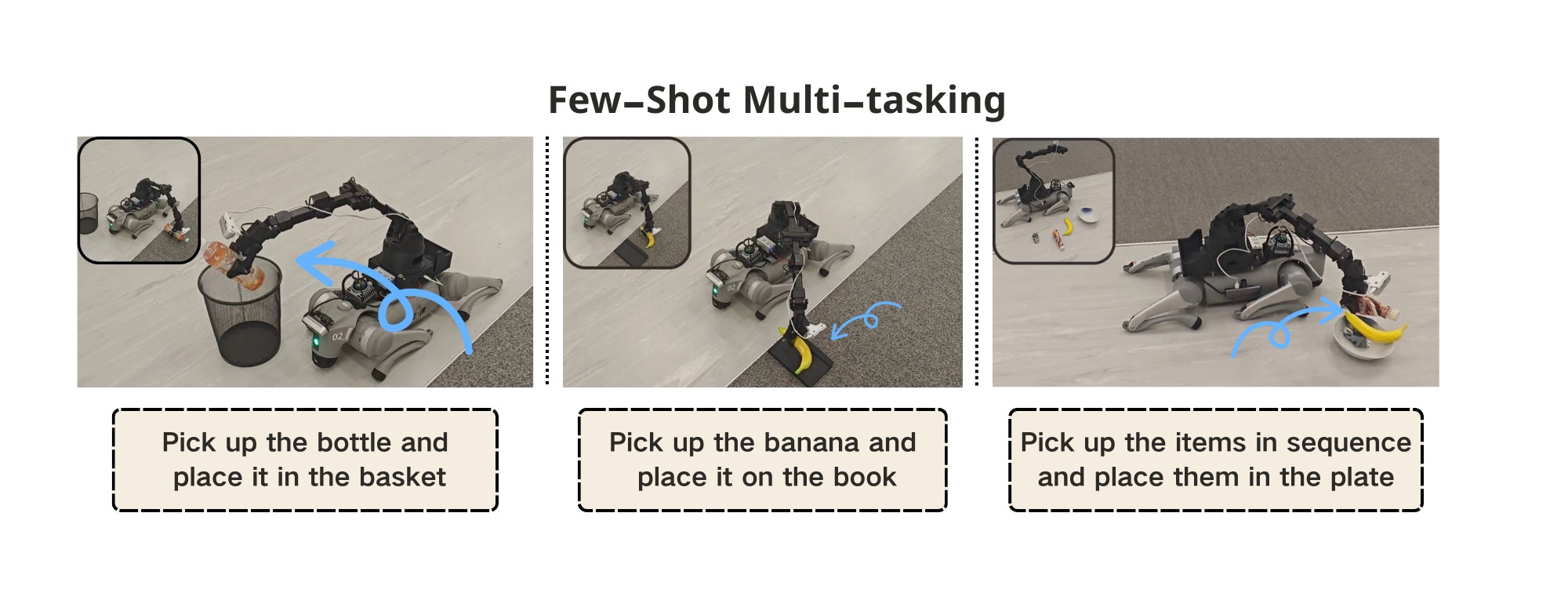
- Few-shot multi-task average: 81.7% vs 64.0% PointVLA and 37.7% DexVLA.
Active four-view sensing adds about 3.7 s of wall-clock on the clutter task (33.2 s vs 29.5 s). Late-block injection is listed at 80 ms per chunk vs 175 ms if every block is touched. The authors do not claim onboard, real-time 3DGS inside the servo loop.
A Human’s Take
The photo-banana result is the one I will quote. A VLA that cannot tell a fruit from a screen is not ready for a kitchen, and a 3D field that you rebuild from four wrist shots is a practical fix, not a new foundation model. The 4090 off-board and the 16-second grounding stage are the bill. I want this loop on the Orin, and I want it to refresh when someone walks through the scene, not only when grounding already failed.