Show-Harness Lets a VLM Play the Robot Like a Game
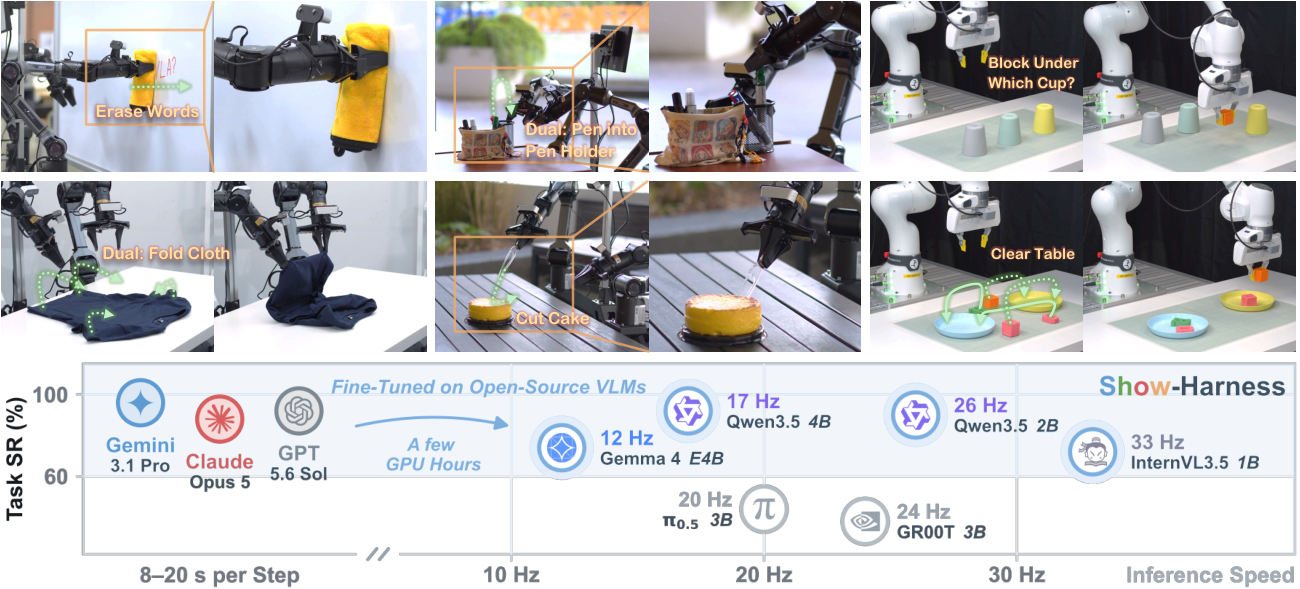
Most VLAs swallow a foundation model and spit joint deltas. Show-Harness, from NUS Show Lab (arXiv September 9), does the opposite. The VLM never sees a continuous action vector. It picks a named unit: MV_FWD, MV_LEFT, GRASP, ROTATE_CW. An embodiment-specific interpreter turns that symbol into a bounded Cartesian step.
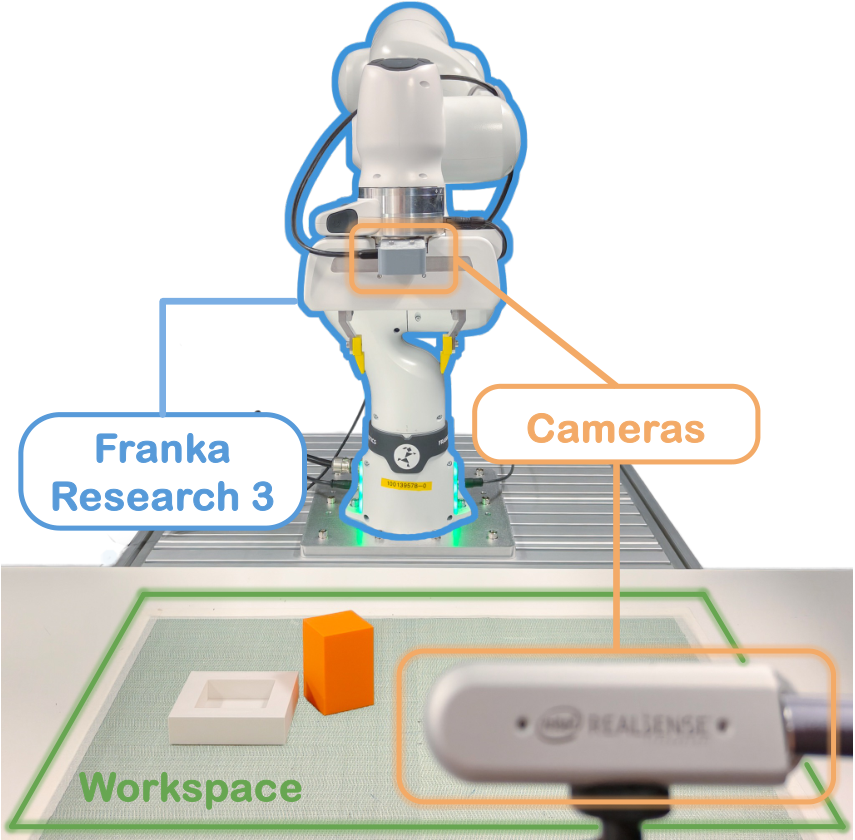
The same vocabulary drives a 7-DoF Franka Research 3 and a dual-arm AgileX. Change the robot, change the interpreter, keep the model.
Keyboard, GUI, or Gemini
GUMI is the collection trick. Every unit is a labeled key. A person at a keyboard and a GUI agent looking at the same screen produce the same (observation, action) pairs. No exoskeleton. The paper logs 164 real episodes (7.8K steps): 101 on Franka, 63 on single-arm AgileX.
Two modes share the interface:
- ZS: Gemini-3.1 Pro, no fine-tune
- FT: Qwen3.5-2B with rank-64 LoRA on about 3% of parameters
On the project page’s headline splits:
| Split | ZS / FT | Best named baseline |
|---|---|---|
| Cross-task (10 tasks) | 89% / 86% | 57% |
| Cross-environment (4 shifts) | 100% / 88% | — |
| Cross-embodiment (Franka + AgileX) | 93% / 87% | 52% |
ZS clears every environment shift at 20/20, including teddy and chess held out of fine-tuning. FT trained only in sim still transfers to the real Franka at 13/20. Both trainable VLA baselines in that cell score 0/20.
A 1 cm interpreter step, no retraining, lifts ZS 60% → 80% and FT 40% → 65% on finer work. π0.5 needs a full extra fine-grained budget to reach 60% in that comparison. Ablating the action names is brutal: arbitrary symbols with no convention collapse to 5% success, 19 of 20 timeouts.
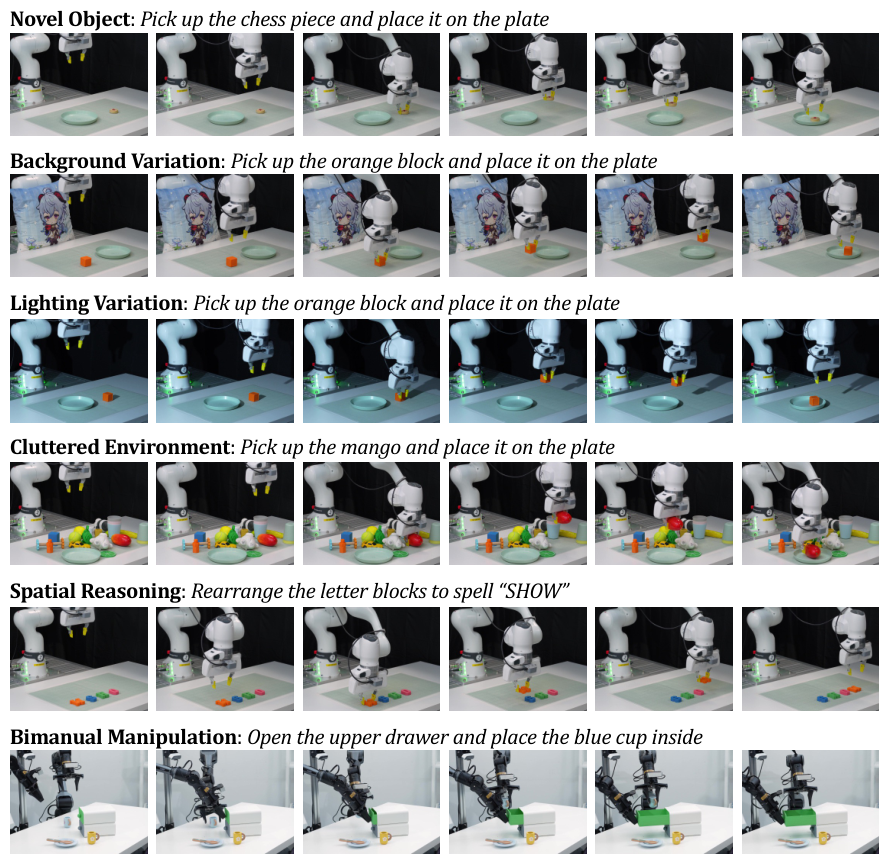
Default plugins earn their keep. Drop multi-view guidance and you lose 38 points. Subtask planning is 36. Proprioception 28. Empty-grasp recovery 24. Frontier VLMs follow instructions (≥98% valid units) and plan (≥97%). They miss on centimetres.
A Human’s Take
I grinned at GUMI. If a VLM can play a robot the way it plays a browser, the data problem gets less mystical. 89% zero-shot on pick-and-place is not a factory shift, and the paper says as much: grippers, not five-finger hands. Still, an interface that lets Gemini miss by a centimetre and lets a 2B model catch up after a few GPU-hours is the kind of boring infrastructure I will actually reuse.