IIT Kanpur Teaches a G1 to Stand Up Without Demos
Standing up from a chair looks trivial until you write the controller. Meet Pal Singh, Vyankatesh Ashtekar, and Ashish Dutta at IIT Kanpur put a paper on arXiv on August 21 that trains sit-to-stand from scratch on a simulated 29-DoF Unitree G1. No demonstrations. No reference trajectories.
On a deterministic, force-free evaluator the policy clears more than 97% balanced-standing success across eight chair heights, including seats the authors call substantially deeper than prior work.
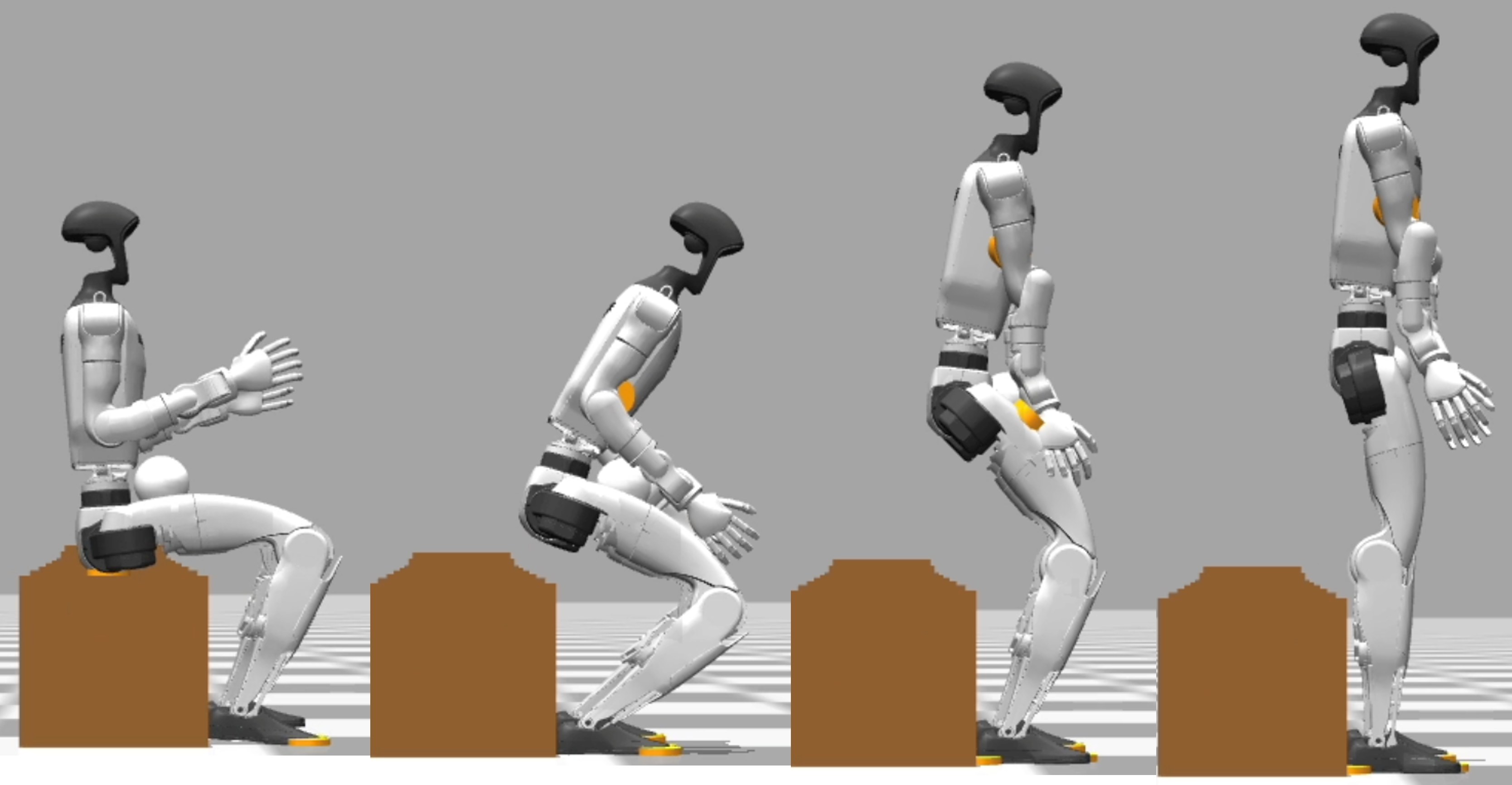
The trick is the curriculum, not a motion clip
The robot is G1 in MuJoCo. The policy is PPO, 50 Hz, episodes up to 40 seconds. Observations are proprioceptive (97-D): gravity in the torso frame, IMU, joint positions and velocities, last action, and an action-bound scaler.
Three pieces do the work:
- Assisted exploration that decays. A vertical pelvis-assist force starts high and drops. New, taller chairs unlock only as that force comes down. The table in the paper starts with force above 100 N on the lowest chair only, and does not open all eight lanes until force is in the 20–40 N band.
- A huge pose library. Inverse kinematics, not joint noise, randomizes seated and standing poses. 29,260 seated states over eight heights. Head rise from sit to stand is 0.24–0.34 m, largest on the lowest chair.
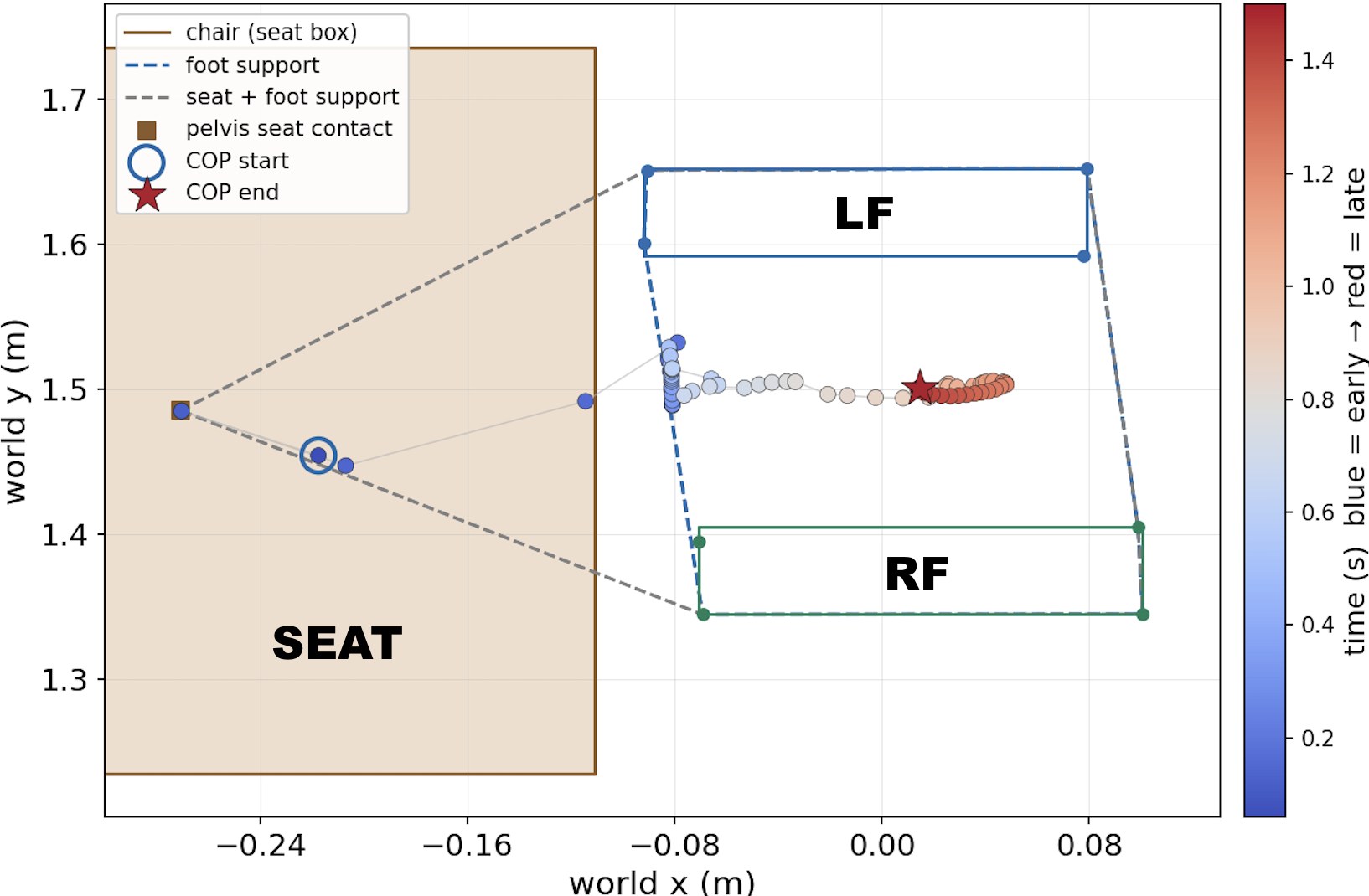
- Stage rewards from biomechanics. A rise-fraction ρ based on head height picks among sit, mid-rise, and stand rewards so the same thresholds work on every chair. Center-of-pressure shaping and angular-momentum terms cover seat-off.
The authors’ complaint about earlier RL sit-to-stand: either the robot is barely sitting (most of the weight already on the feet) or the stand-up is abrupt. They want a deep sit and a smooth rise.
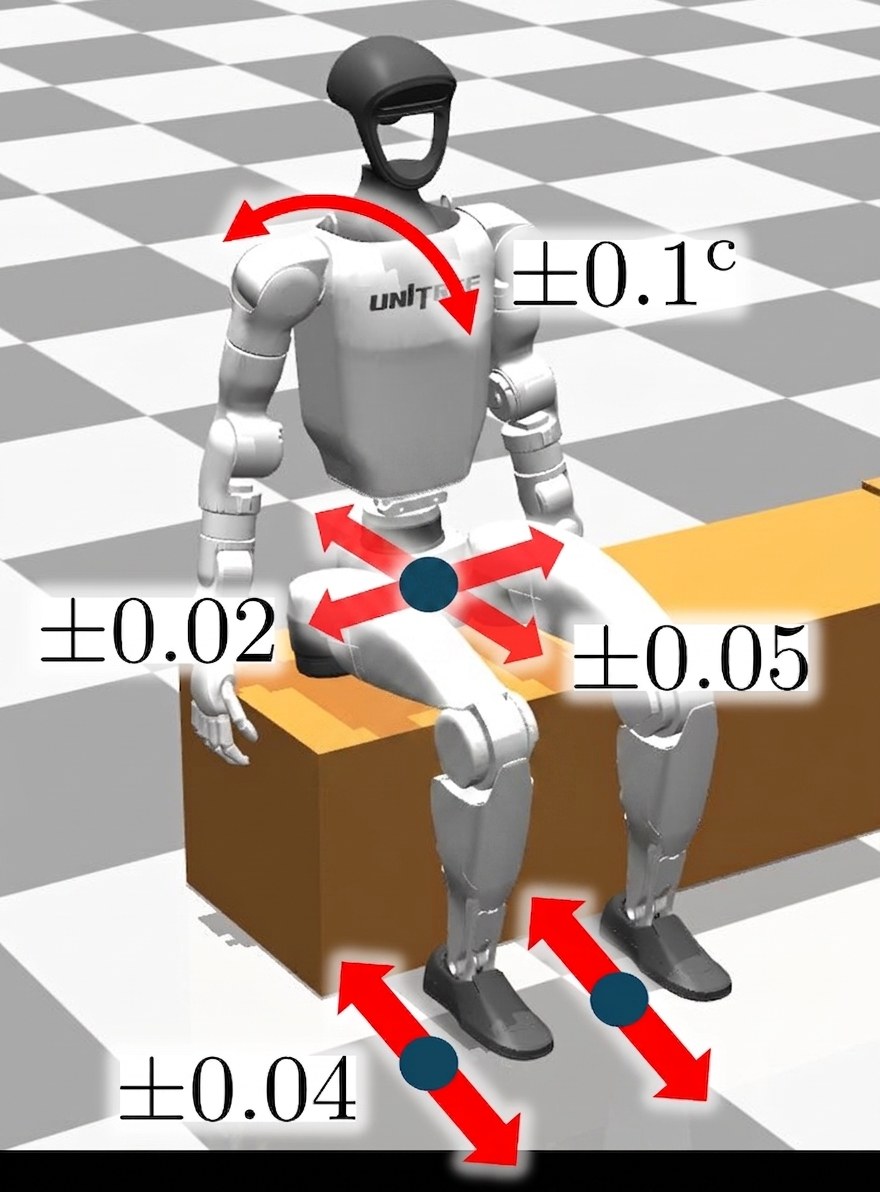
What this is not
This is simulation. The paper describes the motion as “amenable to physical implementation.” It does not report a real G1 standing up from a chair. Jiang et al., which they cite, did show a shallow sit-to-stand on hardware and lost 40–60% success outside a favorable sitting zone. That is the bar this method still has to clear on metal.
A Human’s Take
I like that they refused to cheat with a mocap clip. Sit-to-stand is exactly the kind of contact-rich, one-off motion that imitation learning papers hide inside a skill library. Training it from a decaying pull-up force is closer to how you would actually boot a robot that sat down and now has to leave.
The honest next frame is a real chair, a real G1, and the same 97% after the carpet compresses. Until then, it is a very clean sim result from a small lab, and those still belong in the feed.