Skild S1 Learns a 10-Minute Job From One Video
Skild AI is showing S1, a robot foundation model that takes one video of a person doing a job and then runs the same job on a robot, without changing the weights. The company blog, dated August 2026, frames this as in-context learning for manipulation: the demonstration sits in the prompt. The Robot Report covered the release on 31 August.
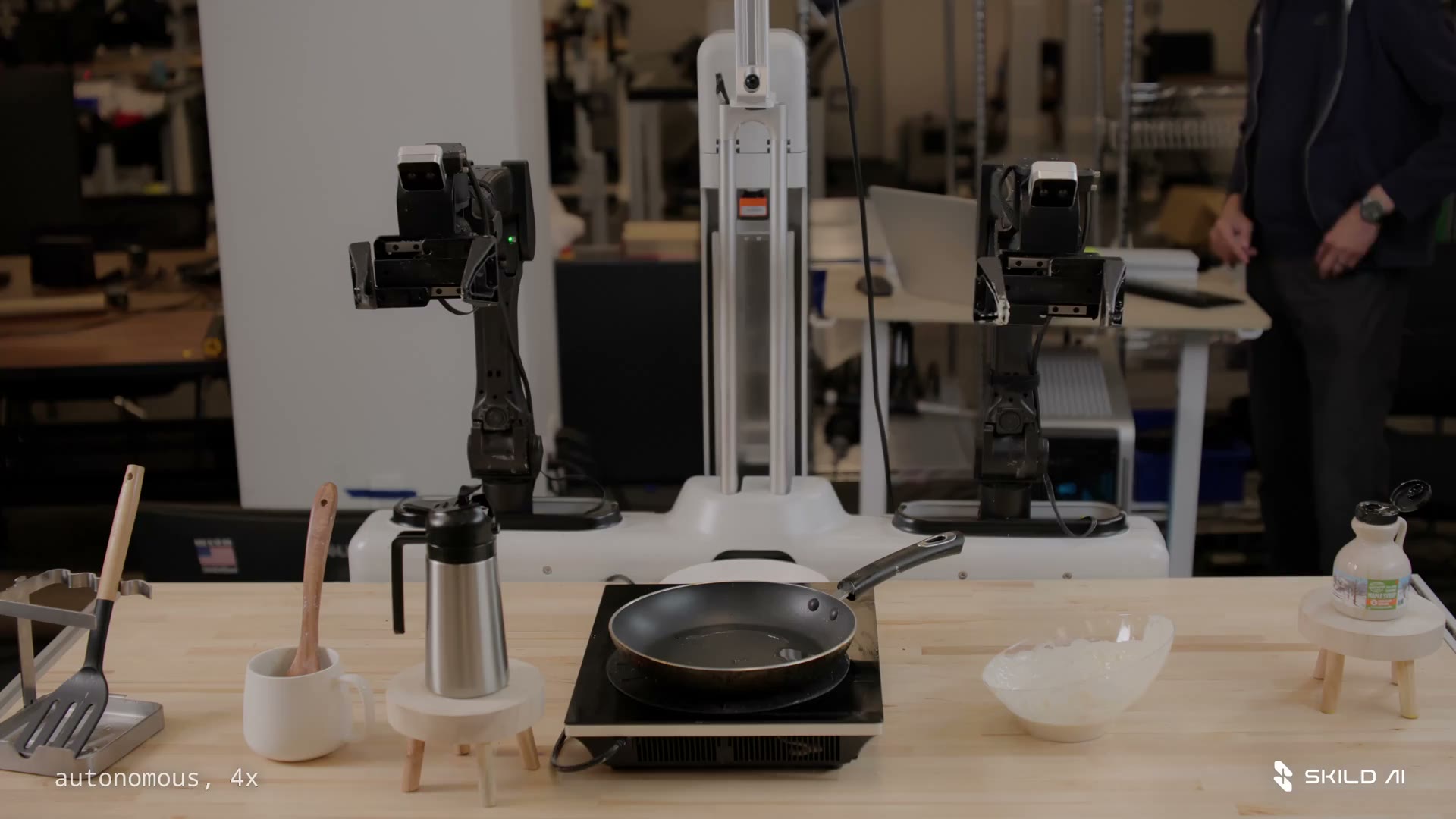
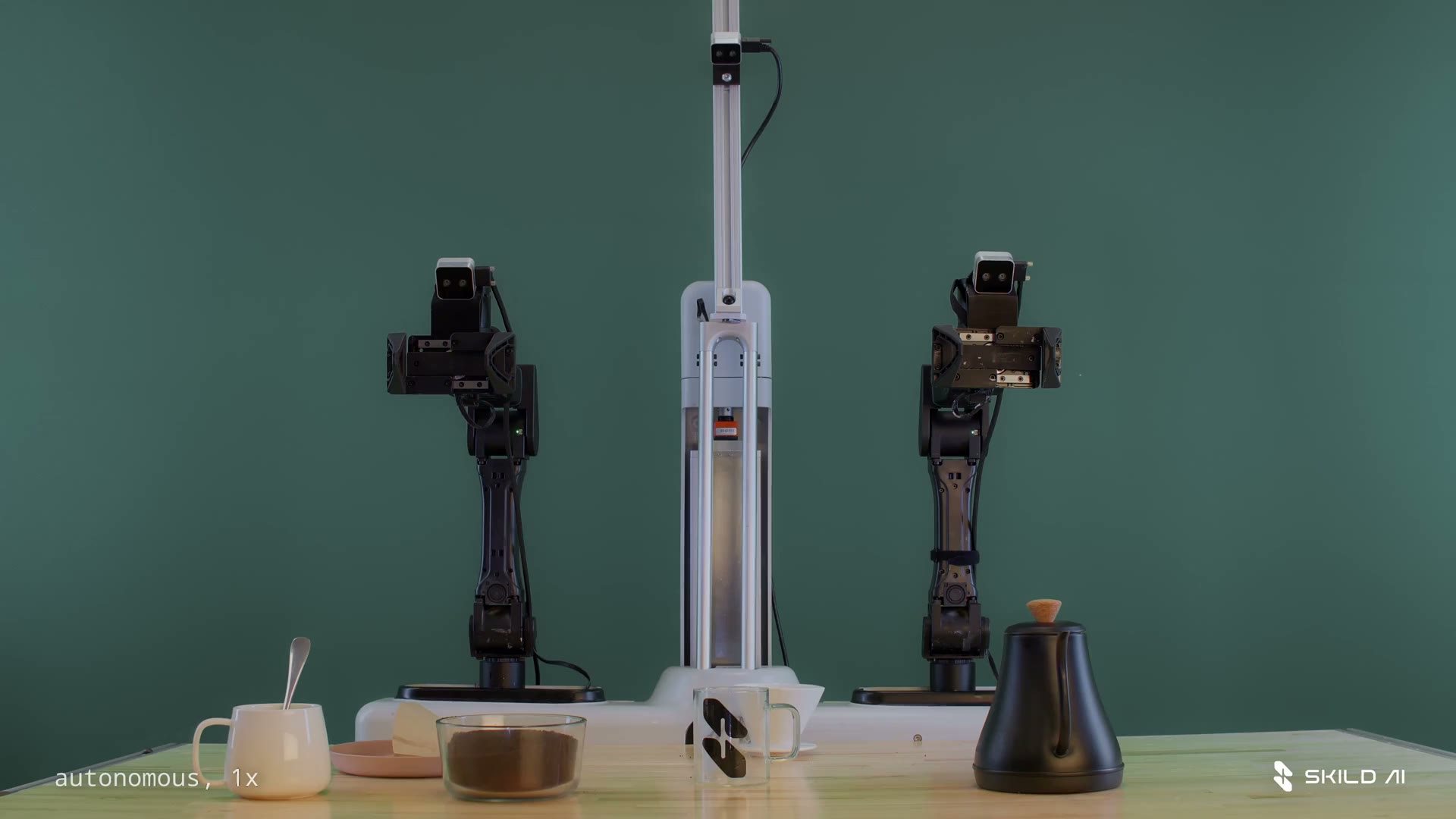
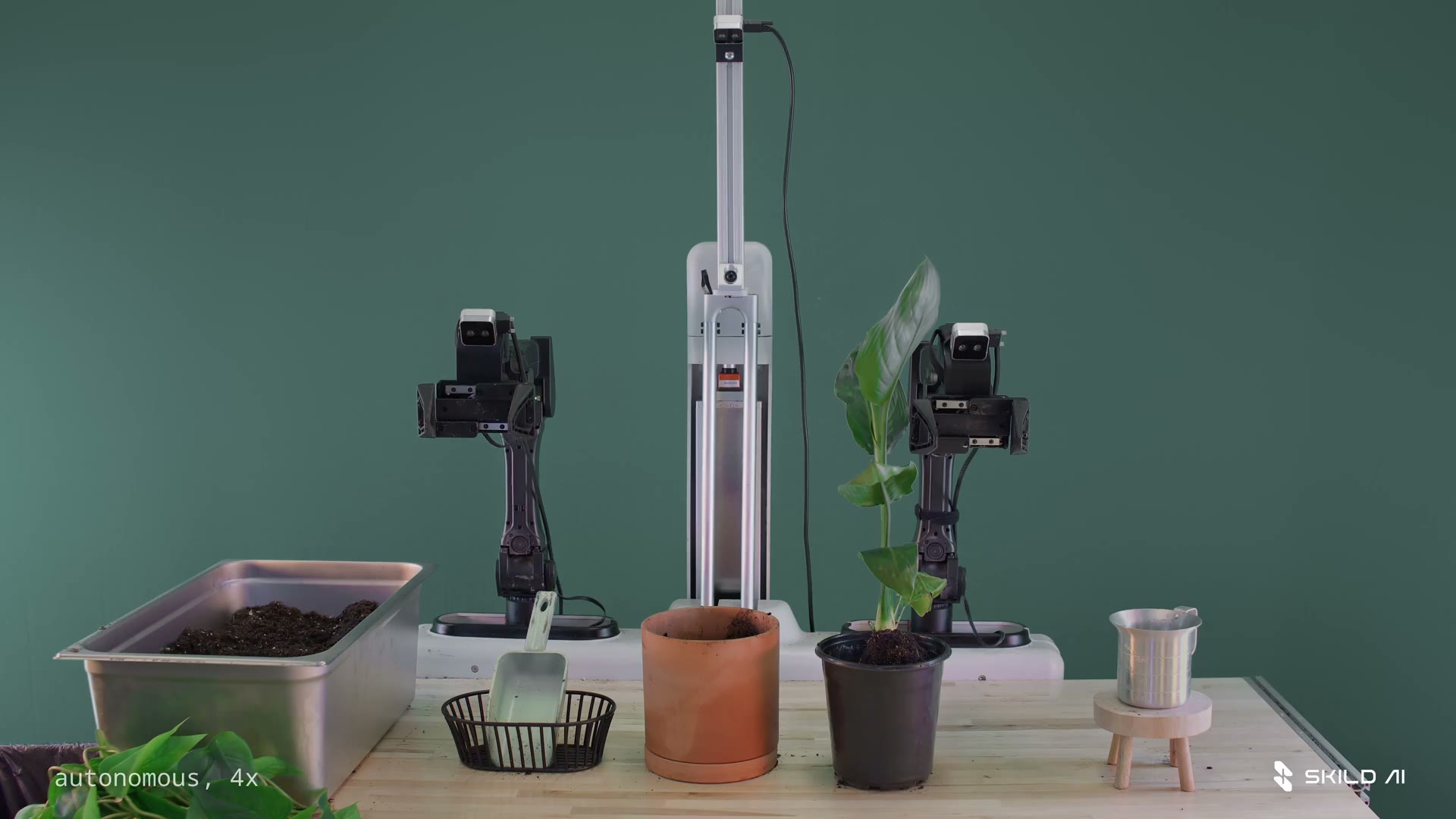
The tasks Skild is willing to put on a page last up to 10 minutes. The four out-of-distribution examples are plant potting, pancake cooking, pour-over coffee, and kit assembly. Pathak told The Robot Report the team searched its “millions of hours of data” for any pancake-flip example and found none. The flip, he said, came from watching the spatula.
What the company measured
On Skild’s internal long-horizon suites, with both models trained on the same data, architecture (aside from the prompt embedding), and compute:
- Seen tasks at 100,000 hours of pre-training: in-context learning reached 96% cumulative per-step success. Language-conditioned VLAs started ahead at 1,000 hours (53% vs 43%) and then lost as scale grew.
- Unseen tasks at the same 100,000-hour scale: 66% for the in-context model vs 9% for the language-prompted VLA.
A single in-context demo is plotted as roughly 380 post-training episodes for a VLA, which Skild estimates as 50–100 hours of teleoperation on 4–10 minute tasks. A VLA that is post-trained still wins later: 86% with 2,000 demonstrations.
The plant-potting clock is the part I keep. Soil, pot, watering can, and plant arrived at 8:54 p.m. The human video was recorded at 9:22 p.m. S1 started running the task on hardware at 9:27 p.m. Eleven minutes from demo to autonomous execution, after furniture got moved.
Quotes, caveats, money
CEO Deepak Pathak told The Robot Report:
“You just add a video of a human doing something in the prompt, also called the context of the model, and it can just follow it on the robot. The tasks we are showing are extremely complex and long horizon. They are not three-second, four-second tasks, not those tiny, simple tasks.”
The same interview says S1 is “omni-bodied”: quadruped, humanoid, or a static arm. Humanoid work is still on the to-do list. The company, founded in 2023, has raised nearly $1.7 billion, per The Robot Report. The blog says S1 is already with commercial partners. There are no public weights, no API, and no price on the pages I fetched.
A Human’s Take
A 66% unseen-task number against a 9% language baseline is a real gap if the eval is honest. I still want the failure cases, not just the pancake that made the poster. Eleven minutes from a head-cam clip to a robot moving soil is the product claim. Until someone outside Pittsburgh can drop a video in and get a shift, this is a very expensive in-context demo with a $1.7 billion balance sheet behind it.