SkillMemo Stores Atomic Skills and Pulls Them Back at Runtime
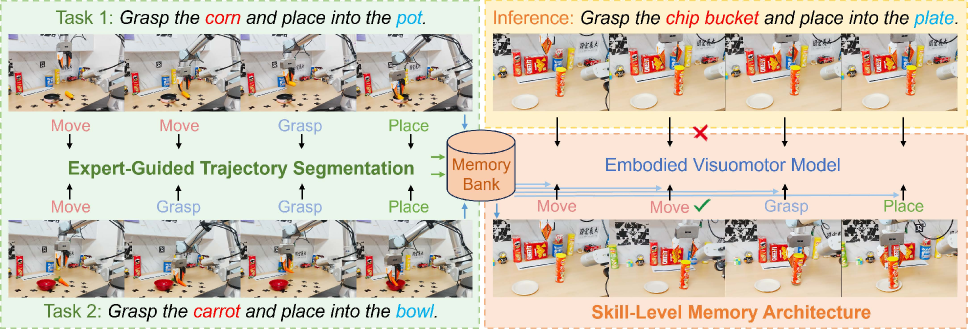
Long-horizon manipulators often learn one blob of behavior per demo. When the strawberry moves from bowl to plate, the blob falls apart. SkillMemo, posted August 6, 2026 (arXiv:2608.05970) from Tsinghua, NTU, and collaborators, with a project page, tries a different structure: split trajectories into latent skills, store them, and retrieve them when the next task needs a remix.
Two pieces
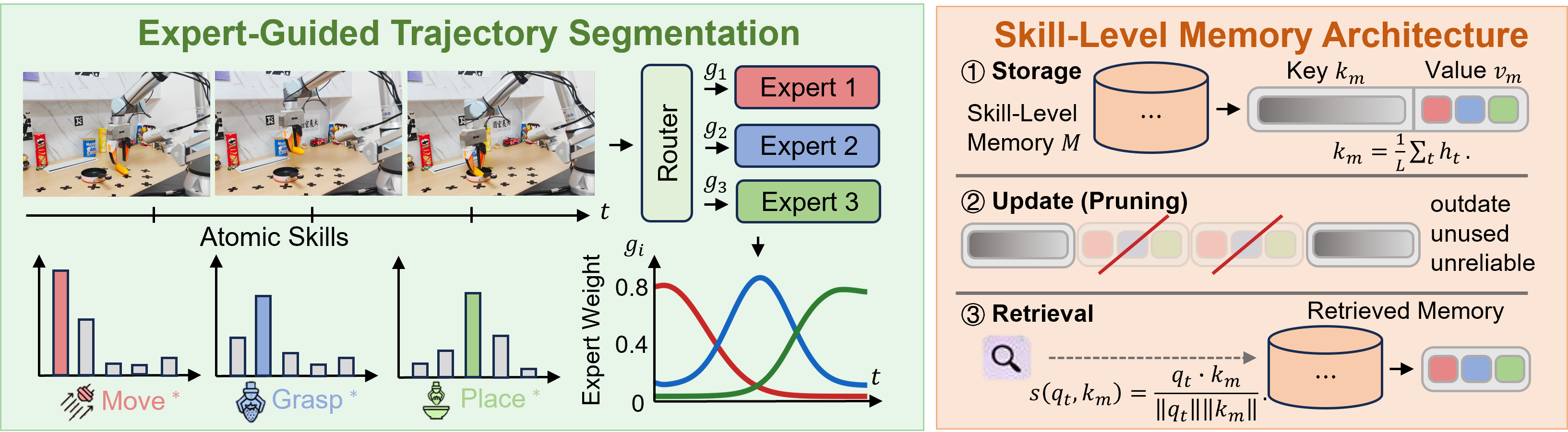
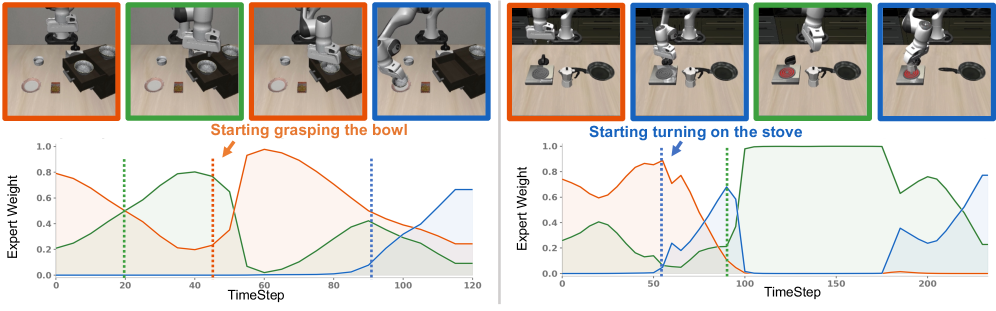
Expert-guided trajectory segmentation puts a Mixture-of-Experts layer on the backbone. Gating coefficients over time act as soft skill boundaries — no hand-labeled primitives required. A PID-style synergy loss pushes experts to specialize without collapsing.
Skill-level episodic memory stores each segment as a key-value pair: a temporally aggregated latent key, and the full sequence of gating weights as the value. At inference, cosine similarity retrieves top matches; if average similarity clears a threshold δ, retrieved gates fuse with the live gate via a mix weight λ. A usage-based prune keeps the bank finite for lifelong runs.
Default expert count in ablations is N = 5 (more helps a bit, then latency climbs).
Where it moved the needle
On Diffusion Policy suites, SkillMemo averages 64.6% success vs 61.2% for plain DP (Push-T, BlockPush, Kitchen). On LIBERO with VLA backbones, π₀.₅-SkillMemo hits 98.0% average vs 96.8% for π₀.₅ alone (Goal 99.0, Spatial 99.4, Object 98.2, Long 95.4). UniAct and UniVLA also pick up points when SkillMemo is stacked on.
Real UR5e single-task rates over 40 trials improve across five tasks (e.g. Butter in Pot 62.5% → 75.0%). On held-out object–receptacle recombinations, SkillMemo beats DP on every reported crossover (Strawberry on Plate 65.0% → 75.0%).
A Human’s Take
A 1.2-point LIBERO bump over π₀.₅ is not a fireworks demo, but the real UR5e crossover tasks are the receipt that matters: same objects, new pairing, better score. If skill memory is just a fancy retrieval buffer, fine — as long as it keeps working when the chip bag is not on the training table.