SLIM-0.5B Packs Action-Grounded Latents Into a Compact Robot Policy
Most vision-language-action stacks keep a multi-billion-parameter backbone in the control loop even when the next action only needs compact state, language, and dynamics. Pixel world models swing the other way and spend capacity on textures the gripper never cared about.
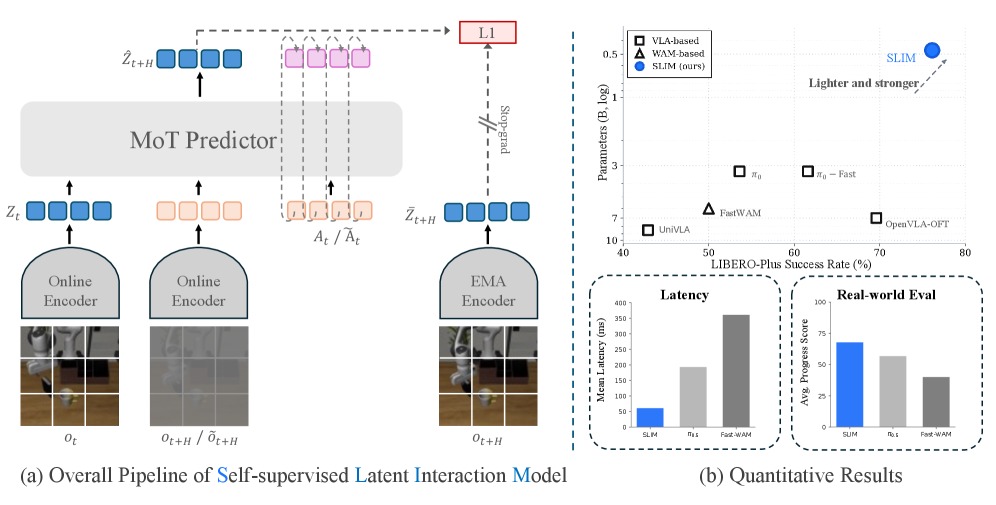
SLIM (Self-supervised Latent Interaction Model), submitted to arXiv on Aug 10, 2026 (arXiv:2608.09771) by Fudan, BAAI, Tsinghua, and Renmin University of China authors, is a ~0.47B policy that learns action-grounded predictive latents: reconstruct the action that explains a transition, and predict the future observation latent an action would produce — without generating pixels at inference.
How it works
Stage 1 masks trajectory pieces and trains inverse- and forward-dynamics style objectives in observation-latent space (DINOv2 encoder, T5-small language, Mixture-of-Transformers backbone). Stage 2 trains a flow-matching action policy that never receives future frames at deploy time — only the predictive structure baked into the backbone.
The project page is at kzz1031.github.io/slim-project-page.
Results
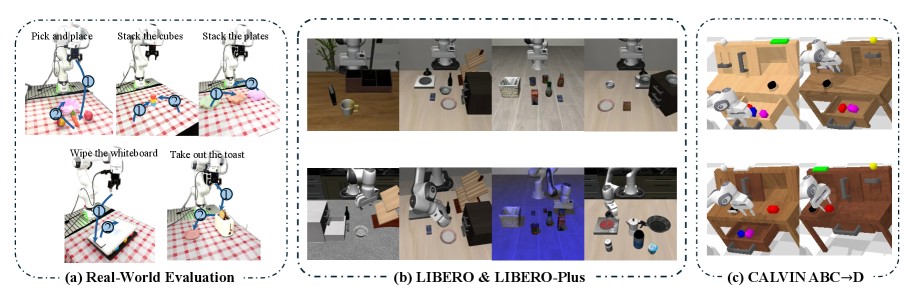
On original LIBERO, SLIM reaches 97.5% overall success with no additional embodied pretraining. The same checkpoint, zero-shot on LIBERO-Plus, hits 77.45% average across seven perturbation axes. On CALVIN ABC→D, average sequence length is 4.556 out of 5.
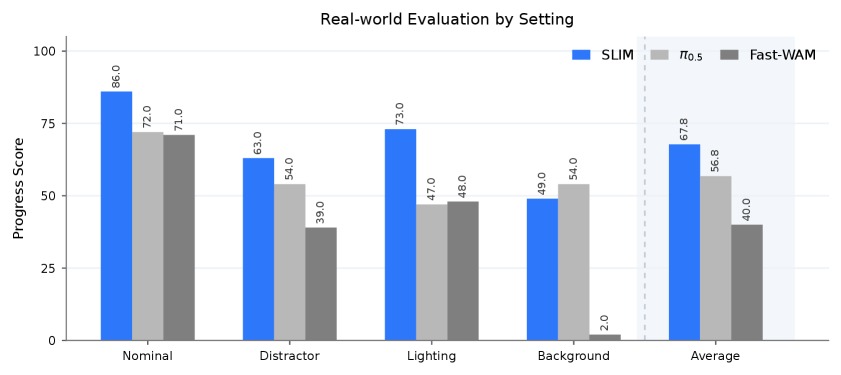
Real-world multi-task training used 750 demos (150 each on five tasks). Against π0.5 and Fast-WAM, SLIM leads average progress under nominal, distractor, and lighting settings; under hard background shift it scores 49 vs π0.5 at 54.
Controlled H100 inference: 60.6 ms mean latency, 4.26 GiB peak incremental VRAM — 3.19× faster and 1.86× lighter than π0.5 under the authors’ PyTorch-eager protocol.
A Human’s Take
I care less about another leaderboard peak than about latency and memory per correct chunk. If a half-billion-parameter model can hold LIBERO-class success while cutting GPU footprint versus multi-B VLAs, that is the stack you can actually run next to a cell controller. The honest caveats are in the paper: single scale, limited embodiment diversity, zero-shot LIBERO-Plus still droops under robot-initial-state shift. Show me multi-robot finetune curves next.