SmellDiffusion Maps a Named Gas Leak, Then Plans the Walk
A leak inspector does not want “follow the strongest smell.” They want “find the chlorine.” Faith Ogunwoye, Iana Zhura, Dzmitry Tsetserukou, and colleagues at the Skolkovo Institute of Science and Technology posted SmellDiffusion (arXiv:2609.20624) on 17 September 2026.
It is a simulation pipeline. No physical quadruped run is reported. The teaser art in the paper is labeled conceptual. The useful part is the split: a language-tagged map chooses where, a planner chooses how.
Graph first, then a gate
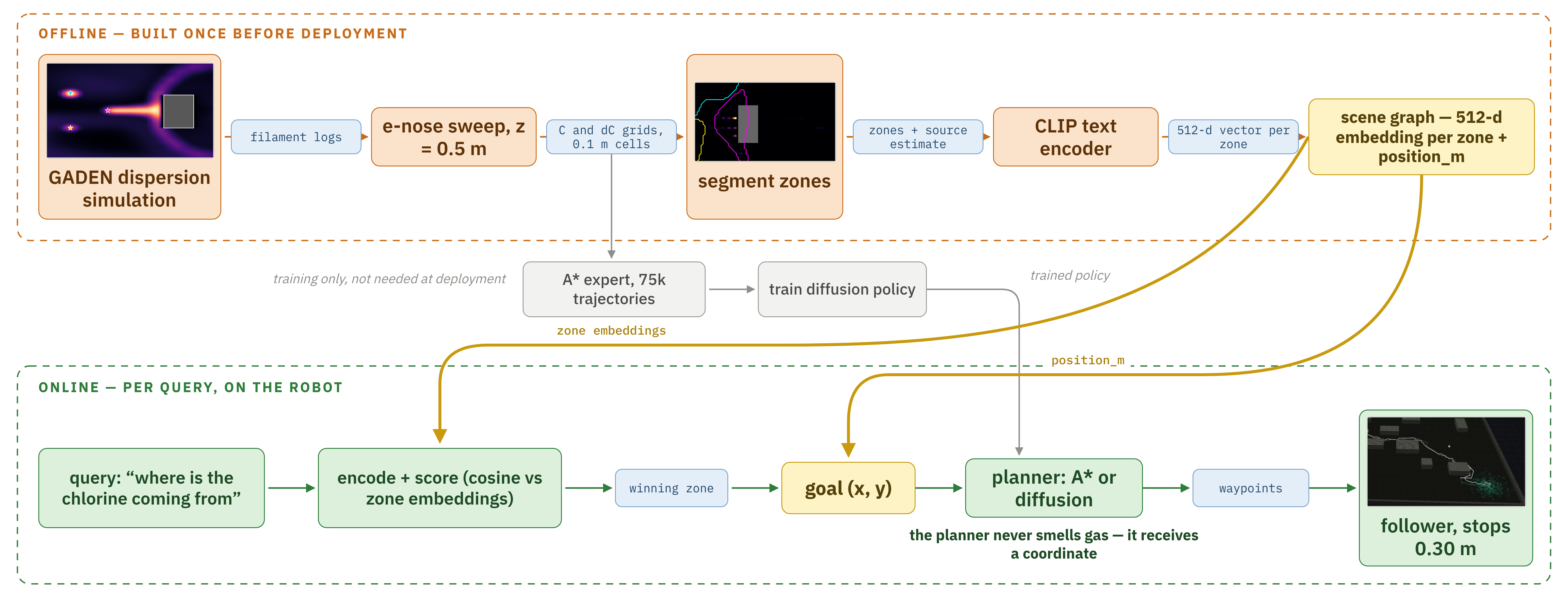
Offline, GADEN filament fields are swept by a virtual e-nose at 0.5 m height on a 0.1 m grid. Zones store a peak-based source estimate and a 512-d CLIP text embedding. A query is scored against those sentences. The winning coordinate becomes the goal for either A* or a diffusion waypoint policy.
Obstacle flow can shove the concentration peak off the source. Among 424 unique source–wind configs, 28 have a peak more than 0.5 m from the source. A peak-local geometric gate, fit only on training data, fires on 14 of 204 held-out cases: 9 true positives, 5 false positives, 1 miss (0.64 precision, 0.90 recall). When it fires, a library lookup of training simulations cuts mean error on the displaced subset from 1.468 m to 0.592 m (60%). All-case mean error goes 0.205 m → 0.180 m. Matching every peak without the gate makes the majority worse.
Diffusion is not faster if you sample ten times
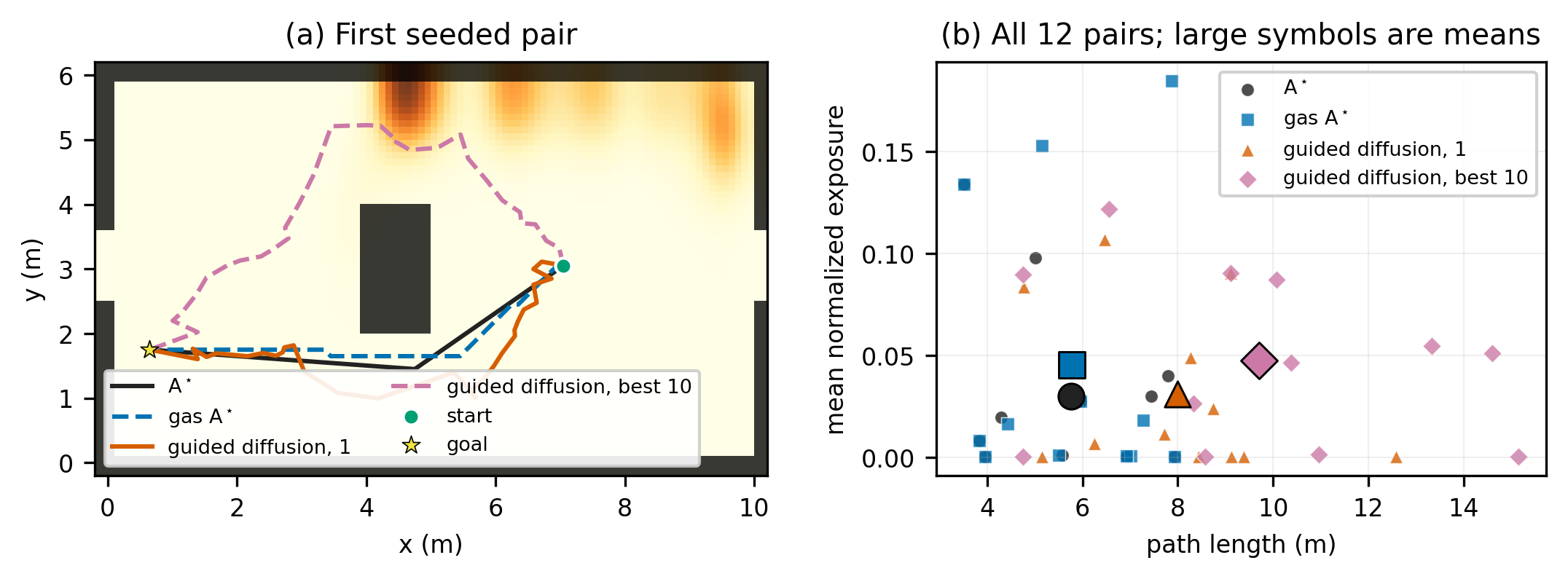
On 12 start–goal pairs, every method succeeds. Plain A* is shortest and fastest (15.2 ± 8.9 ms). One diffusion sample is 41.7 ms with higher clearance and 39% more length. Best-of-ten diffusion hits mean gas exposure 0.0476 versus 0.0455 for gas-guided A*, at 407.7 ms.
Six matched Gazebo runs (chlorine, ethanol, methane × two planners) give mean robot-to-source error 0.39 m (A*) and 0.31 m (diffusion). One execution per condition. The paper does not treat that as a statistical win.
Language is the weak joint. An integrated query test scores 7/9. A held-out probe on new sentences is 3/10 until nearest-neighbor normalization lifts it to 5/10. Code: github.com/FaithOgunwoye/Olfsg.
A Human’s Take
I will take a gate that only spends the expensive lookup on 14 of 204 cases. That is engineering. I will not take a CLIP sentence match that still loses half of the held-out queries and call it “find the chlorine.” The map has to know the species. The language layer, as written, is not there yet.