RAI Trains Spot and a G1 to Push Boxes With Sparse Rewards
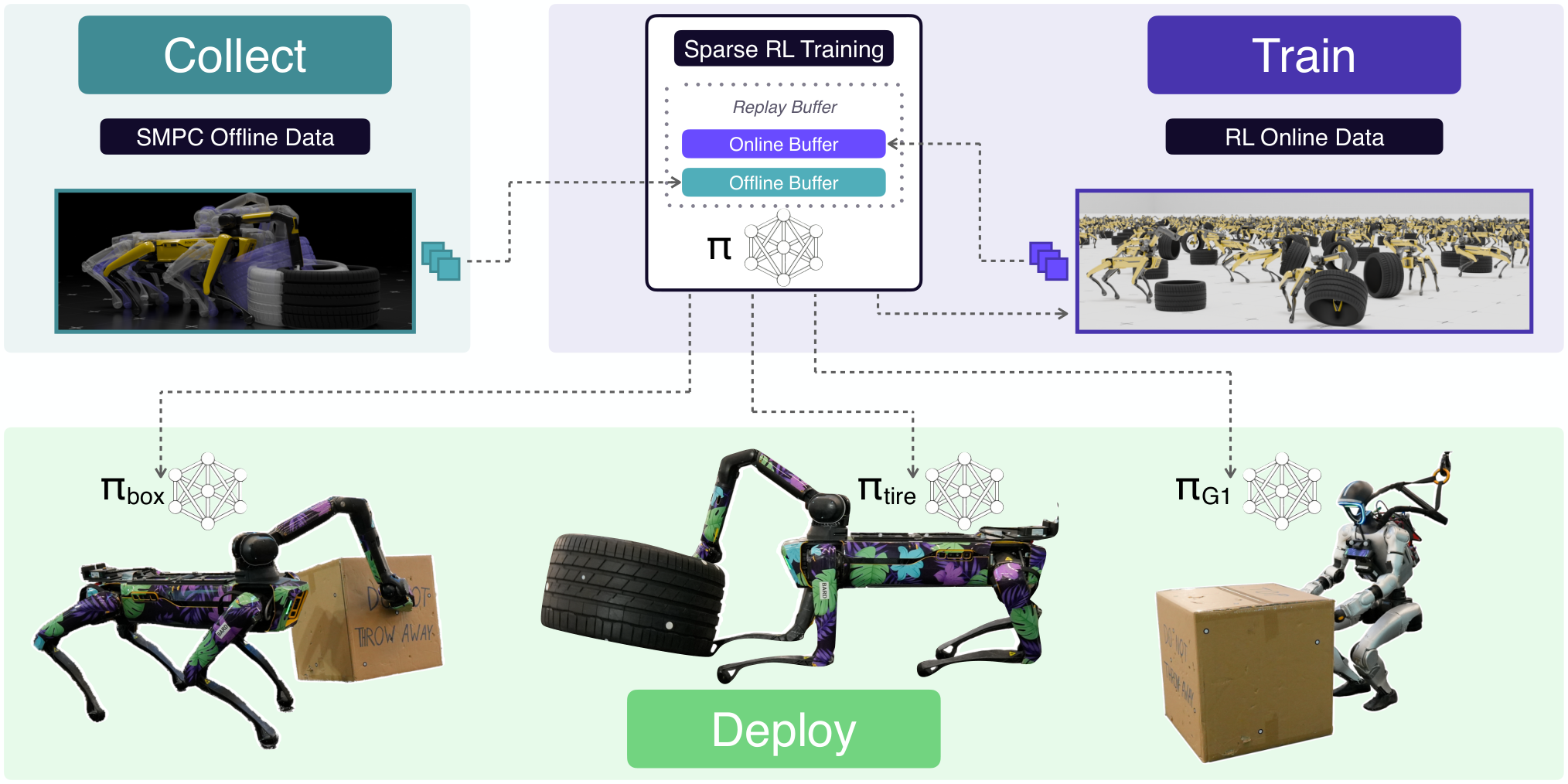
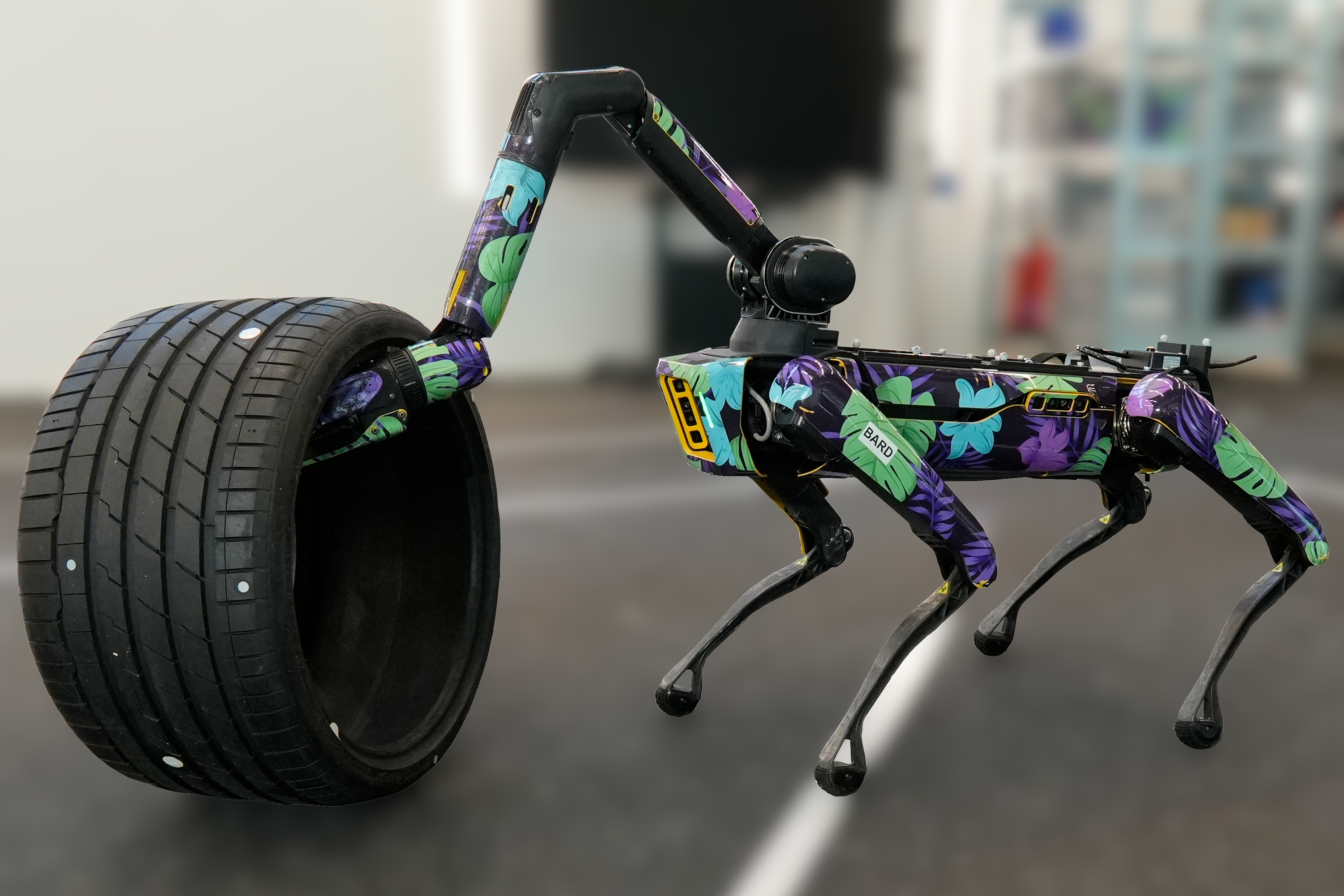
A RAI Institute team with TUM and ETH Zurich is using sample-based model predictive control as a cheap expert, then training sparse-reward policies that run on a Boston Dynamics Spot with an arm and a Unitree G1. The paper posted to arXiv on August 12. The hardware clips show Spot pushing a box, standing a tire up, and rolling a tire, plus a G1 shoving a cardboard cube.
Why they threw out dense rewards
Dense reward shaping is the usual way to teach loco-manipulation. Every tweak means another training run. The authors flip that: SMPC, which they can retune in minutes in simulation, writes a large offline dataset. Because those trajectories already solve exploration, the RL agent only sees a sparse objective:
- 0 at the goal
- a one-time crash penalty
- −1 otherwise
A frozen low-level whole-body controller (ReLIC) tracks arm motion and base velocity and keeps the legs under the robot. The high-level policy only outputs deltas: base velocity, arm joints, and, on the G1, torso height and pitch.
On one RTX 5090, the SMPC expert runs at about 0.5× real time. After the costs are set, a tiled GPU collector produces about one million samples per hour. The hardest task, tire rolling, needs about four million samples, or four GPU hours.
What actually moved
Five real-world tasks transferred without platform-specific reward engineering. The box is 0.5 m on a side and 1.2 kg. The tire has a 0.33 m radius, 0.34 m width, and 14.3 kg. Spot commands go over Wi-Fi from an offboard computer. G1 inference runs onboard. State comes from OptiTrack plus the robots’ own sensors.
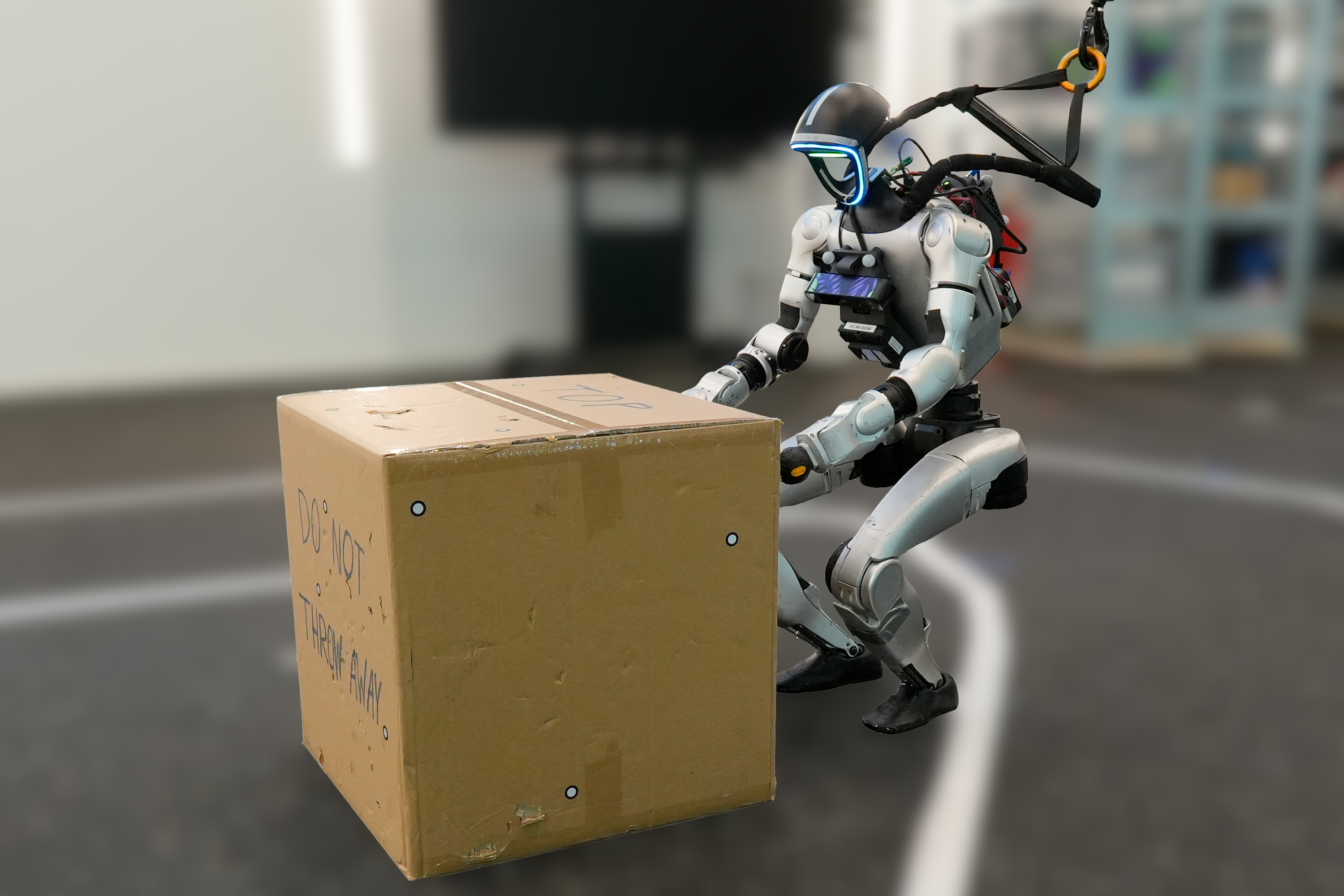
The sparse policies finish faster than the SMPC teacher, by more than 50% on some tasks, and cut the standard deviation of completion time by 11–45%. Without the expert buffer, the same sparse setup never learns. Multi-modal SMPC data (kick the tire, shoulder it, step into it) also fails: the uni-modal policy needs one behavioral mode.
The authors are blunt about limits. The policy stays near the teacher’s distribution. The low-level controller is frozen, so it cannot adapt to task-specific disturbances. And outdoor or vision-only deployment would need a second training or distillation step.
A Human’s Take
This is the right kind of “the robot works a shift” paper: a 14 kg tire, a G1 pushing a box, and a reward you can write on a napkin. I like that they measured the teacher and then beat it, and I like that they said multi-modal planner data wrecks training. What I want next is the same stack with a wrist camera and no motion-capture hall. Until then this is a lab method that already walks on two bodies.