SocioGesture Teaches a G1 When Not to Walk Over
A Unitree G1 that waves back when you wave, and stays put when you put a palm up, is the demo. SocioGesture, posted 3 September 2026 as arXiv:2609.04545 by Wenjin Fu, Li-Fan Wu, Jerin Peter, Chip Huyen, Boyuan Chen, and Jan Liphardt at OpenMind, is the stack that decides.
The robot-mounted Jetson Thor runs the whole one-person loop in 25 ms, inside a 30 FPS camera’s 33 ms budget. No cloud inference in the live path.
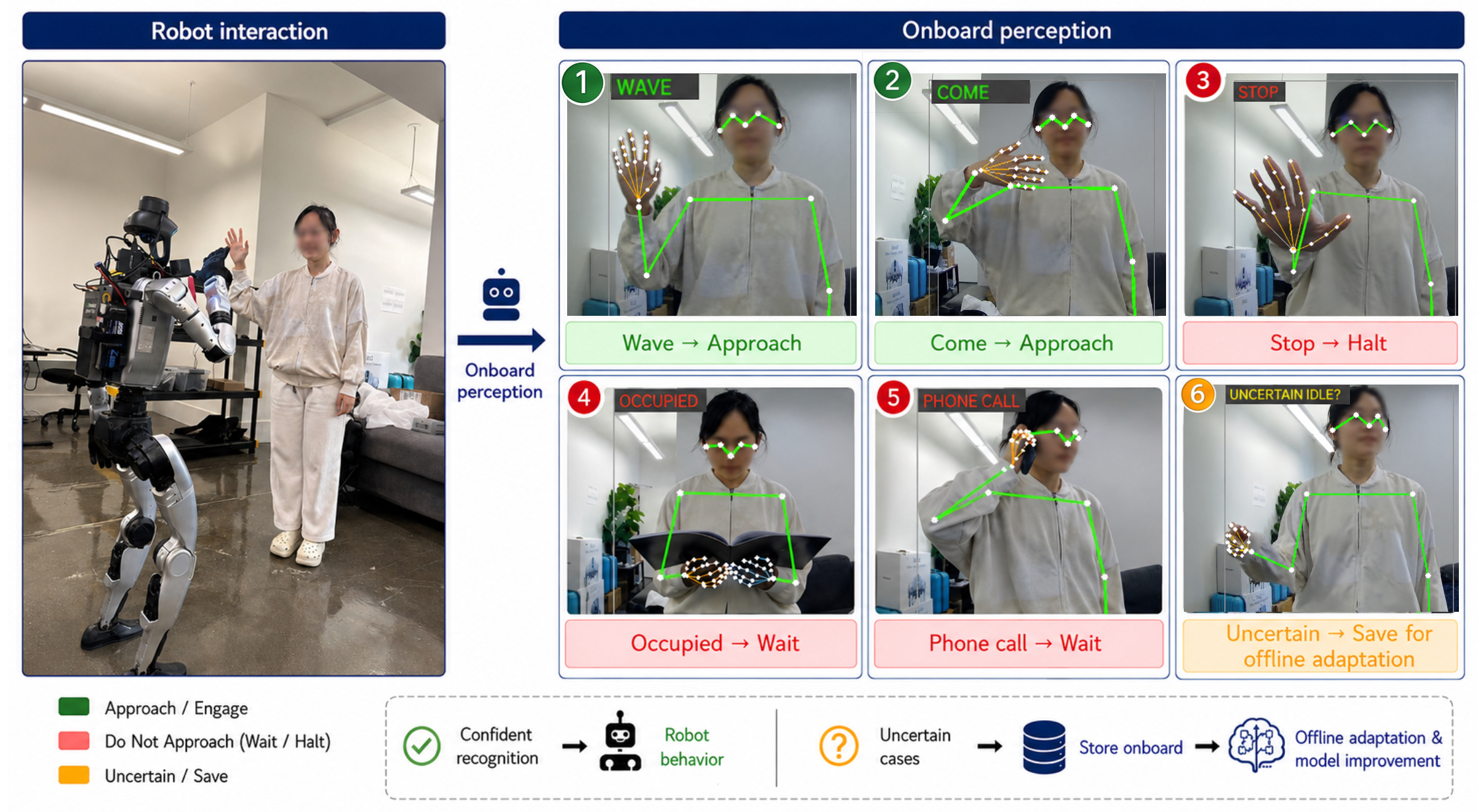
What it recognizes
Seven training classes, mapped to conservative actions:
- Come / wave → approach (wave also waves back)
- Stop → halt
- Phone call / occupied → wait, keep distance
- Idle facing / scratch head → approach and engage (scratch head is a distractor for hand-to-head cues)
Below 0.7 confidence the robot holds position and saves the clip. After deployment, those uncertain segments get labeled offline and folded back in. The vocabulary grew from 7 to 10 with handshake, salute, and thumbs up.
On a held-out 5-subject 10-class test set, overall clip accuracy went 64.6% → 87.9%. The original seven stayed at 98.5%. The three new classes hit 67.6%.
Occlusion and the live G1
Hands vanish in robot-view pose estimates. Training with missing-hand and missing-arm skeletons lifts hand-occlusion accuracy from 31.8% to 84.9% and arm-occlusion from 28.3% to 79.5%, with clean accuracy basically unchanged (~96% leave-one-subject-out).
Live closed-loop on a G1, five people who appear nowhere in training, fine-tuning, or the offline test: 146 of 150 trials recognized correctly (97.3%). When the robot did act, the behavior was right 98.3% of the time. No stop gesture produced an approach. Behavior success overall is 79.3% because low-confidence trials stay still on purpose.
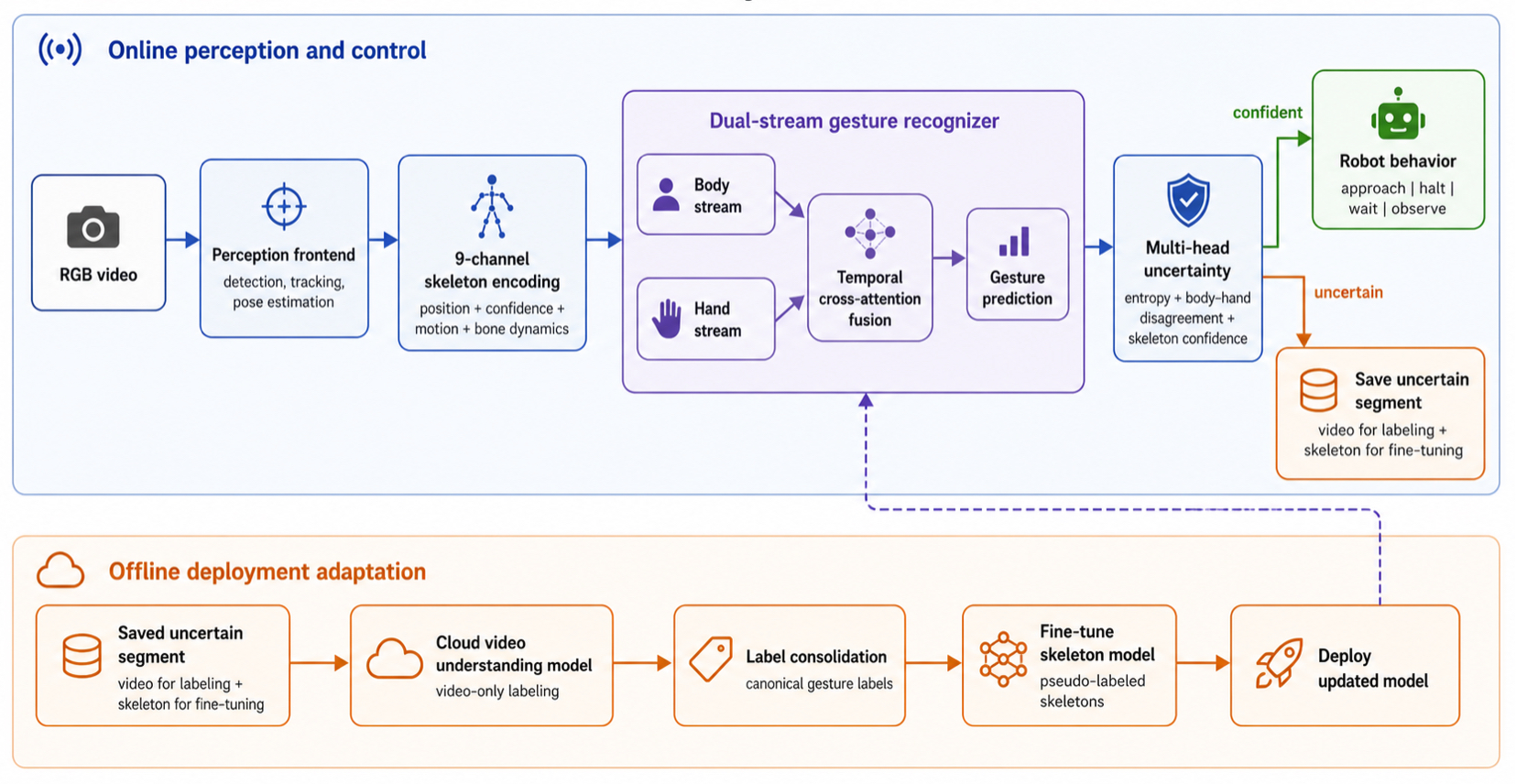
The recognizer is 1.3 M parameters and 2.3 GFLOPs, one forward pass. Full stack on Thor: YOLO11n 5 ms, BoT-SORT 1 ms, RTMW-l pose 8 ms, gesture model 11 ms. Three people in frame: 42 ms.
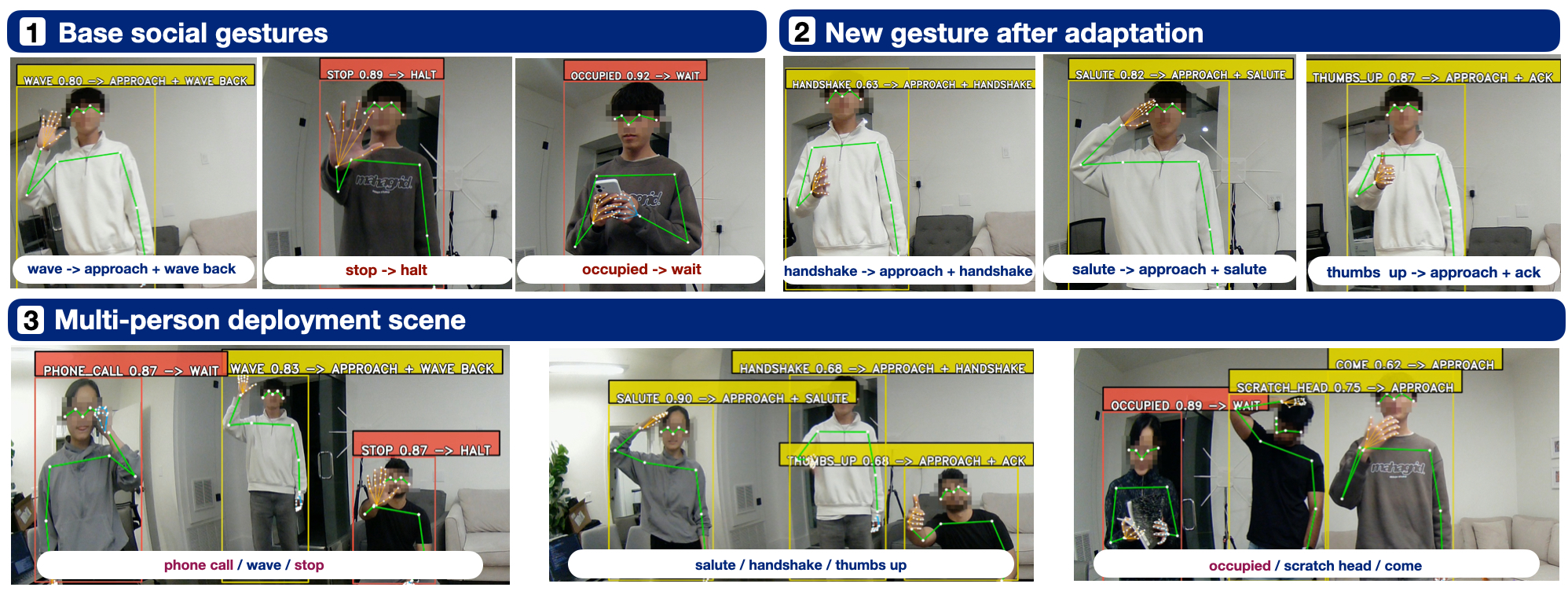
Offline labeling used Gemini 2.5 Flash on saved RGB, then human verification (67 of 71 clips kept). Dataset and eval code are promised on the project page; they were not linked at fetch time.
A Human’s Take
The useful part is the fail-safe: if the G1 is not sure, it does not walk at you. I will take a robot that waits over one that hallucinates a wave. New-class accuracy at 67.6% is still a shrug. Handshake in the wild will tell us if the offline loop is a product or a lab ritual.