SpaceVLA Puts User Grasp and Place Anchors Into OpenVLA
Language is fuzzy about where to grab. “Pick up the mug and put it on the table” leaves a dozen legal grasps and landings.
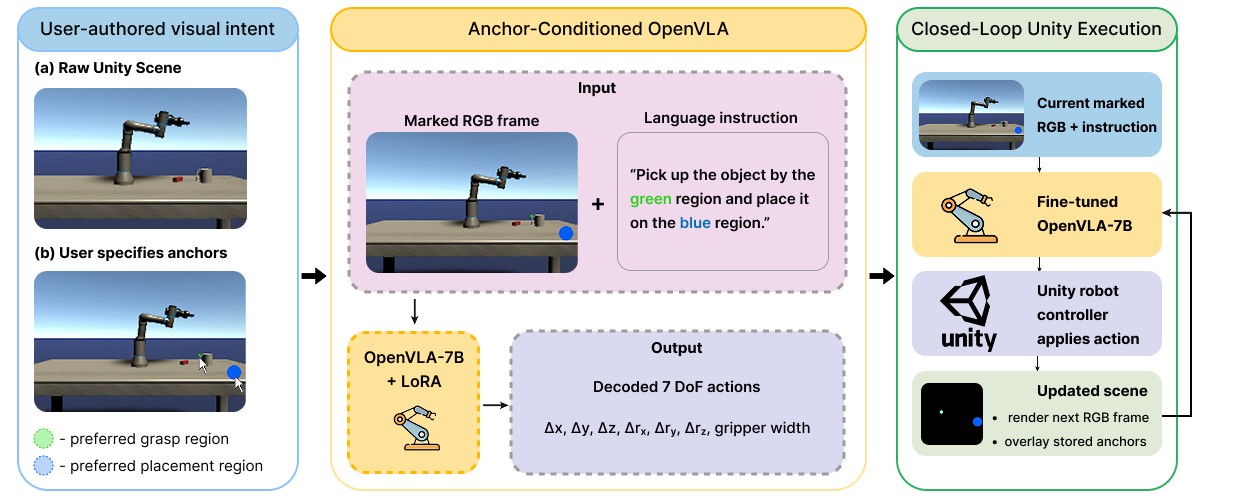
SpaceVLA (arXiv:2608.05730, Aug 6, 2026) adds Visual Intent Anchors: the user points to a preferred grasp region and placement region in a Unity XR-style interface. Those points become green and blue image-space overlays on the RGB frame that an OpenVLA-7B policy (fine-tuned with LoRA) already knows how to read. Authors are from Skoltech and MWS R&D (Zinniatullina, Kolomiets, Konenkov, Altamirano Cabrera, Tsetserukou).
Setup
- 200 Unity pick-and-place demos (mug, pot, thermos, saucepan); ~150 RGB frames each
- Split: 120 train / 80 held-out episodes; 18,000 anchor-augmented training observations
- Policy predicts tokenized 7-DoF incremental actions (translation, orientation deltas, gripper width)
- After grasp, the green mask drops; only blue placement stays during transport
- Instruction for anchor policy: “Pick up the object by the green region and place it on the blue region.”

Numbers (closed-loop Unity, 80 held-out episodes)
| Condition | Full-task success | Mean grasp / place distance |
|---|---|---|
| Correct anchors | 91.25% (73/80) | 0.5 cm / 0.7 cm |
| Random anchors on objects | 77.5% (62/80) | 2.6 cm / 3.4 cm |
| No-anchor baseline | 50.0% (40/80) | n/a |
Correct anchors cut average grasp-and-placement action error from 3.0 cm to 0.6 cm vs random object anchors. A separate test put anchors at arbitrary workspace points (including off objects); the robot redirected toward the marks, not just the objects.
Current limitation the authors call out: anchors are fixed image-space masks under a static camera — they do not stick to moving objects or reproject under viewpoint change. Future work points to 3D world/object-relative anchors for VR/AR on real robots.
A Human’s Take
This is preference injection without full teleop, and the ablation is honest: wrong anchors hurt, no anchors collapse. Until the masks live in 3D, it is a sim-and-static-camera trick. I still want it — “green means grab here” is something a floor supervisor can understand without learning a teach pendant.