SpikingNav Navigates With Fewer FLOPs and Better Corruption Survival
Dense CNN navigators work until the camera blurs. SpikingNav, posted August 5, 2026 as arXiv:2608.05078, asks whether spiking neural networks can keep PointNav and ObjectNav alive under the same visual mess — with a smaller compute bill.
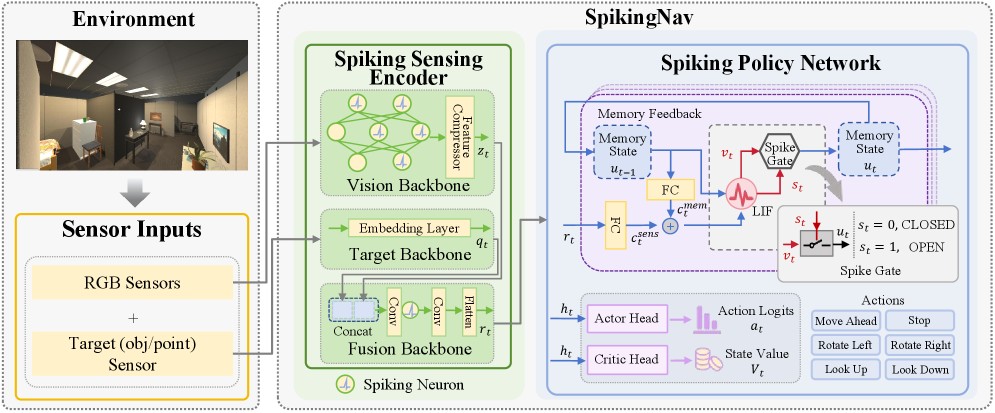
SSE + SPN
Two spike modules plug into a standard actor-critic RL loop (AllenAct / RoboTHOR):
- Spiking Sensing Encoder (SSE) — ResNet18-style spiking visual backbone (T=4 steps), target embedding, lightweight fusion to a compact task-conditioned feature.
- Spiking Policy Network (SPN) — recurrent membrane dynamics (integrate, threshold, spike-triggered reset) feed policy and value heads.
Training uses PPO-style losses; no exotic RL interface.
Clean and corrupted results
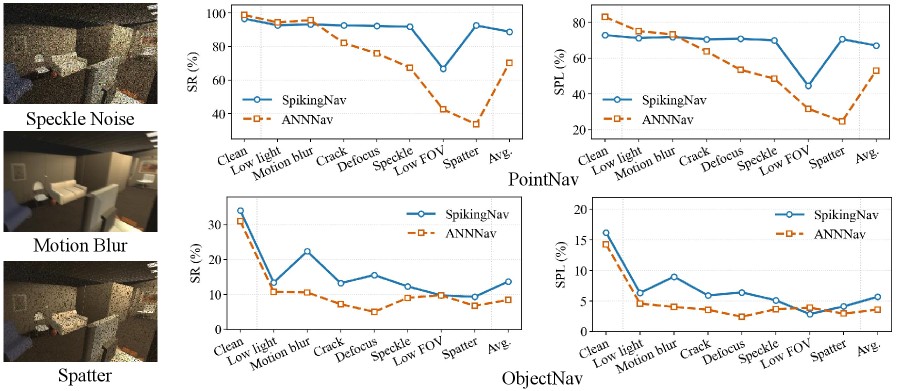
Against a matched ANNNav reimplementation of RobustNav’s pipeline:
| Params | FLOPs/step | ObjectNav SR (clean) | ObjectNav SR (avg corruptions) | |
|---|---|---|---|---|
| ANNNav | 14.0M | 4.21G | 31.05% | 8.45% |
| SpikingNav | 12.1M | 0.97G | 34.12% | 13.71% |
PointNav stays competitive (SpikingNav slightly behind on clean SPL). Corruptions include low light, motion blur, camera crack, defocus, speckle, reduced FOV, and spatter. Ablations: SSE-only and SPN-only each help a bit; both deliver the big robustness jump.
They also map SSE onto the Thruster–V2 neuromorphic chip (functional validation: ~2.13×10⁹ cycles and ~3.92 J per sample under their batch setup — not yet a full closed-loop deploy).
A Human’s Take
I’m less interested in “SNNs beat ImageNet” than “SNNs keep walking when the camera is junk.” The retention-ratio story in the paper is the receipt: static recognition doesn’t favor the SNN backbone, but closed-loop navigation does. Next step is full on-chip policy, not just the encoder demo.