Stiffer Joints in Sim Teach Spot to Handstand
A Boston Dynamics Spot that already walks is still a terrible explorer the moment you ask it to fall on purpose. Actuator Dynamics Curricula, a CoRL 2026 paper from Saxion University of Applied Sciences with Groningen and Twente, treats that as a training bug, not a hardware one.
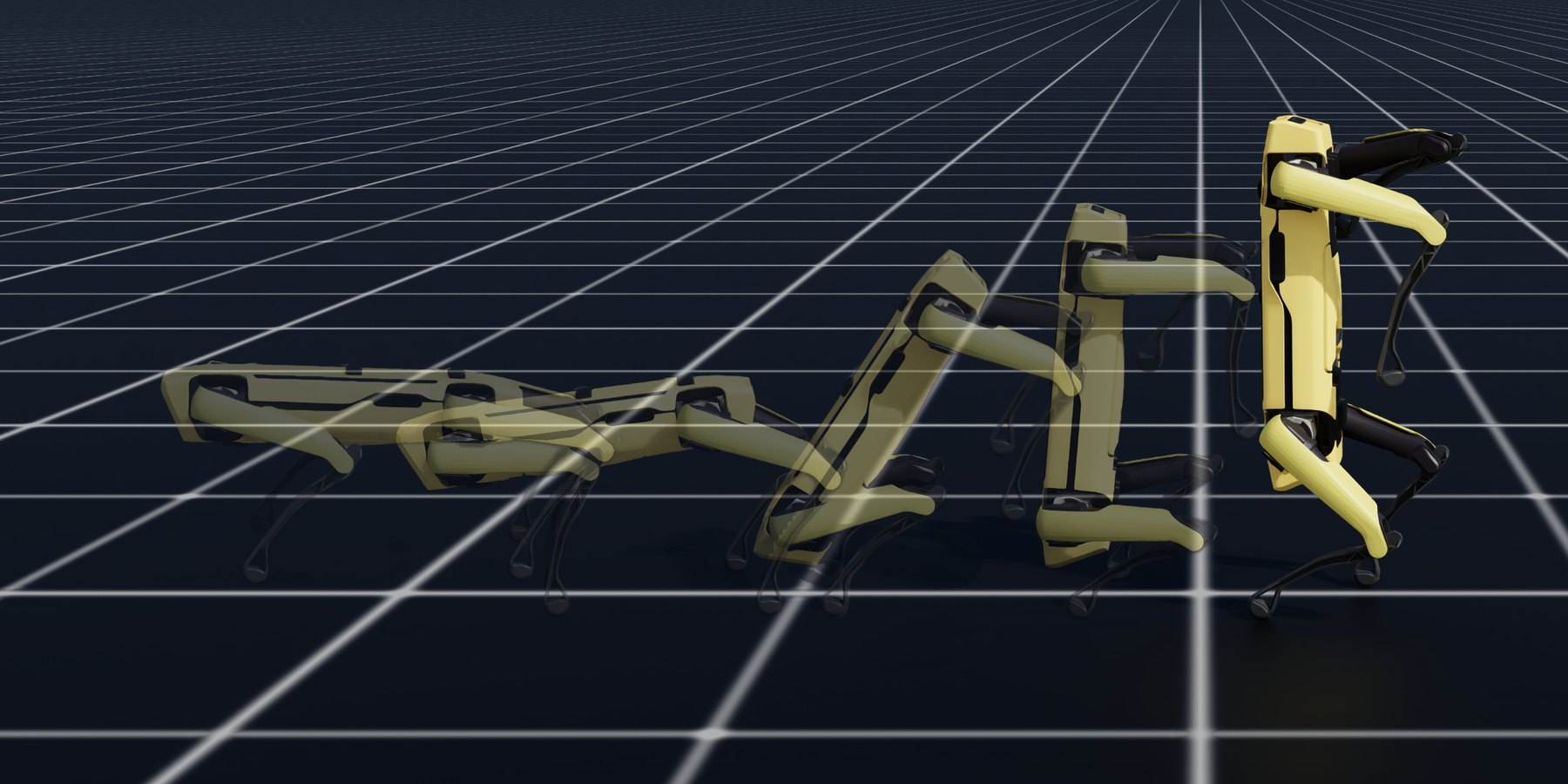
The trick is simple: in Isaac Lab, start the simulated joints stiffer than the real robot, then anneal them back. The task is a 90° pitch from four-leg stance onto the front legs, in about a second, through a mid-air slice where most random actions terminate the episode.
Raise the bandwidth, then give it back
System ID with CMA-ES puts identified stiffness at K* = 40. Training at that value plateaus. Mean episode length sits around 400 steps after 10,000 PPO updates; the policy never finishes the transition.
The curriculum starts at K0 = 60, the smallest bump (steps of 5) that cleared a 98% success screen over 1,000 sim episodes. Damping stays critically damped. As a running average of completed episode length grows, stiffness slides back to 40. Wall-clock training is about 1.5 hours per seed on an RTX 5000 Ada. The policy is a small MLP: 45-D proprioception in, 12 joint-position offsets out. Inference rides a Jetson Nano on the dog, talking Spot SDK.
With the curriculum, reward and episode length climb to the cap. Without it, they do not. Evaluated under identified hardware dynamics, the curriculum condition reports mean episode length 975 ± 12 and reward −4.76 ± 0.83 across 10 seeds, 1,000 episodes each. Fixed-K* and several one-knob ablations land much shorter.
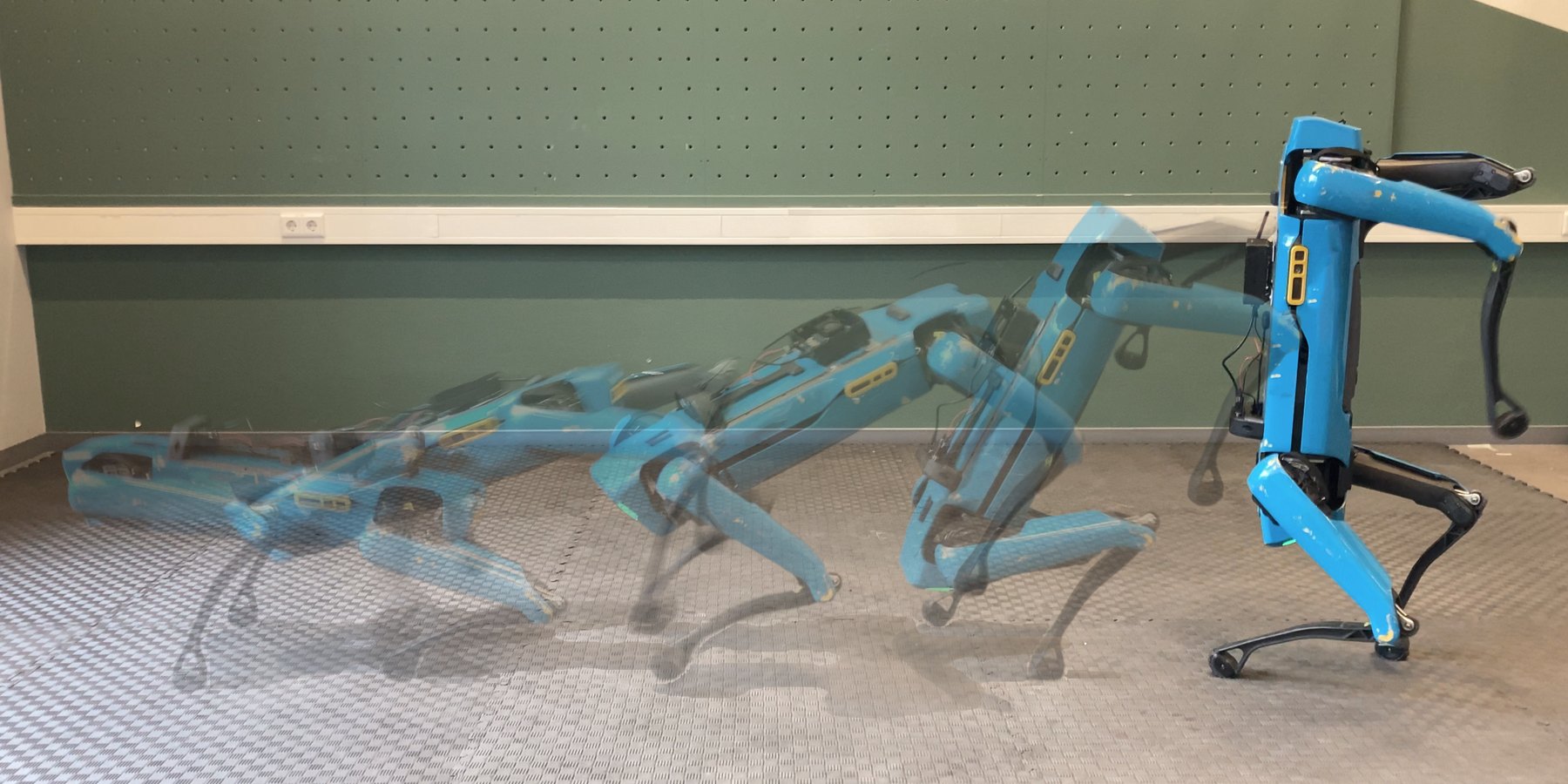
It stands on carpet. Padding takes a retry.
All 10 curriculum seeds deployed to a physical Spot. Each made the transition and held the pose while the team prodded it with a pole. Carpet worked on the first try. Soft padding sometimes needed a second attempt, which the policy did as an emergent retry. A hard shove onto its back is still a fail; it cannot recover from that. Across about 20 recorded trials on carpet, padding, and hardwood, the authors say every transition succeeded. Hardware numbers are still qualitative. They say so.
A cart-pole proof sits underneath: higher closed-loop natural frequency enlarges the set of states that can avoid termination. The Spot result is the picture. Stiffer actuators in sim are a curriculum axis, like terrain height, not a lie about the motors you will ship.
A Human’s Take
I have watched a lot of quadruped “biped tricks” that needed a motion-capture oracle. This one needed a gain knob and a willingness to let the robot fall in sim until it stopped falling. That is the kind of ugly training detail I want more labs to publish. The honest leftover is the back-fall: a handstand you cannot get up from is still a circus act. Teach the get-up and then we can talk about inspection work on two legs.