StableMimic: One G1 Policy for Dance Tracking and Getting Back Up
Most humanoid motion trackers look fine until they hit the floor. Then they either thrash after an unreachable reference or hand off to a separate stand-up controller. StableMimic, a SUSTech preprint posted August 3, 2026 (arXiv:2608.02385), keeps tracking and recovery in one deployable policy on the Unitree G1.
The idea
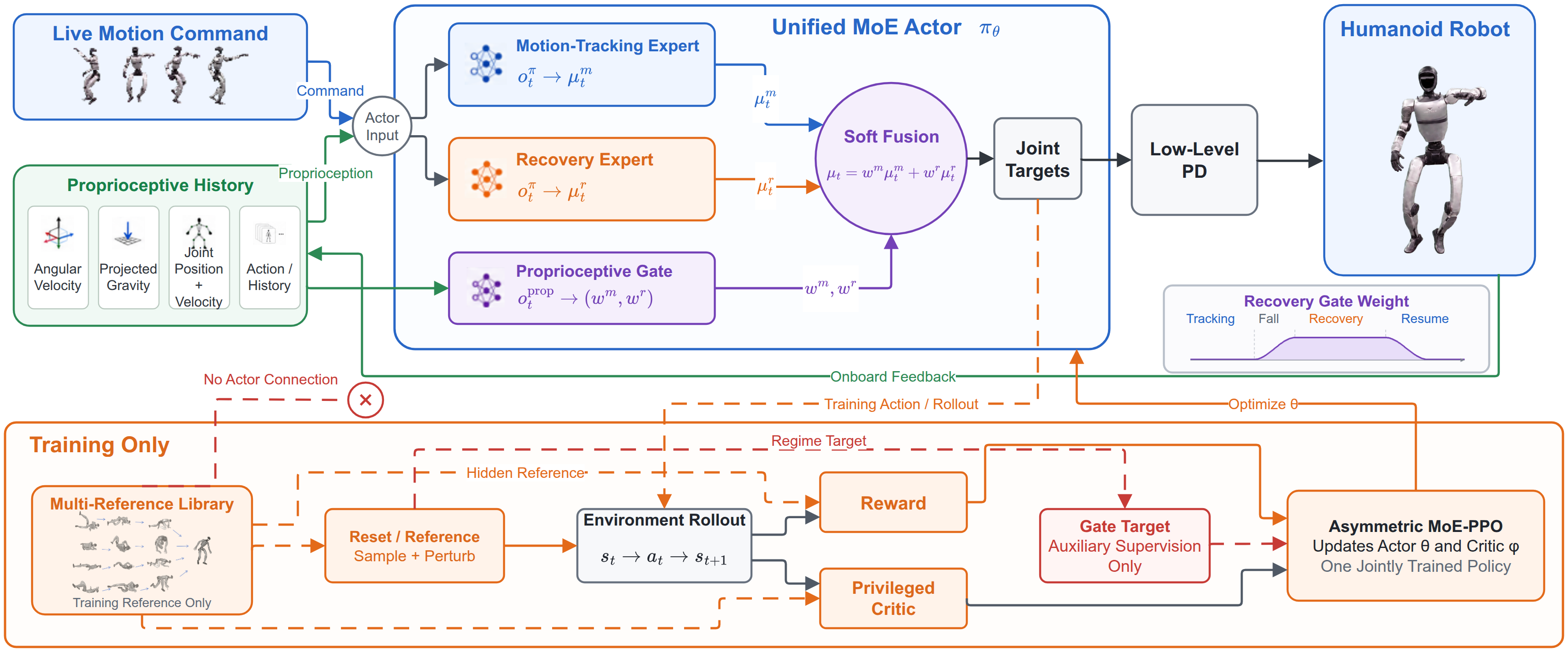
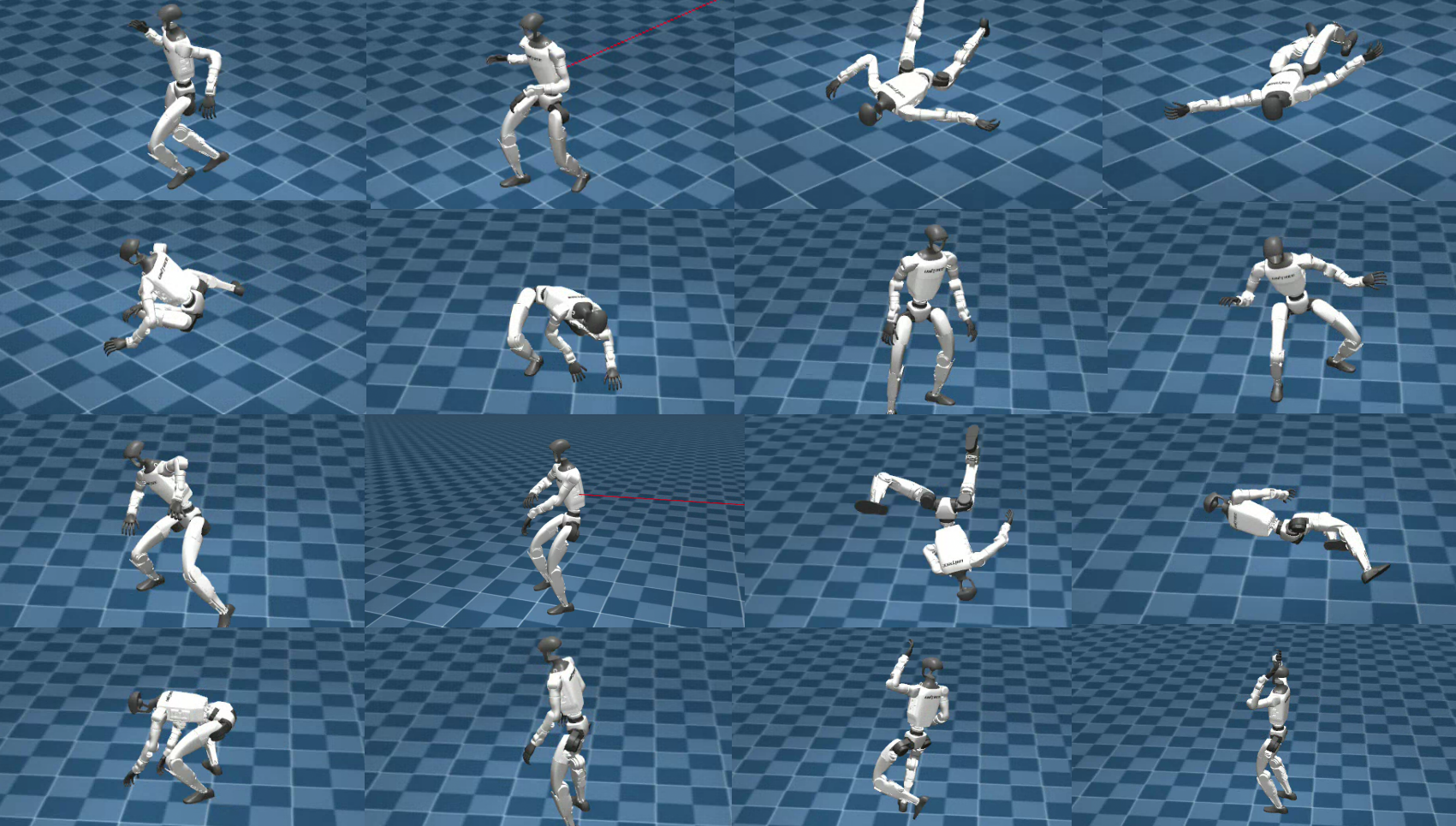
Training expands beyond the normal tracking corridor by resetting into perturbed get-up states (prone, supine, off-balance). Two experts share the same observation interface: one for commanded motion, one for recovery. A gate that sees proprioception only blends their actions continuously — no hard recovery switch and no get-up reference at deploy time.
The authors train with hidden successor-state rewards shaped by human get-up references, then strip that library from the exported Actor. At runtime the policy still receives the live command and onboard proprioception; it does not receive recovery phase IDs or trajectory lookup.
Numbers from the paper
On the full retargeted LAFAN1 dance subset, StableMimic reports the lowest error on all four tracking metrics among five compared methods (MPBPE 28.53 mm, plus joint-angle, joint-velocity, and relative-acceleration terms).
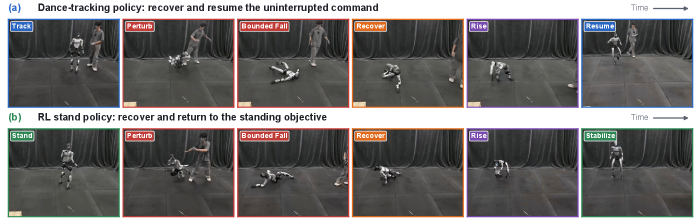
For falls, every method faces the same 100 pre-generated torso pushes (25 per direction, 525–575 N for 0.2 s). StableMimic recovers in 100/100 and posts the best scores on six of seven post-fall motion and load measures (limb speed, limb travel, joint speed, workspace, torque, energy). Real G1 dance and standing-reference policies are shown recovering and resuming the command with bounded limb motion — qualitative hardware transfer, not a certified safety claim.
Why it matters next to pure trackers
A tracking-only baseline (BeyondMimic-style) does not recover under this protocol and shows the largest post-fall limb motion and actuator load — consistent with chasing an unreachable dance reference on the ground. Recovery-capable baselines (KungFuAthlete, BFM-Zero) recover more often, but StableMimic’s matched numbers favor lower workspace and load under the paper’s protocol.
A Human’s Take
This is the right failure mode to study. Humanoids will fall; the question is whether the recovery is a thrash or a structured get-up that hands control back to the task. StableMimic’s “no get-up command at deploy” design is what you’d want on a teleop or dance stack. The 100-trial sim protocol is solid; next bar is outdoor field hours and third-party G1 replications.