StageGuard Distills When to Stop a Skill Into a Tiny VLM
Long-horizon stacks fail in the handoff. The pick worked. The place started too soon. Jinbang Huang, Yingxue Zhang, and colleagues at Huawei Noah’s Ark Lab posted StageGuard (arXiv:2609.20791) on 17 September 2026: a small vision-language model whose job is to say continue, advance, or skip.
A cloud VLM can reason about a scene. It is slow, and its “done” threshold is not your subtask. StageGuard distills demonstration-grounded explanations into a student that can sit next to the controller.
Teacher talks, student keeps the punchline
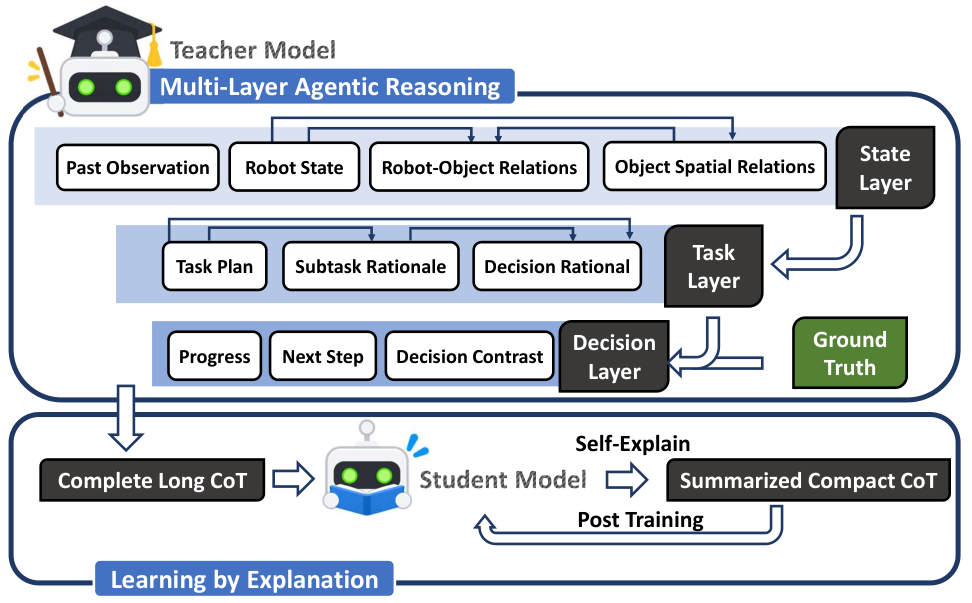
Teacher: Qwen3.5-397B-A17B. Student: Qwen3.5-0.8B. A three-layer agentic pass (state, task, decision) writes a long chain of thought against annotated transitions. The student rewrites that into a compact self-explanation. The teacher judges three candidates. Fine-tuning weights explanation tokens at 0.5 and the structured decision at 1.0.
Training uses 10 trajectories per task. LIBERO-Logic covers short tabletop sequences. BEHAVIOR-1K is limited here to six household tasks (radio, trash, boxes, modem, cans, scanner).
On LIBERO, StageGuard reports 96.23% transition completion (within ±3 s of the label), 97.50% of trajectories reaching the last planned subtask, 89.81% next-subtask accuracy, at 1.03 Hz. Prompted VLMs and a ROVER-style progress reasoner sit far below that on the same protocol. On BEHAVIOR-1K the student still leads: 90.18% transition completion, 81.67% full trajectories, 57.23% next-subtask, 1.74 Hz.
Closed-loop on BEHAVIOR-1K, with a PDDL planner and π0.5 skills, StageGuard narrows the success-rate gap to an oracle that uses ground-truth transitions from 0.28 to 0.10.
Two real arms
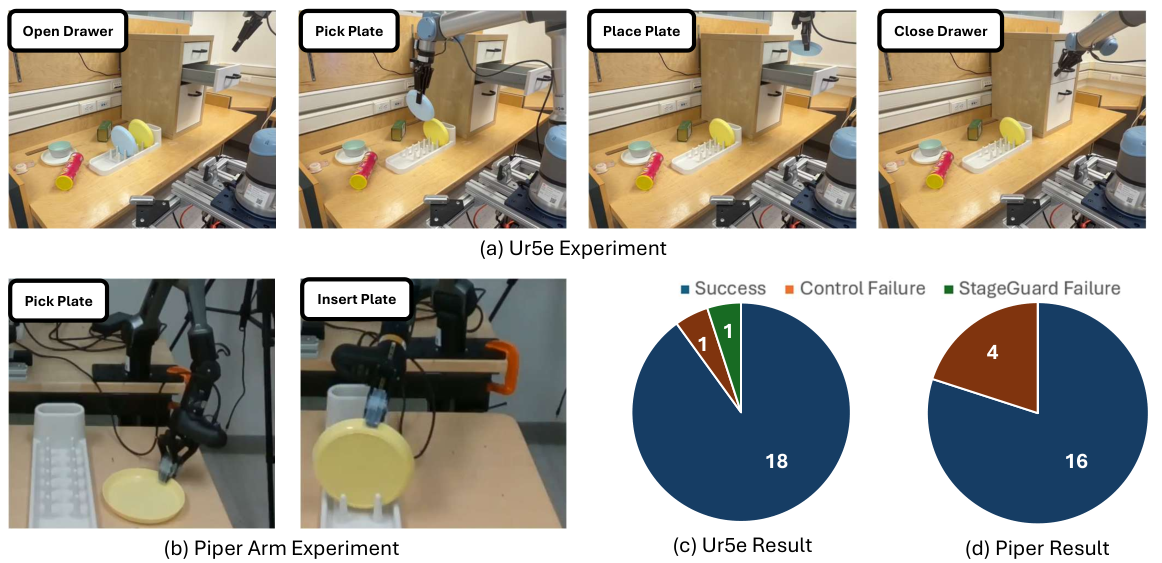
UR5e: open drawer, move a plate from a rack into the cabinet, close the drawer. 18/20 (90%). One miss is the VLA. One miss is a late transition under partial observability.
Piper: pick a thin plate and insert it in a rack. 16/20 (80%). All four misses are grasp failures. None are blamed on StageGuard.
The monitor runs at 2.2 Hz in parallel with the local VLA and does not block the loop, the authors say. Limits they list: you still need annotated demos, the teacher is expensive, and a small model cannot see around a bad camera angle.
A Human’s Take
I have watched too many “generalist” stacks stall because nobody owned the moment a skill was finished. A 0.8B monitor at 2 Hz is the right size for that job. The Piper result is the honest one: the hand still drops the plate. StageGuard cannot save a bad pinch. It can stop you from closing the drawer on the way in.