StellaVLA Adapts From One Demo by Teaching the Why
StellaVLA is a vision-language-action recipe that adapts at test time from one retrieved demonstration. The twist is what that demonstration contains. An offline pipeline turns a raw trajectory into a task plan, sub-goal text, and verbalized 2D/3D motion, then stuffs that structure into the prompt. No extra human labels. The paper and the StellarEdge project page went up with the August 12 arXiv listing.
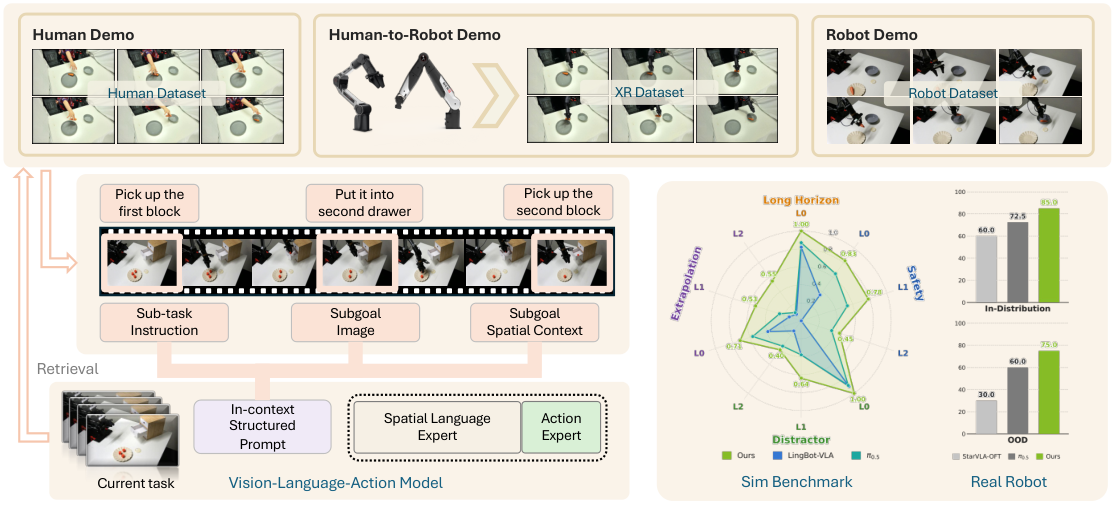
Imitate the plan, not the pixels
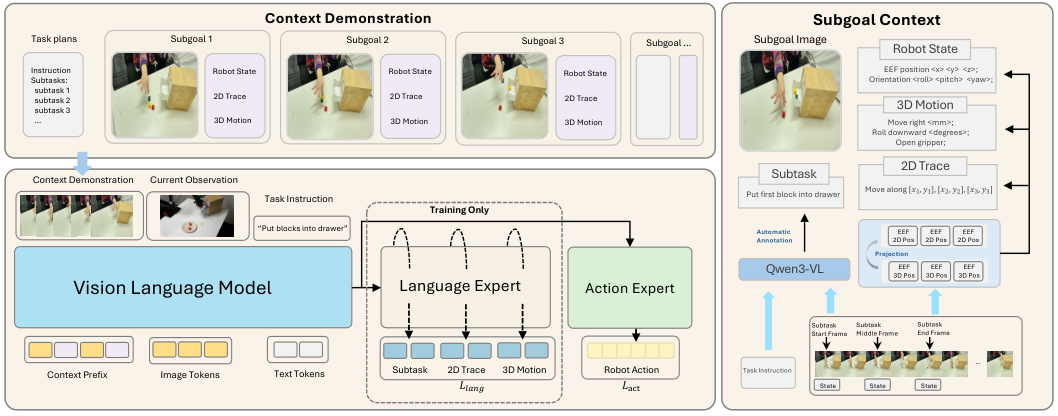
Most in-context imitation feeds the policy raw observations and actions. StellaVLA’s authors say that teaches what happened and hides why. Qwen3-VL segments the expert clip. A deterministic verbalizer writes the 3D workspace move and its 2D projection. Retrieval is by instruction embedding, so a human-hand or XR clip can be fetched for a robot episode.
Training uses two heads in parallel: an action expert that regresses a continuous chunk, and a spatial-language expert that predicts the current subtask and the same motion in words. At deployment the language head is stripped. The demonstration prefix is KV-cached once. The project page puts the cached path at about 2× faster than an uncached image+text prefix.
The backbone is Qwen3-VL-4B with an OpenVLA-OFT-style MLP action head.
Leaderboard and a real arm
On the VLA-Arena board dated August 1, 2026, StellaVLA is first at 0.63 overall versus 0.44 for π0.5 and 0.22 for LingBot-VLA. Level scores: 0.84 / 0.62 / 0.43 on L0 / L1 / L2. On LIBERO it averages 98.8%. On LIBERO-Plus, trained only on standard LIBERO, it hits 85.1% zero-shot, 10.1 points above a matched demonstration-free control.
A causal check on a frozen checkpoint is the part I keep quoting. Correct demo: 98.8%. No demo: 62.4%. Wrong-task demo: 44.9%. The model is using the context as a task spec, not wallpaper.
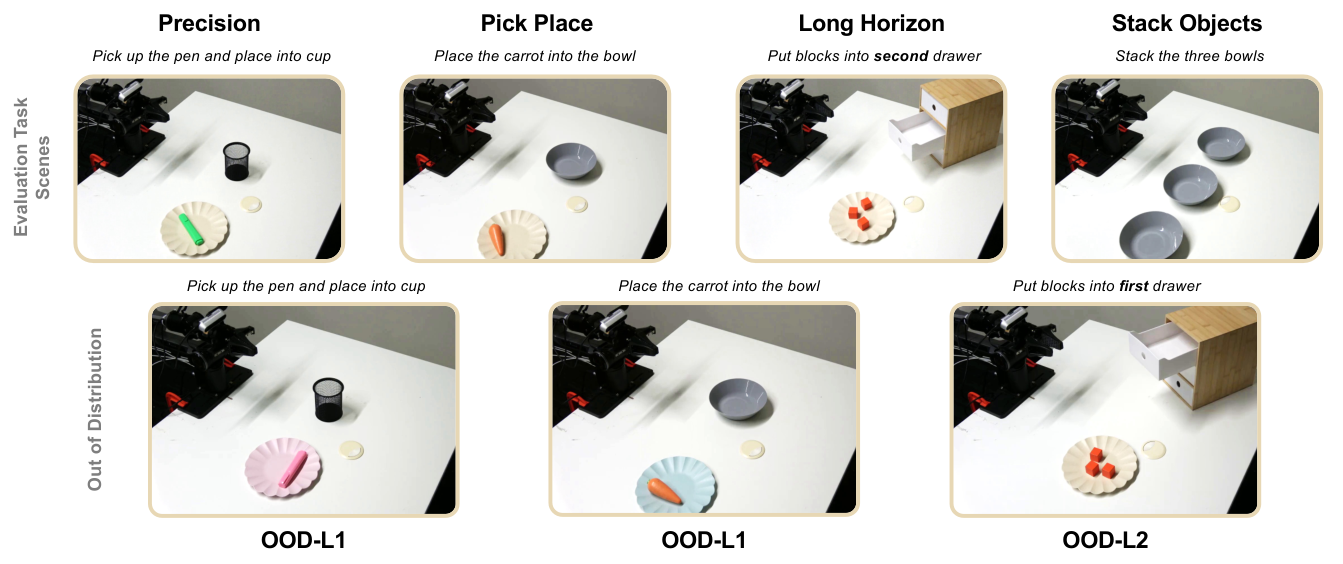
The real-robot set is a 6-DoF AgileX Piper with third-person and wrist cameras. 125 teleop episodes (71,702 frames), plus 26 human-hand XR takes and 26 frame-aligned retargeted clips. In-distribution success is 85.0%. OOD-L1 (object color / identity swaps) is 75.0%. Nobody finishes the unseen OOD-L2 drawer task; StellaVLA’s progress score is 1.9 / 4.
Code, a Hugging Face model card, and the VLA-Arena link sit on the project page.
A Human’s Take
I like a paper that breaks its own context. If a wrong demo hurts more than no demo, the model is actually reading the example. That is the receipt. The Piper numbers are a small tabletop cell, and the unseen drawer still fails, so this is not a generalist you drop in a kitchen. It is a clean argument that a retrieved plan travels farther than a retrieved pixel tape.