SwarmNxt Flies Six Open-Source Drones Without a Collision
A six-drone swarm swapped places in an indoor arena and never hit. SwarmNxt, posted 10 September on arXiv by Charbel Toumieh, Niel Mistry, and colleagues at EPFL and HKUST, is an open-source ROS 2 stack on the existing OmniNxt airframe: 360° fisheye cameras, an NVIDIA Orin NX, and PX4.
The paper’s point is not a new airframe. It is the missing middle: assembly docs, Ansible playbooks that update a whole fleet, and a multi-agent autonomy stack that actually flies.
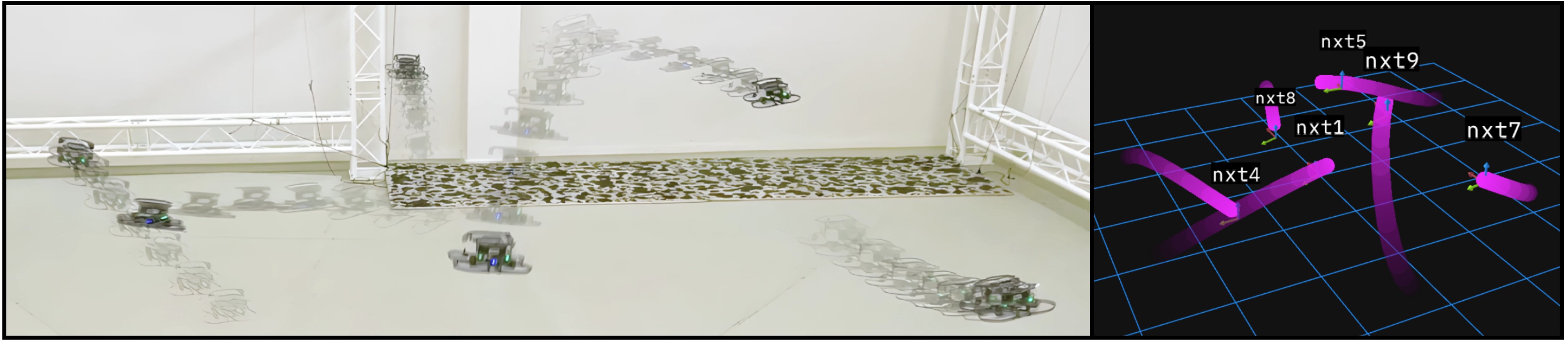
What they flew
Two indoor experiments, both in an 8 × 8 × 4 m motion-capture hall. Global position comes from OptiTrack. Perception, planning, and control run onboard.
- Six drones, no obstacles. Circle swap toward the center, then roaming on a 2.8 m radius. About 2 hours of cumulative flight. No collisions despite 0.2% packet loss.
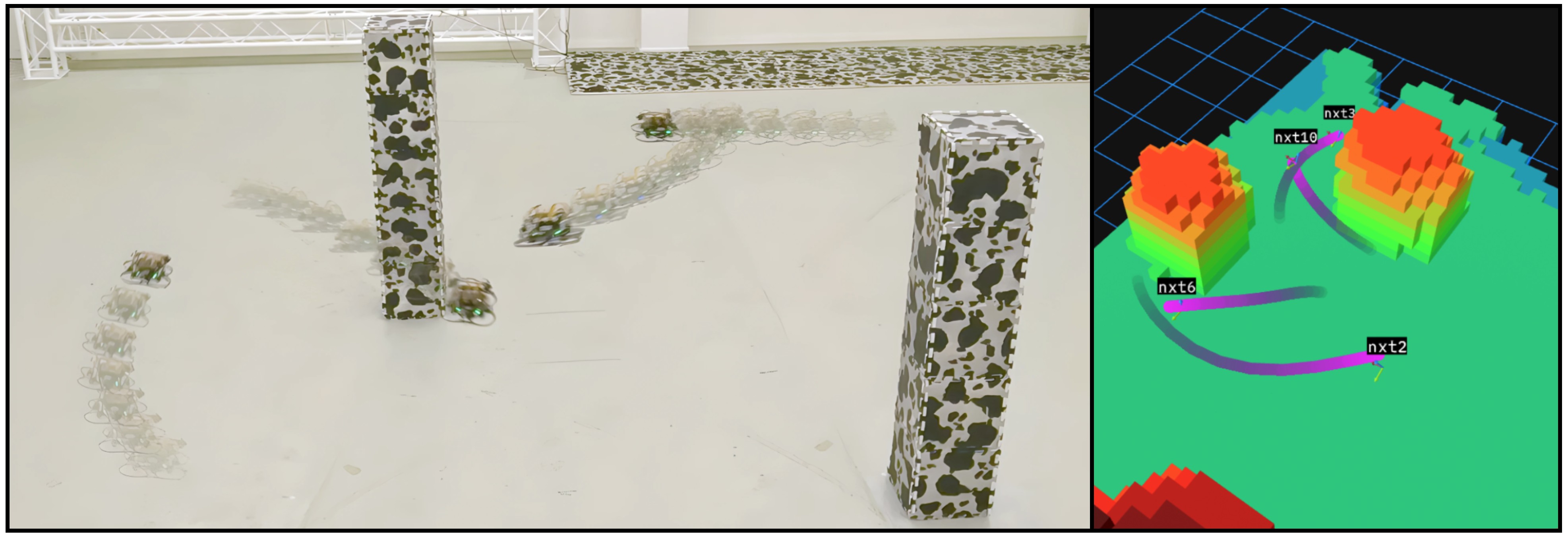
- Four drones with obstacles. Same roaming protocol, onboard stereo depth on. About 30 minutes cumulative. No hits with pillars or neighbors.
Mean tracking error sits around 0.075 m. Minimum inter-agent distance: 0.668 m with vision, 0.652 m without. Peak speed in the logs is about 5 m/s.
The planner uses a 0.45 m safety radius to cover the worst-case MPC tracking error (0.301 m in the four-drone run). Depth from S2M2 (small variant, 26.5M parameters, 256×160) runs at about 7 Hz and occupies 95% of the GPU. The authors inflate obstacles by an extra margin because depth error is about 10 cm at 2 m.
The kit
Each vehicle is 0.27 m diagonal and 660 g, same as OmniNxt. The authors quote about 2,300 CHF per drone and five hours of assembly with a video tutorial. Ansible playbooks handle hostname setup, parallel ROS 2 builds, a 20-second pre-flight check, and 30-second log pulls.
Limits they flag: motion capture is still required; current collaborative VIO is not accurate or fast enough for this agility; S2M2’s resolution struggles with small distant objects; the GPU is nearly full, so extra perception modules do not fit beside depth.
Code and docs: github.com/lis-epfl/swarm-nxt.
A Human’s Take
I like a paper that publishes the playbooks. Six drones swapping through each other’s wash is a real test; the obstacle run with noisy depth is the one I would actually reuse. The next interesting clip is the same stack outdoors, without the motion-capture hall doing the hard part.