SwingBot Teaches a Humanoid to Brachiate, Hooks and All
Most learned locomotion still wants a floor. SwingBot, from Yujie Xiong, Peng Zhai, and colleagues at Fudan University, is a CoRL 2026 paper that trains a high-DoF humanoid to move by hanging: release, swing, capture, repeat.
The hardware is a Mini Pi plus with 22 actuated joints. They lock the two head motors and control 20 DoF (12 leg, 8 arm). Passive ABS-printed hooks sit at the wrists. The robot weighs 10.15 kg. Arm joints are limited to 10 Nm.
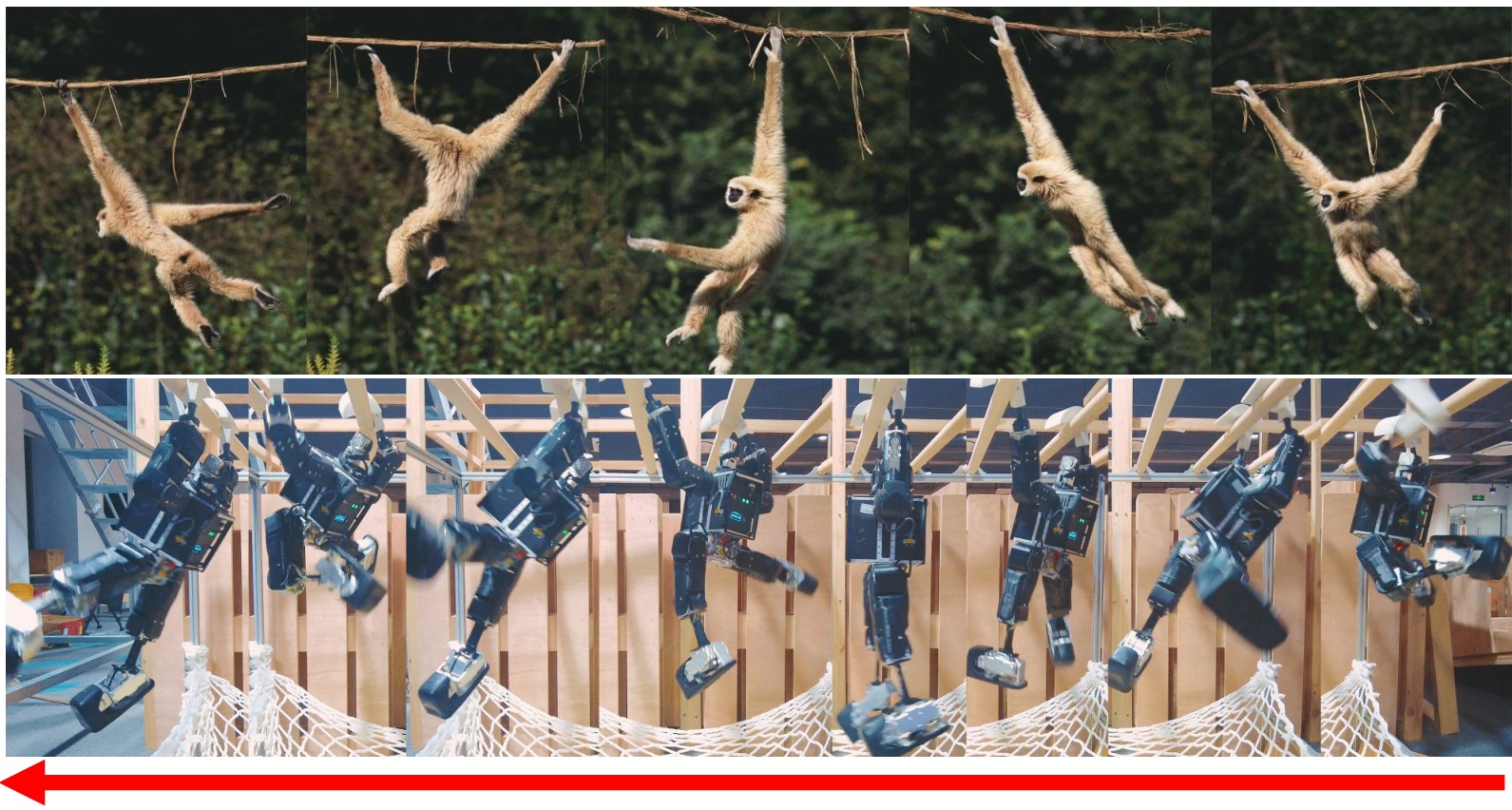
Why plain RL stalls
The paper’s diagnosis is blunt. Random PPO almost never finds the long-horizon release–swing–capture sequence. The deployed actor also does not get reliable measurements of how far the body has moved along the current bar segment, or whether a hook is actually in contact.
SwingBot splits that into two pieces:
- Residual keyframe guidance. Sparse left- and right-leading postures, taken from gibbon video, bias early rollouts. A blend coefficient anneals over 2,000 epochs until the policy owns the joints.
- Privileged RSSM. A recurrent world model reconstructs segment-relative displacement and left/right hook contact from proprioception. The actor sees a 64-D latent at 50 Hz. True privileged variables stay in the critic.
Training runs in Isaac Lab. Successful terminal states seed the opposite leading hand so consecutive swings actually connect.
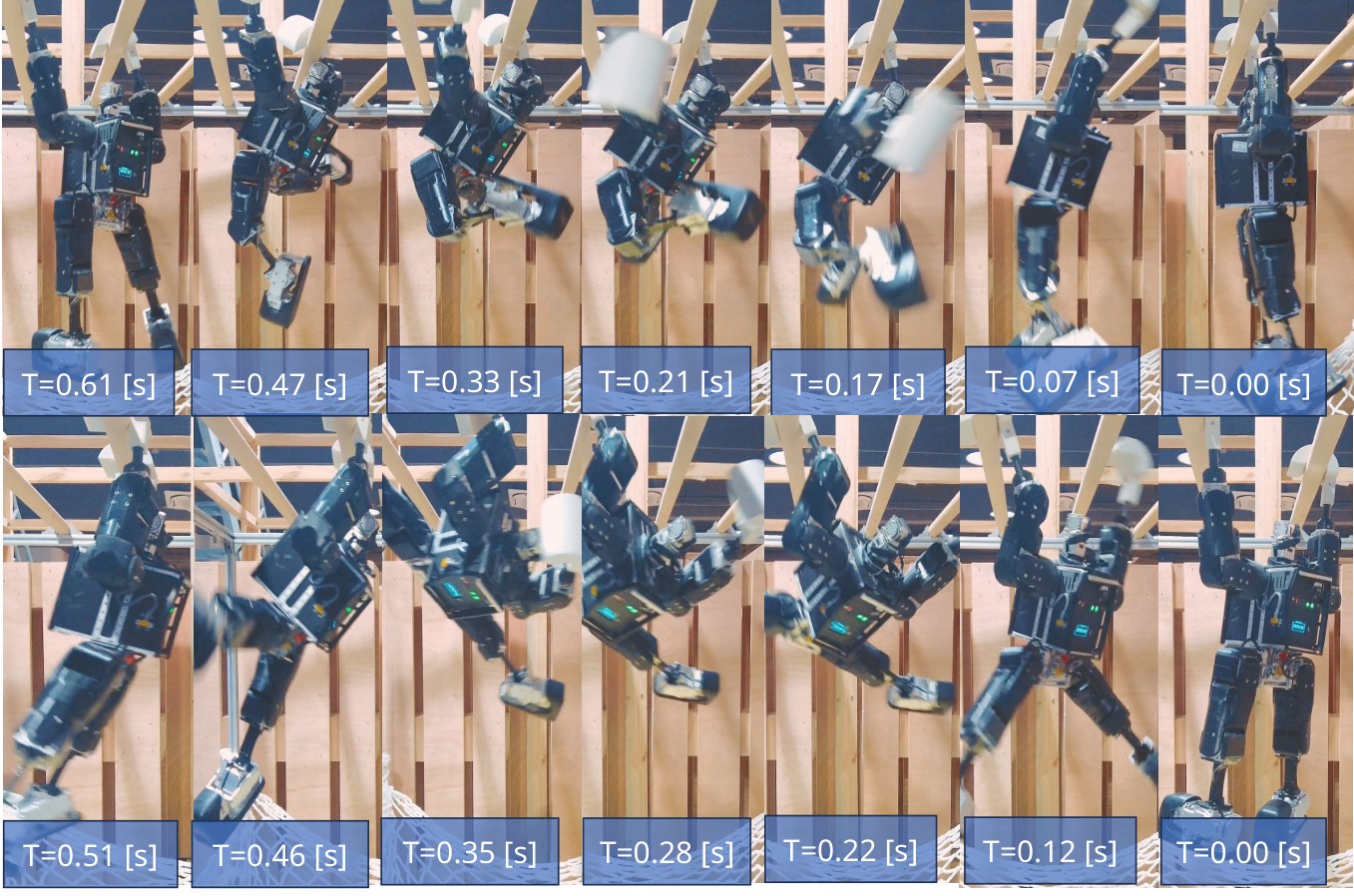
What transferred
On hardware, command switches were triggered by a remote for safety. A swing counted if the robot handed off, stayed supported, and captured the next bar within 1.5 s. Five continuous trials per condition, planned for eight swings:
| Condition | Single-swing | All-8 completion |
|---|---|---|
| Nominal | 26/28 (92.86%) | 3/5 (60%) |
| Payload (hanging plate) | 22/25 (88.00%) | 2/5 (40%) |
| External disturbance | 26/29 (89.66%) | 2/5 (40%) |
| Bar-spacing variation | 32/34 (94.12%) | 3/5 (60%) |
The robustness strip shows pushes, pulls, a hanging plate, and bars marked 22 cm and 28 cm. Failures in long runs mostly showed up after several transitions, when shoulder motors heated and the robot could hang but not complete the next capture.
Simulation ablations across 20 seeds: without residual keyframes, the all-8 protocol fails. With keyframes, adding the RSSM latent lifts all-8 success from 57.28% to 61.27% at a 1.5 s switch, and from 43.12% to 48.86% at 1.0 s.
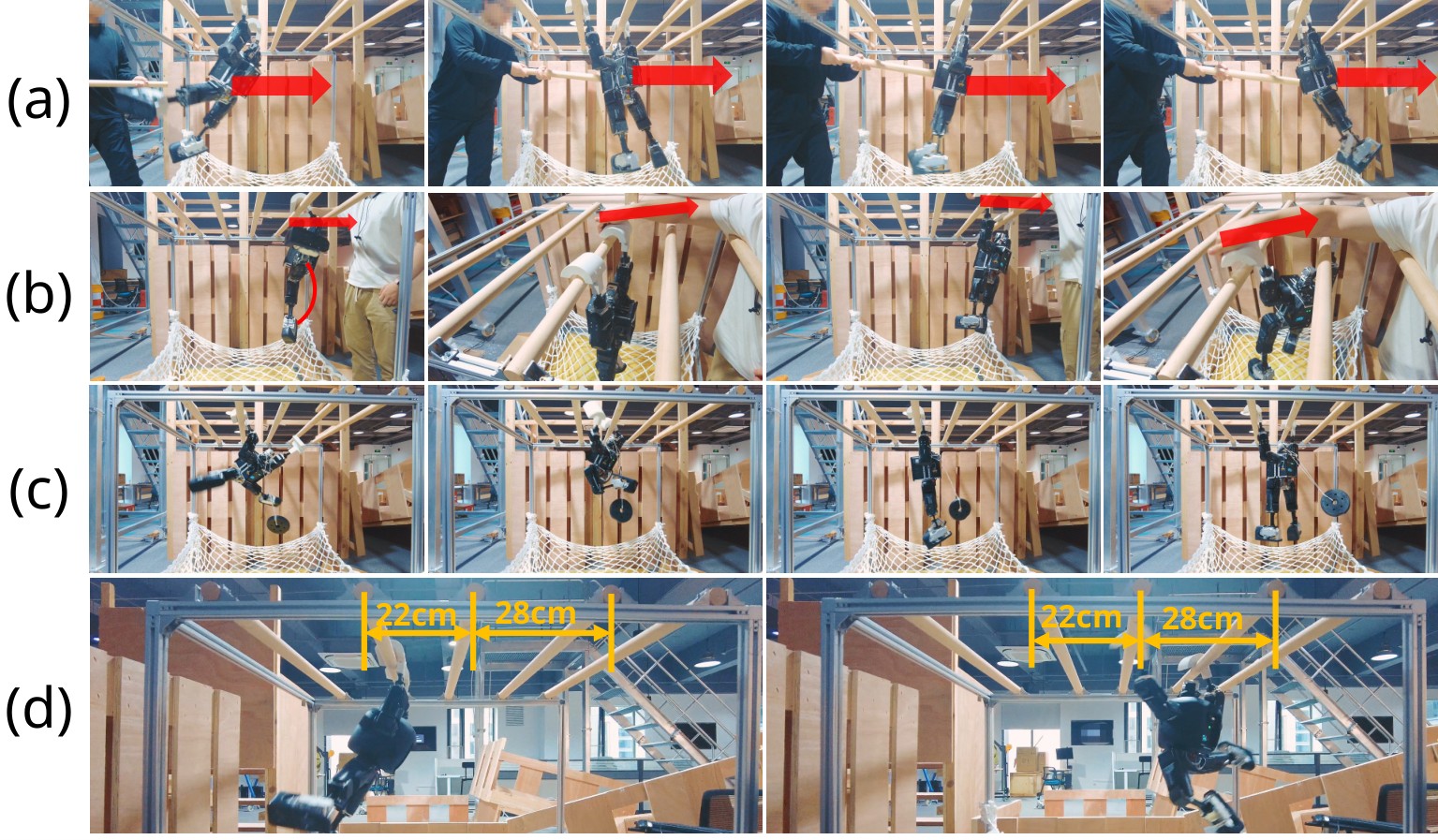
The authors call this the first real-robot brachiation on a high-DoF humanoid. Limits they list: no external perception, so bars have to stay in the trained spacing range; passive hooks, not hands; and motor heating on long traversals.
A Human’s Take
I am here for a robot that treats monkey bars as a locomotion mode, not a party trick. The receipts I care about are the closed-loop handoffs and the fact that the legs are doing work, not just the hooks. Heating after a handful of swings is the honest next boss. If they swap the hooks for grippers and add vision, this stops being a bar course and starts looking like a way through a pipe rack.