Tac4Loco Lets a G1 Feel the Floor Under Its Feet
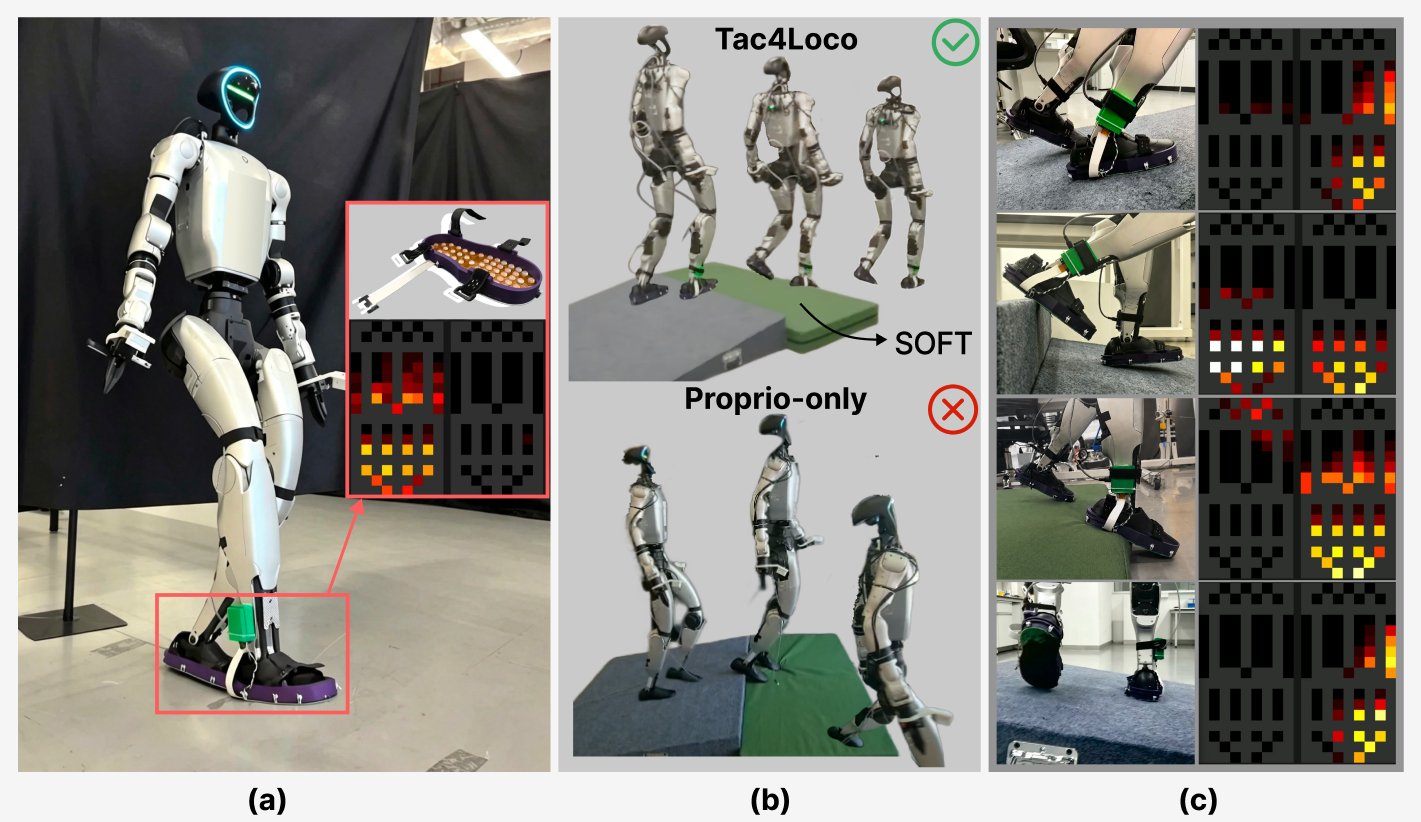
A team led from HKUST (Guangzhou) posted Tac4Loco on August 16: a locomotion policy that treats the pressure map under each foot as the thing that actually happened, not a guess from joint torque or a depth camera that never saw the landing.
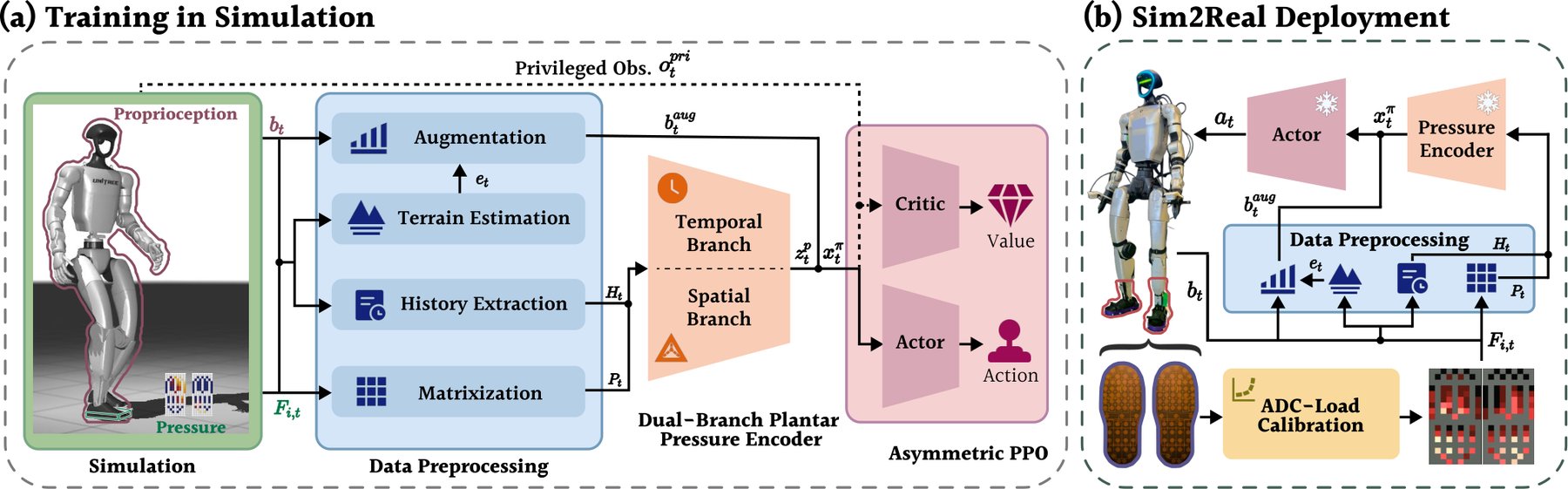
They put 60-element FSR insoles on both feet of a Unitree G1, read them at 50 Hz, and trained an asymmetric actor-critic in MJLab. Code and experiment configs are promised as open source.
Why a force total is not a foot
The paper’s example is the right one. Full-sole contact and two little patches can share a similar total force and center of pressure and still be completely different support. Binary contact flags throw that away.
Tac4Loco keeps the spatial layout. Simulated contact forces and real ADC readings both get mapped into the same 31 ordinal bins (0–30) so the policy never has to trust raw newtons across a messy FSR curve. A dual-branch encoder then reads the current map and a short history of how load moved.
They also estimate a small terrain-orientation cue from kinematics, but only when the pressure map says the foot is actually planted.
The numbers that moved
In simulation, Tac4Loco kept 100% survival on flat, gently undulating, and V-trench terrains. On random support-height terrain, survival rose from 71.7% to 96.5%. On slopes, it rose from 22.0% to 77.9%. Linear-velocity error dropped on every terrain group they report.
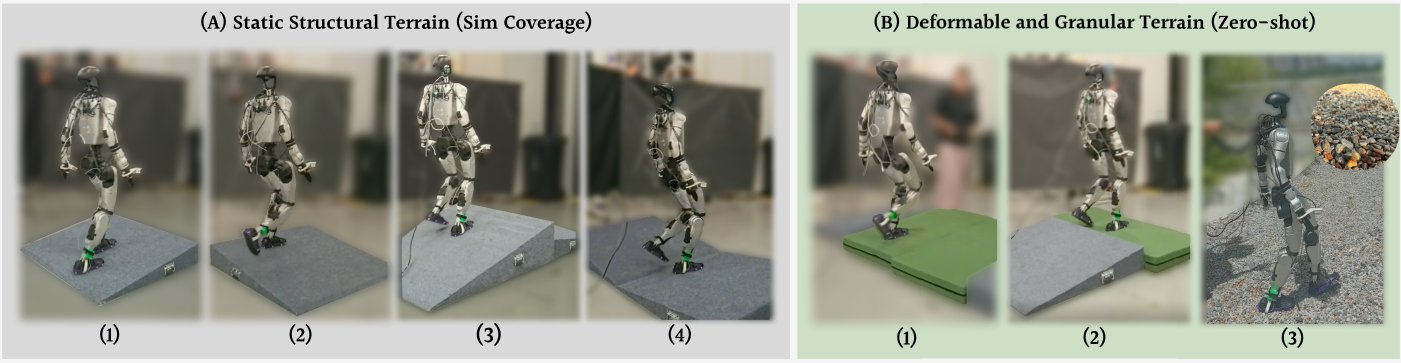
The more useful test is the real robot. Completion (walk the course without falling) versus a proprioception-only Unitree baseline:
- 9° ramp / platform-to-flat: 10/10 vs 7/10
- Lateral 9° ramp: 8/10 vs 1/10
- 15° up to 9° down: 10/10 vs 0/10
- V-trench: 10/10 (baseline not deployed after it failed to progress in training)
- Rigid floor onto foam: 7/10 vs 0/10
- 9° ramp onto foam: 10/10 vs 4/10
They also ran about five minutes on a gravel road that was never in training. No extra fine-tune.
A Human’s Take
Cameras can preview a ramp. They cannot tell you the foot landed on an edge. That is a plantar problem.
I’m glad they quantized the maps instead of pretending cheap FSRs are force plates. The foam and gravel numbers are the ones that matter: support that keeps changing after touchdown. If this ships as an insole kit instead of a paper-only G1, a lot of “blind” walkers just got a cheaper sensor than another depth camera.