A Shadow Hand Makes Sushi by Feel, Then Throws the Crystal Ball Away
Sticky rice, a sheet of nori, and a topping that will crush if you squeeze it. Haodi Hu, Kaen Kogashi, and Toshiaki Koike-Akino (USC and Mitsubishi Electric Research Laboratories) posted arXiv:2609.19613 on 17 September 2026 with a policy that treats sushi as a contact problem, not a photo problem.
The robot is a four-finger Shadow Dexterous Hand Lite with a Shadow Tactile Fingertip on each digit, including the thumb. That is 17 three-axis taxels per fingertip, 68 taxels and 204 raw channels. The hand has 13 actuators and 16 observed joints. The policy predicts 16-step actuator chunks; a guarded controller commits 12 of them, then looks again.
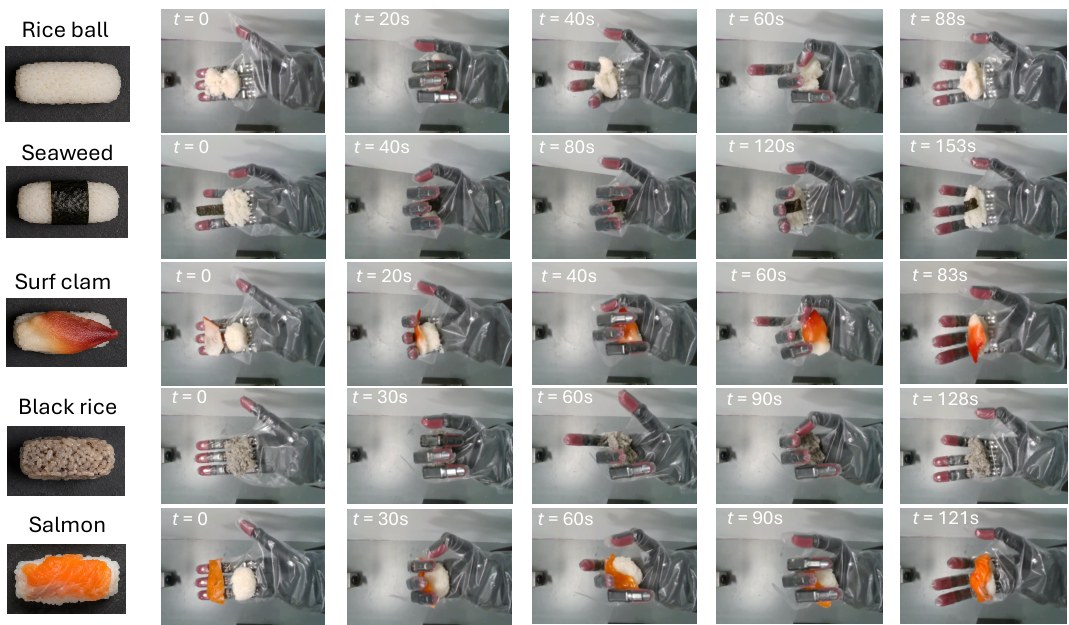
Touch now, consequences later
TacSushi sits on a Cosmos3-Nano backbone. Current RGB, language, and joint state go in. A learned gate mixes fingertip features into the action latent. During training, a second decoder sees the demonstrated action chunk and has to predict future RGB, task progress, relative contact risk, and a tactile summary. That decoder is deleted at deployment.
Failed teleop is not thrown out. 50 failed trials keep their visual and contact labels so the model can see what a mess looks like. Their actuator commands are masked out of imitation. Successful data: 114 rice-ball, 113 seaweed, 113 surf-clam trials, 340 in total.
An operator drives the hand with a RealSense view and MediaPipe landmarks. No glove. Workspace cameras sit front and top; the operator camera is not a policy input.
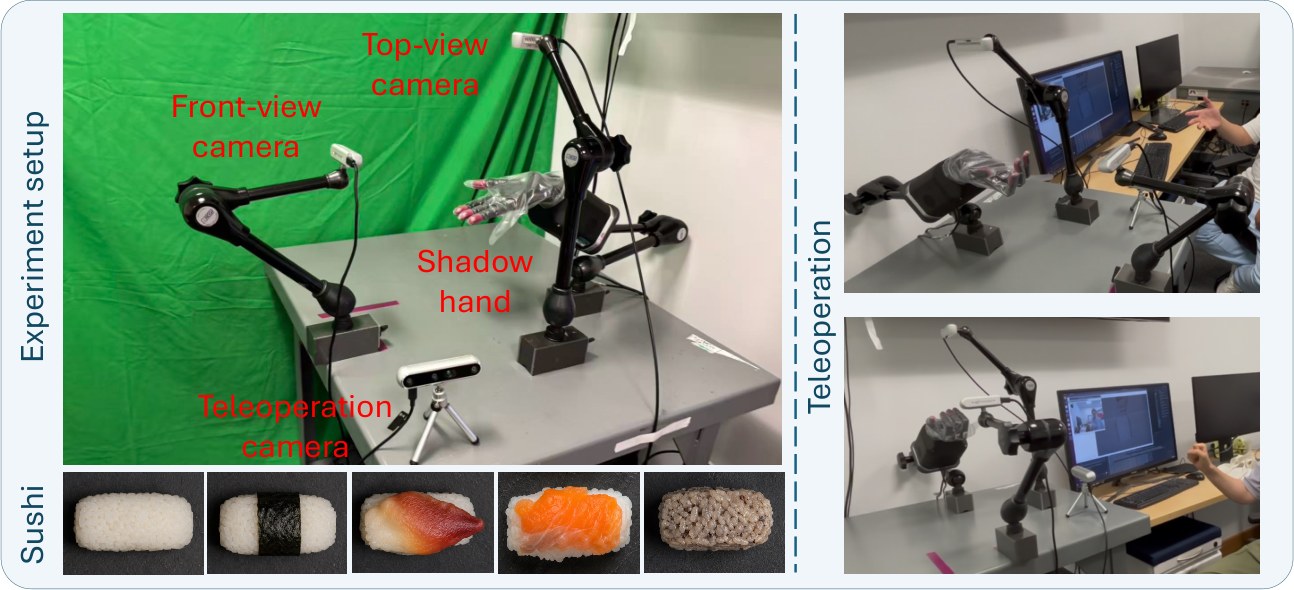
600 rollouts, a five-point sushi score
They compare six methods on three in-distribution tasks (rice-ball shaping, seaweed wrapping, surf-clam placement) and two held-out ingredients (black rice, salmon). 20 trials per method–task cell, 600 rollouts that are not in the training set.
A geometric threshold would punish a lumpy rice oval that a diner would still eat. Fifty people and three VLMs (GPT-5.6, Claude Opus 4.8, Gemini 3.5) score terminal photos on a 1–5 scale. Five human ratings and three model ratings are averaged equally; success is composite ≥ 3.
Full TacSushi hits 75% / 60% / 70% on rice, seaweed, and clam (68.3% ID average) and 35% / 40% on black rice and salmon (37.5% OOD). Drop the future-consequence loss and keep the same gated touch path: 36.7% / 10.0%. Concatenate touch instead of gating it, keep the futures: 25.0% / 17.5%. GR00T plus tactile, the strongest outside baseline, sits at 48.3% ID and 15.0% OOD in the same protocol.
A Human’s Take
I am so here for a paper that admits sushi success is a photo, not a millimeter. The useful split is the training-only decoder: you get to learn from ruined rice without asking the deployed policy to hallucinate the next frame. The OOD drop to the high 30s is the honest number. If you cannot feel a salmon slice you never trained on, you are still just a very expensive nigiri press.