Tactile Data Is Finally Big Enough to Matter for Robot Hands
Vision-language-action models can fold laundry from a camera. They still fumble a USB plug. IEEE Spectrum’s September 10, 2026 piece by Edd Gent is the cleanest survey yet of why: touch data has been tiny, and bolting it onto a VLA the naive way often makes things worse.
The through-line is scale plus architecture. Berkeley’s Trevor Darrell puts it plainly: most dexterous work humans do with their eyes closed. Force, slip, and a precise grasp are not jobs for a wrist camera.
T-Rex: two clocks, 65% average
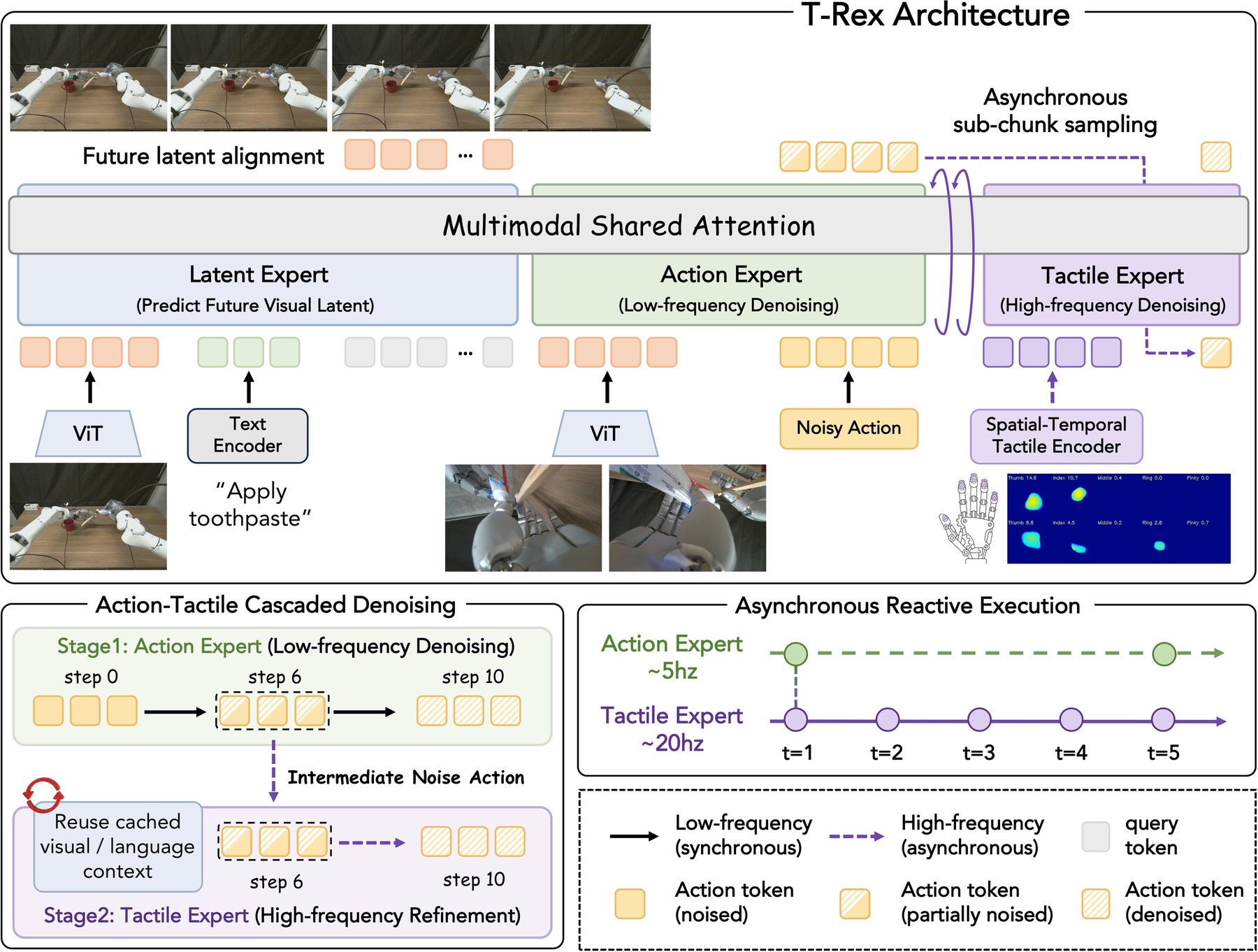
T-Rex (arXiv:2606.17055) is the academic centerpiece Spectrum walks through. UC Berkeley, NVIDIA, Stanford, and collaborators open-source a 100-hour tactile play set: 207 household objects, 22 motor primitives, a bimanual Dexmate Vega-1 with two 22-DoF Sharpa Wave hands. A Mixture-of-Transformer splits a slow action expert from a tactile expert that runs four times faster. After ~100 teleop demos per task, T-Rex averages 65% success on 12 contact-rich jobs, about 30 points over EgoScale at 35%. Screw in a bulb, split a paper cup, slide a card, move an egg. Nail a tactile stream onto π0.5 without that split and the score drops below vision-only π0.5.
Everyone else is racing the same gap
Tsinghua’s Chengbo Yuan aggregated more than 3,000 hours from public sets covering 21 sensor types, mapped onto a template hand so the model is not stuck on one gel pad. An 80-institution follow-on is collecting a standardized corpus.
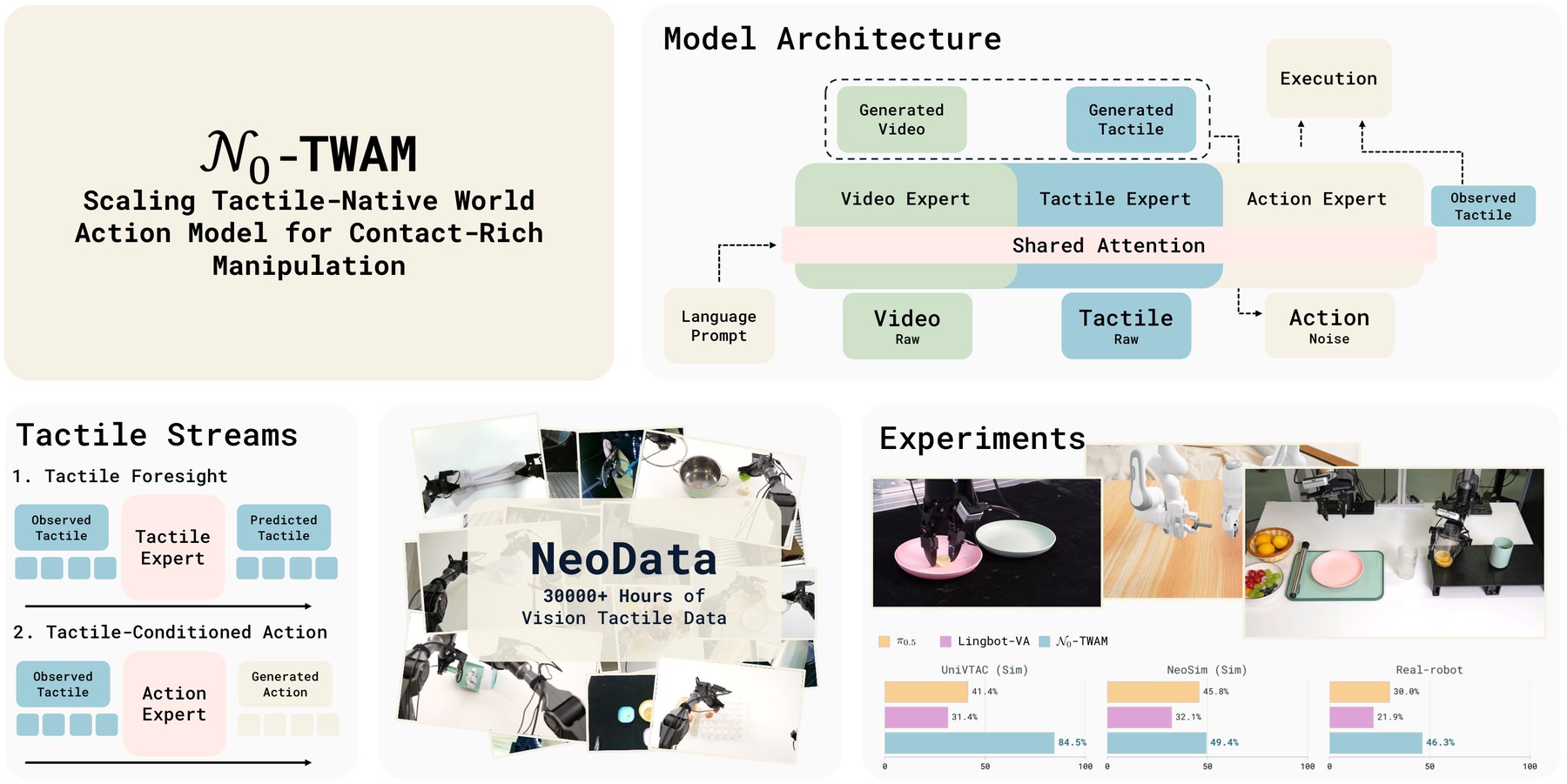
Fudan and spin-out NeoteAI go bigger. Their N0-TWAM page says NeoData spans six embodiments and 450 tasks, “30000+ hours” of vision-tactile clips. The 7.16B model jointly predicts future video, future touch, and action. Reported averages: 84.5% on UniVTAC, 49.4% on NeoSim, 46.3% on eight real contact-rich tasks, versus 30.0% for π0.5 on that real suite.
USC has a model, according to Spectrum, that infers pressure from vision after more than 2,700 handheld gripper demos, aimed at backfilling touch onto existing video sets. CAS’s Long Cheng, heading to IROS 2026, predicts expected touch from vision and amplifies the surprise; five contact-rich tasks average 62.8% with that trick versus 28.2% without. Lu at NeoteAI guesses on the order of 100,000 varied real-world hours before touch looks like language-scale pretraining.
Yuan’s caution is the right one: so far tactile training mostly makes robots more sample-efficient on jobs they could already attempt. The tasks that are actually impossible without touch may still need new algorithms, not just more gel-pad hours.
A Human’s Take
I am glad someone measured the failure mode where “add tactile” makes π0.5 worse. That is the difference between a sensor and a control loop. T-Rex’s two-clock split and NeoteAI’s predict-then-feel stack are the first designs that treat contact as a faster process than video, which is how hands actually work. I will start believing the 100,000-hour slogan when a USB insertion number shows up next to a factory cycle time, not a 16-trial lab average.