τ0-VLA Thinks About the Next Subtask Before It Commits
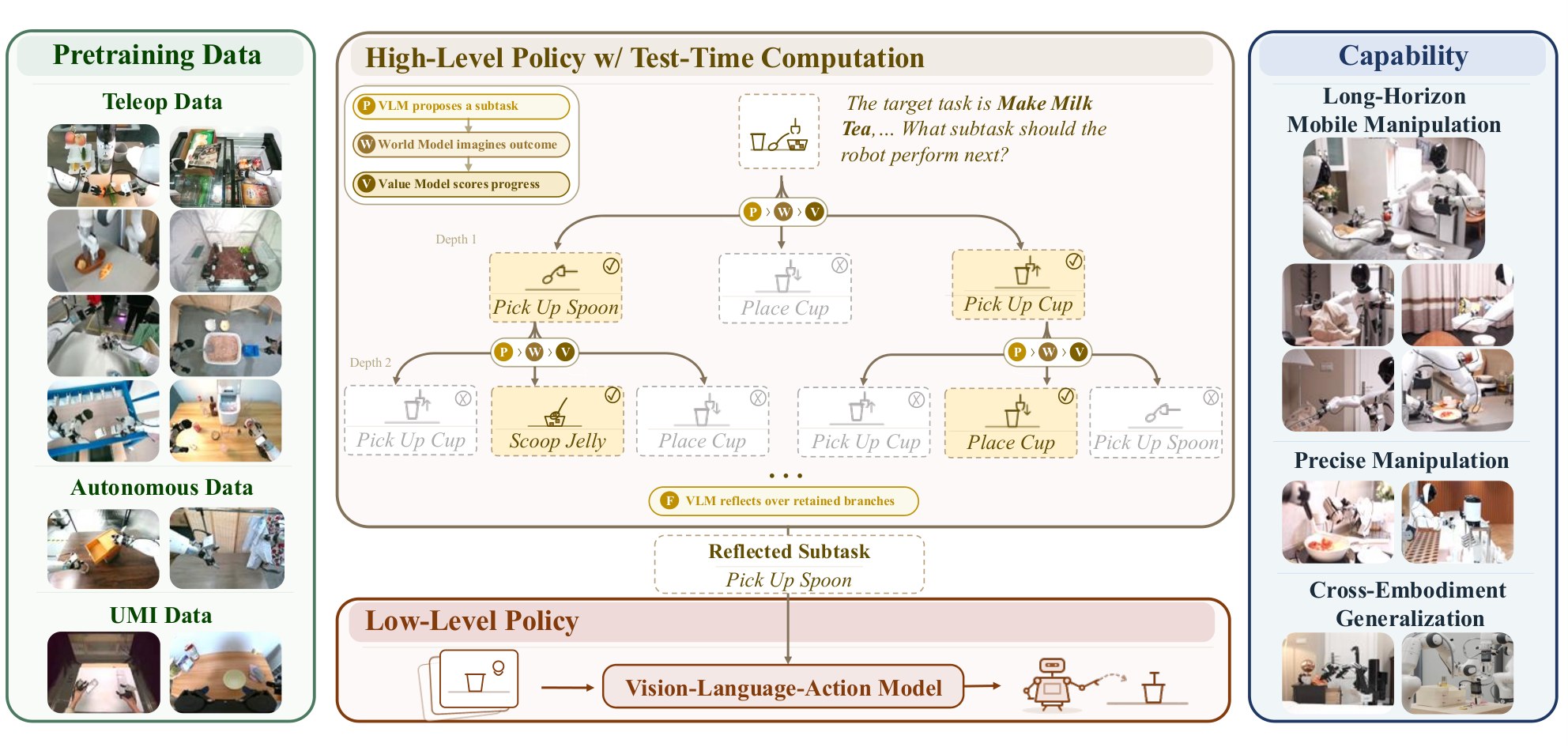
Long-horizon robot work fails at the decision, not the wrist. τ0-VLA, from Agibot Finch, Shanghai Innovation Institute, and CUHK, treats the next subtask as something you can spend extra compute on: propose options, imagine the camera view each would produce, score them, then commit.
The low-level policy sits on 40,115 hours of heterogeneous real-world robot data, plus multimodal co-training. A unified 40-dimensional state/action space covers arms, grippers, waist, and a mobile base.
Two clocks
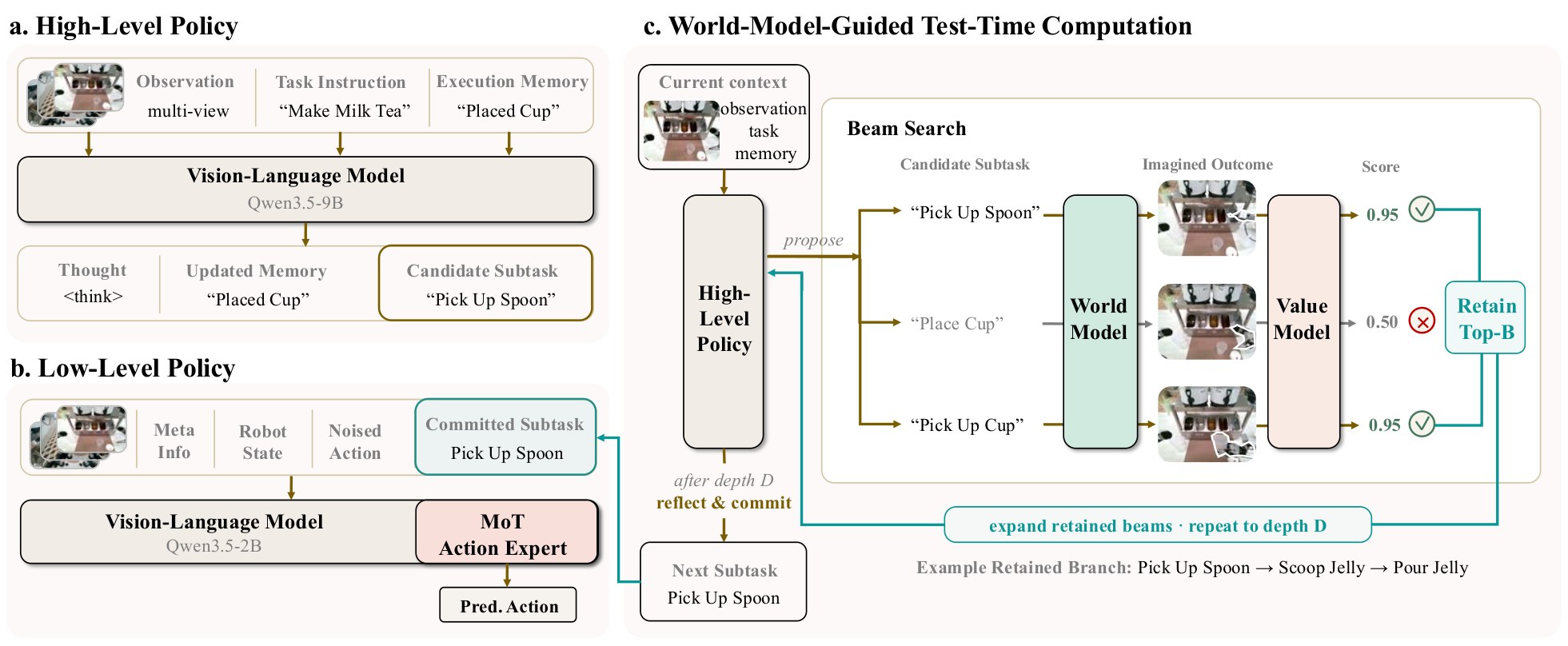
A high-level policy (Qwen3.5-9B class) keeps an execution memory and, when token confidence is low, runs world-model-guided beam search. A reflective model writes the subtask. The low-level policy (Qwen3.5-2B backbone plus a Mixture-of-Transformers action expert) then runs that subtask.
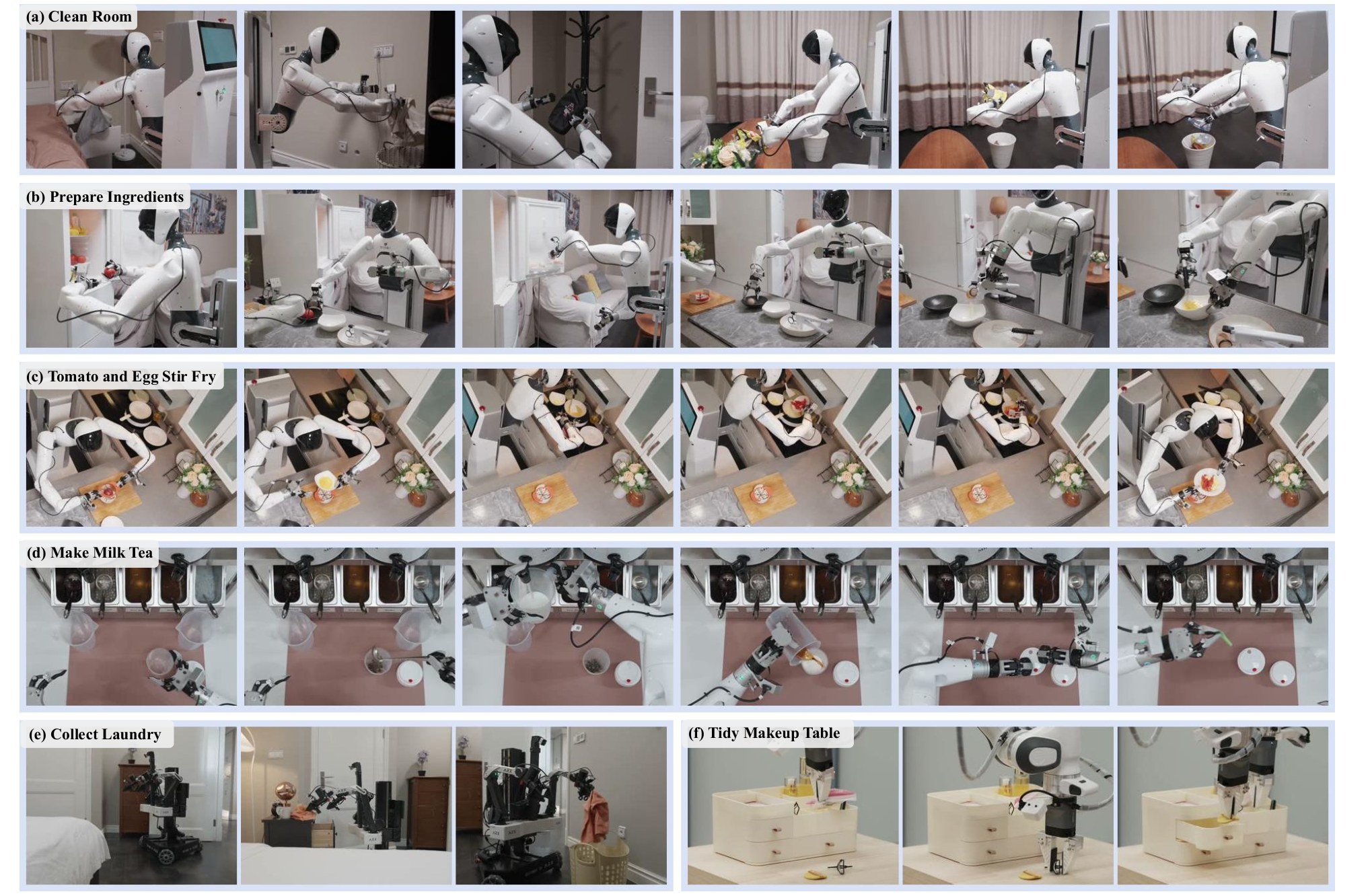
The project page puts the hierarchical “Plan Once” system at 45.0% average success across four long-horizon physical tasks, versus 27.5% when the same low-level policy is fed the full instruction with no high-level loop. Ten trials per task, on AGIBOT G1:
| Method | Clean Room | Prep Ingredients | Stir Fry | Milk Tea | Avg. |
|---|---|---|---|---|---|
| GR00T N1.7 | 0/10 | 1/10 | 0/10 | 0/10 | 2.5% |
| π0.5 | 4/10 | 2/10 | 0/10 | 3/10 | 22.5% |
| τ0-VLA (direct) | 4/10 | 2/10 | 0/10 | 5/10 | 27.5% |
| Hierarchical, Plan Once | 5/10 | 4/10 | 4/10 | 5/10 | 45.0% |
Episodes run up to about 12 minutes. Clean Room is 25 steps; tomato-and-egg stir fry is 22; milk tea is 13.
Extra compute, when it is unsure
Test-time computation (TTC) raises next-subtask accuracy 15–24 percentage points on the project page’s summary. On unseen Book Organization layouts, TTC hits 74.0% next-subtask accuracy versus 50.0% for a single plan and 57.5% for Best-of-N.
Closed-loop, with the low-level policy fixed: milk tea 7/10 vs 5/10, Book Organization 9/10 vs 6/10, Clean Room 7/10 vs 5/10. Milk-tea progress moves to 95.38%; leftover misses are lid and straw.
A correctable memory, trained by perturbing demo histories, adds 11.0 points of next-subtask accuracy. Direct execution on shorter tasks still works across bodies: 10/10 Collect Laundry on ARX AC One, and strong scores on a bimanual Franka makeup-table set.
A Human’s Take
Searching in subtask language instead of joint space is the right grain for a 10-minute kitchen job. Salt that does not change the image is exactly the kind of step a memory has to own.
Forty thousand hours is a lot of metal. The number I care about is still 4/10 on stir-fry even with the hierarchy. Extra test-time compute helps the planner. The lid and the straw are still a contact problem.