A Custom Gripper and Four Wrist Cameras Won WBCD’s T-Shirt Track
RMC2, a TermiTech team out of Shenzhen, took first place in Track 4 of the 2026 What Bimanuals Can Do (WBCD) challenge with a fully autonomous T-shirt loader. Their technical report, posted to arXiv on August 11, says the dual-arm ARX X5 cell loaded 25 shirts at about 23 seconds per attempt and put 22 of them in the required smoothness band.
WBCD ran at ICRA 2026 in Vienna (June 1–5), with remote sites in Shanghai and Silicon Valley. Track 4 is a print-shop job: pick one shirt from a stack, drop it on a pallet, line up the collar, and flatten the print area.
Hardware first, then the policy
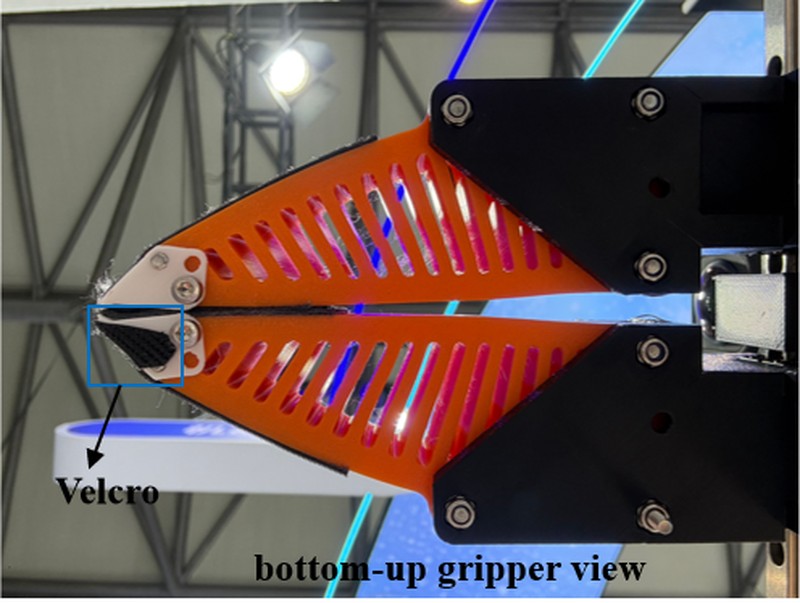
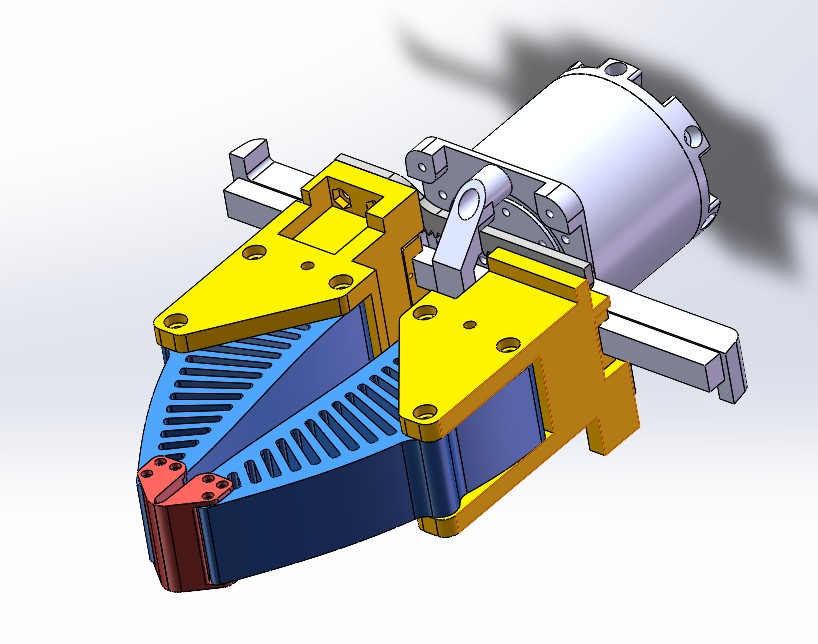
The paper’s argument is that hardware, cameras, and data should shrink the contact mess the policy has to learn. The 3D-printed gripper has three tricks:
- Hard fingertips instead of soft pads, so the top layer actually lifts
- Hook-side Velcro on one face to peel that layer open
- Inward-angled jaws that close tighter and hold fabric during the carry
They also taped the pallet’s rough wood edges, added a 3D-printed cover over protruding screws, and put high-contrast tape plus a patterned tablecloth under the white shirts so the cameras could see a hem.
Four views, mixed demos, 30-step chunks
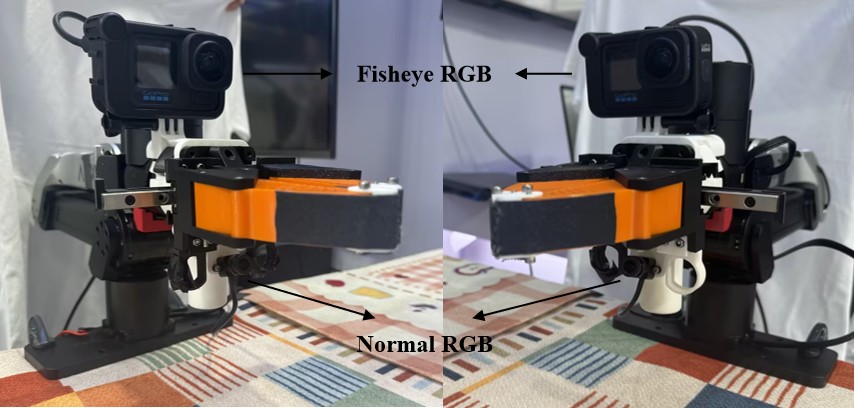
Each arm has two wrist cameras: a 1920×1080 fisheye up top and a 320×240 RGB camera looking at the pinch. All four streams are resized to 224×224 before the policy. The lower pair is there so the model can see whether it grabbed one layer or two.
They mixed 600 portable UMI-style episodes with 500 real-robot episodes collected by dragging the ARX arms in force-compensation mode. After filtering, training used about 200 UMI and 400 real-robot episodes. UMI episodes only have the fisheye views. Competition inference used a four-view prompt.
TCAM (TermiBrain Causal Action Model) is their closed loop: run, tag why a shirt failed (missed edge, double-pick, slip, wrinkle, over-smoothing), stash that in a trajectory memory, then recollect and retrain. The policy emits 30-step end-effector delta-pose chunks for both arms.
WBCD scoring pays +5 for pick-and-load, +2.5 for collar alignment, +2.5 for a smooth print area, and multiplies by ×4 for full autonomy. Double-picks and human hands in the loop cost −5. The team ran the policy without teleop during each cycle, but a human still aborted hopeless attempts to save time. Alignment-specific demos were thin; few attempts scored full alignment.
A Human’s Take
I like that they treated the gripper as part of the learning problem. Velcro and a cheap camera aimed at the pinch are not glamorous, and they are why 22 of 25 shirts were flat enough to print. The leftover confession is honest: alignment data was short, and a person still decided when to quit. That is a win on a timed factory-ish task. It is not yet a cell that can babysit itself through a bad wrinkle.