Twisted Yarns Become Pressure-and-Proximity Robot Skin
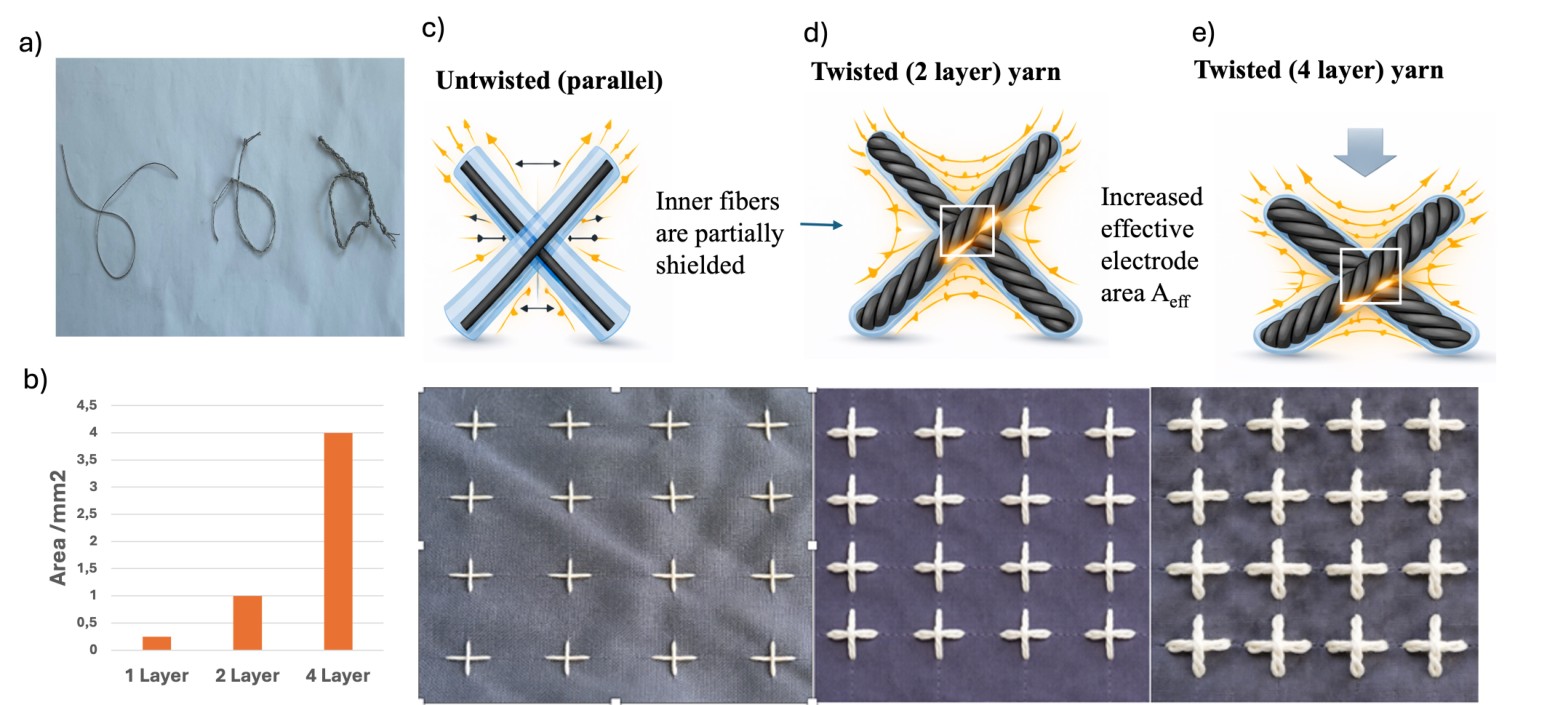
A new instrumentation paper from V-Trion GmbH in Lustenau and ZHAW in Winterthur treats yarn twist as the design knob for robot skin. Silver-coated Shieldex yarns get a ~0.2 mm PDMS sheath, then get twisted into 1-, 2-, or 4-layer bundles and stitched onto polyester as a grid.
Each crossing is a capacitor. Squeeze it and the overlap grows while the gap shrinks. The paper’s point is that you can tune pressure sensitivity and proximity range by changing only how many fibers you twist, not the chemistry.
The numbers they actually measured
Pressure is referenced to the fiber junction, about 0.07 mm², not the whole patch. That puts the test loads at 0.4–3.9 MPa.
Going from one layer to four:
- Elongation at break: 37.5% → 62.5% → 85.0%
- Max load: 23.3 N → 42.7 N → 89.7 N
- Effective contact area: 0.25 → 1.0 → 4.0 mm² (16×)
- Peak sensitivity: 0.1331 MPa⁻¹ on the four-layer sensor at 100 kHz
- Proximity range: 60 mm / 50 mm / 40 mm for 1 / 2 / 4 layers
That last line is the trade-off. More twist packs the electrodes, which is better for contact and worse for the fringe field that sees a hand coming. The four-layer build also ran 15,000 load cycles, showed low hysteresis, and held baseline from 25 to 90 °C. Rise and recovery under a 100 g step sit around 0.9 s.
The grid pitch is about 10 mm, active area 30 × 30 mm². Yarn feed during coating is 10 m/min at 80 °C.
On a Franka, not just an LCR meter
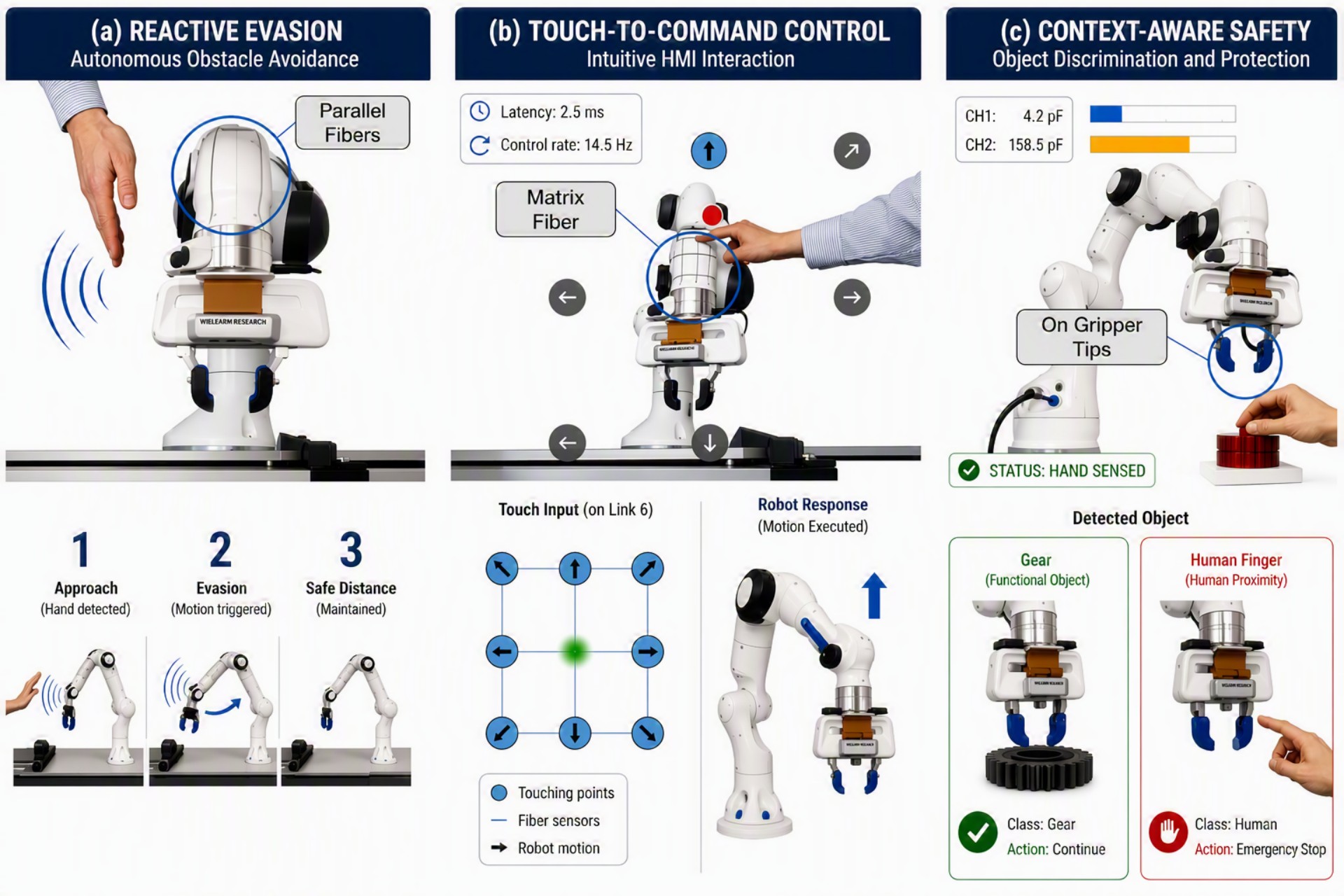
They sewed the yarns onto a Franka Emika Panda and ran three demos:
- proximity-triggered evasion when a hand approaches
- touch mapped to directional arm commands
- a threshold that treats a metal gear as work and a finger as a stop
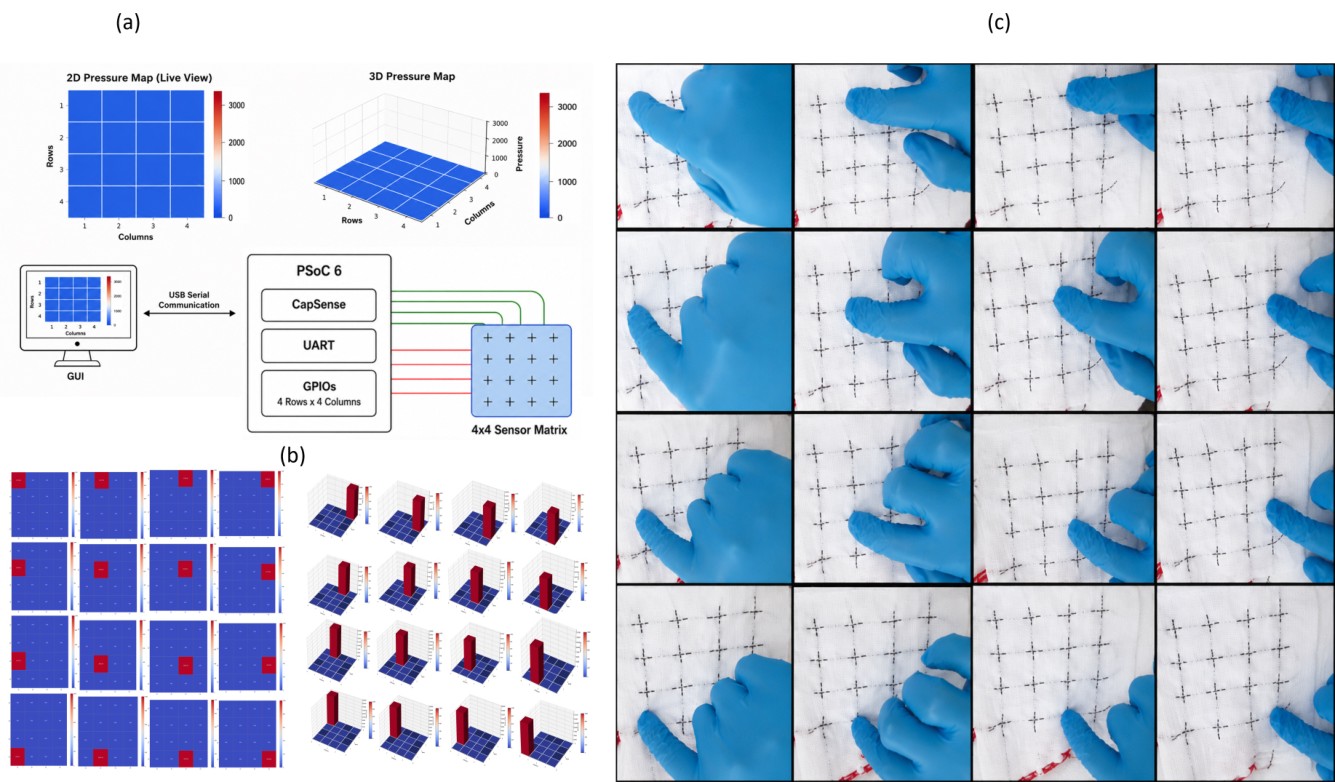
End-to-end latency from detection through processing, serial comms, and motion is 403 ms. Readout used an FDC1004 plus an M5STACK on the arm, and a PSoC 6 CapSense board for the 4×4 heatmap.
The work is submitted to IEEE Transactions on Instrumentation and Measurement. Funding is the SmartSense AI Eurostars project (No. 3087).
A Human’s Take
403 milliseconds is not a reflex. It is still fast enough to prove the skin is not just a sweater with a data sheet. The useful bit is the twist-count trade: four layers for a fingertip, one layer if you want a 60 mm halo. If this stuff survives oil, sweat, and a year of cable flex, I will care. Until then it is a clean geometry result on a Panda.