TRACE: Legged Odometry When Contacts Lie
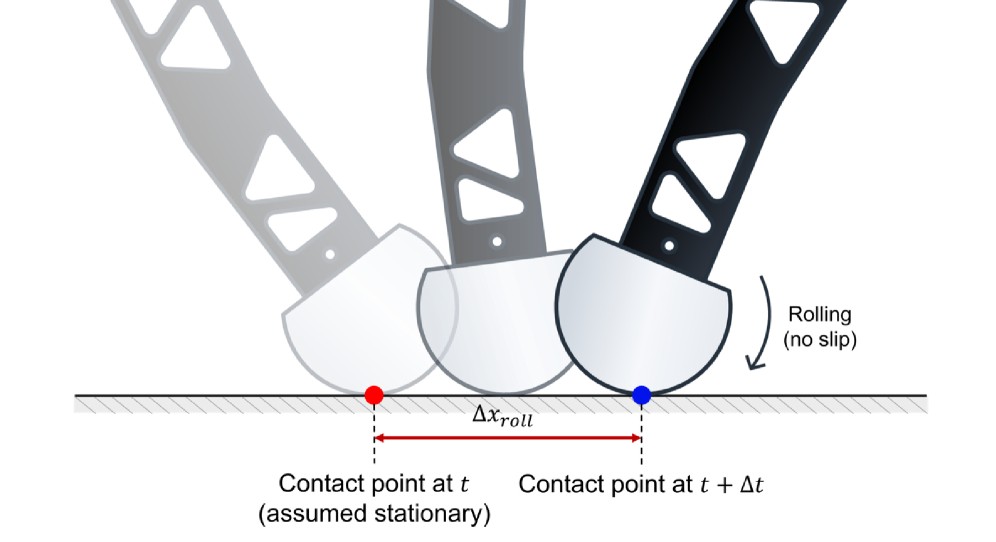
Classic legged odometry assumes you know when a foot is planted. Soft mats, mud, and partial slips break that assumption. TRACE (Tokenized Robust Attention for Contact-Aware Estimation), from Taehyeon Kong, Woojin Kim, and Jemin Hwangbo at KAIST and posted August 6, 2026 (arXiv:2608.05975), is a learned proprioceptive estimator built for unreliable contact.
What TRACE predicts
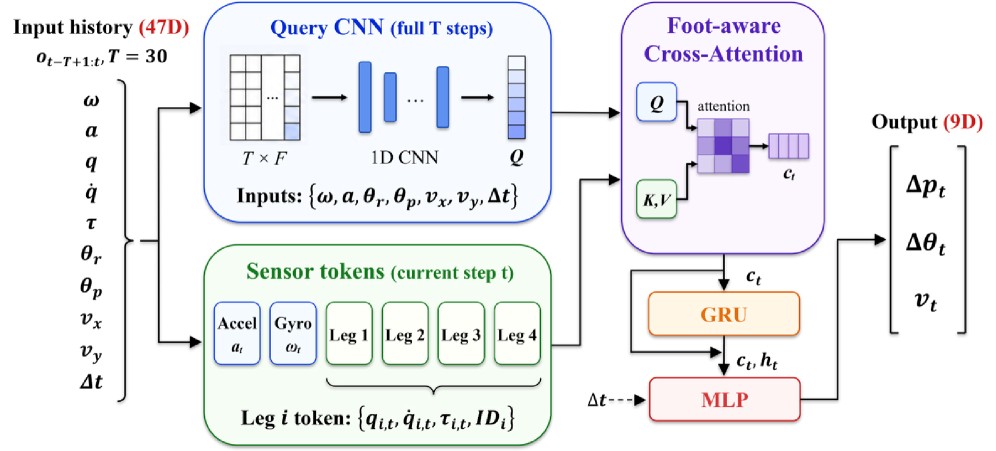
From a short history of onboard inertial and joint measurements, TRACE directly predicts:
- relative displacement
- relative rotation
- body-frame velocity
A foot-aware cross-attention module adaptively weights IMU and leg-wise kinematic tokens without hand-tuned contact or slip thresholds. Training uses direct supervision plus two physics-inspired auxiliary losses for kinematic consistency and reliable use of leg information. To cut policy-specific overfitting, simulation training uses policy randomization, then partial real-world fine-tuning of the temporal encoder and prediction head.
Field picture
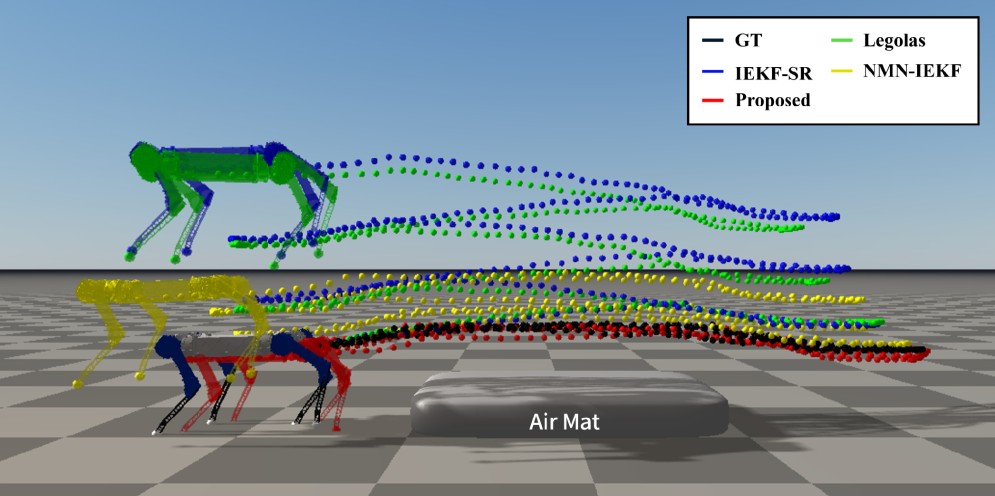
Experiments across indoor and outdoor terrains report consistent reductions in position drift versus classical filtering, hybrid, and purely learning-based baselines. Ablations back the training objectives, policy randomization, and real-world fine-tuning, especially under unreliable contacts and sim-to-real mismatch. The paper is submitted to IEEE RA-L (8 pages, 7 figures).
A Human’s Take
I’m glad someone attacked the air-mat case instead of only hard-floor lab runs. If your humanoid or quadruped is going to work outside a polished demo floor, proprioceptive drift under soft contact is the unsexy bug that kills maps. TRACE’s “no manual contact threshold” stance is what I want bolted under the next parkour stack.