TraceFlow Turns Failed Packing Runs Into the Next Grasp
A frozen vision-language-action policy cannot change today’s action chunk because yesterday’s grasp failed. TraceFlow gives it that input with nothing but a terminal success/fail bit.
Jiaxuan Zhang, Ruizhe Liu, Yu Zhang, and Yanchao Yang at the University of Hong Kong posted arXiv 2609.20646 on 17 September 2026. The hardware is an ARX AC-One dual-arm cell. The frozen backbone is π0.5.

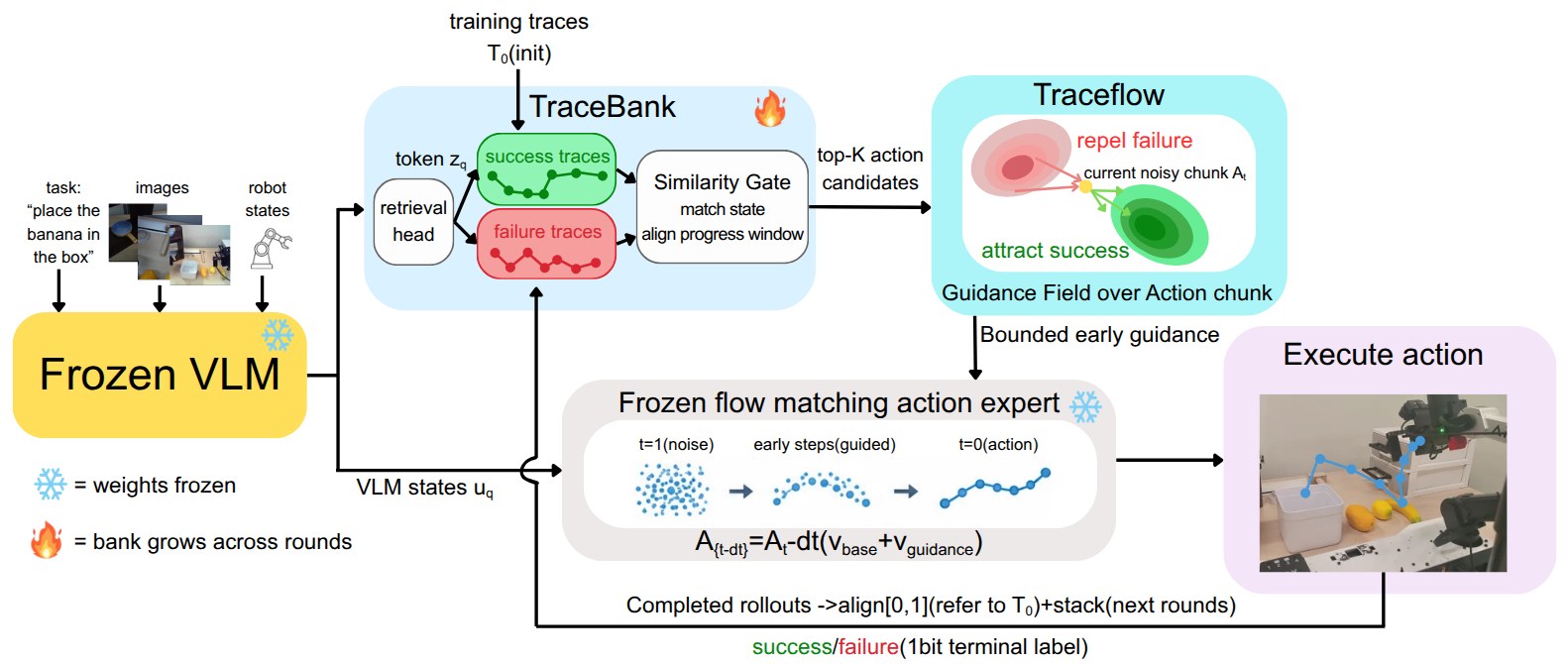
A bank of traces, not a new network
TraceBank stores time-ordered state–action records plus that one bit. A frozen retrieval head matches the current VLM state. A similarity gate pulls the top successful and failed windows. A bounded field then nudges early flow-matching steps toward success actions and away from failure actions, then drops to zero so the base expert finishes contact.
No critic, verifier, or dynamics model. No weight update. After a round, new rollouts can enter the bank.
Where it moved the number
On ordered three-fruit packing (T2), the frozen baseline completed 21 of 50 trials in order, with 20 wrong-sequence episodes. TraceFlow hit 39 of 50 with 2 wrong-sequence runs. After one stacking round of the robot’s own traces, still with frozen weights, the score was 47 of 50 and 0 wrong-sequence.
T1 (tape then hammer) went from 8/50 to 16/50. T3 (six-stage drawers) is 1/10 complete versus 0/10, on ten trials; the paper calls that descriptive.
Simulation is picky. With per-suite settings, RoboMemArena Sequence rises from 78.92% to 91.50% task success. Transferring goes from 54.41% to 62.00% at stacking round 2. The 26-task aggregate is flat (34.92 to 34.99). Counting and Occlusion drop by 1.12 and 1.42 points. LIBERO-Plus (Long) is +1.27 points (p = 0.0733). Every stacking branch in the ten-round study peaked before round ten.
The authors do not run a head-to-head against other test-time guides. The only baseline is the same checkpoint with the field off.
A Human’s Take
21 to 47 on a packing order, with the weights locked, is the kind of result I will actually argue about. The same method hurting Counting and Occlusion is the other half of the story. If your failure is “wrong drawer, same motion,” a fail bit helps. If the policy never saw the event, the bank cannot invent it.