ugo Nova Drills Under Remote Control at Tokyo’s Physical AI Day
Tokyo hosted a one-day physical AI summit on 16 September. Euronews sent cameras. The clip is short and specific: robots that pick, hammer, and drill, with a person still on the other end of the link.
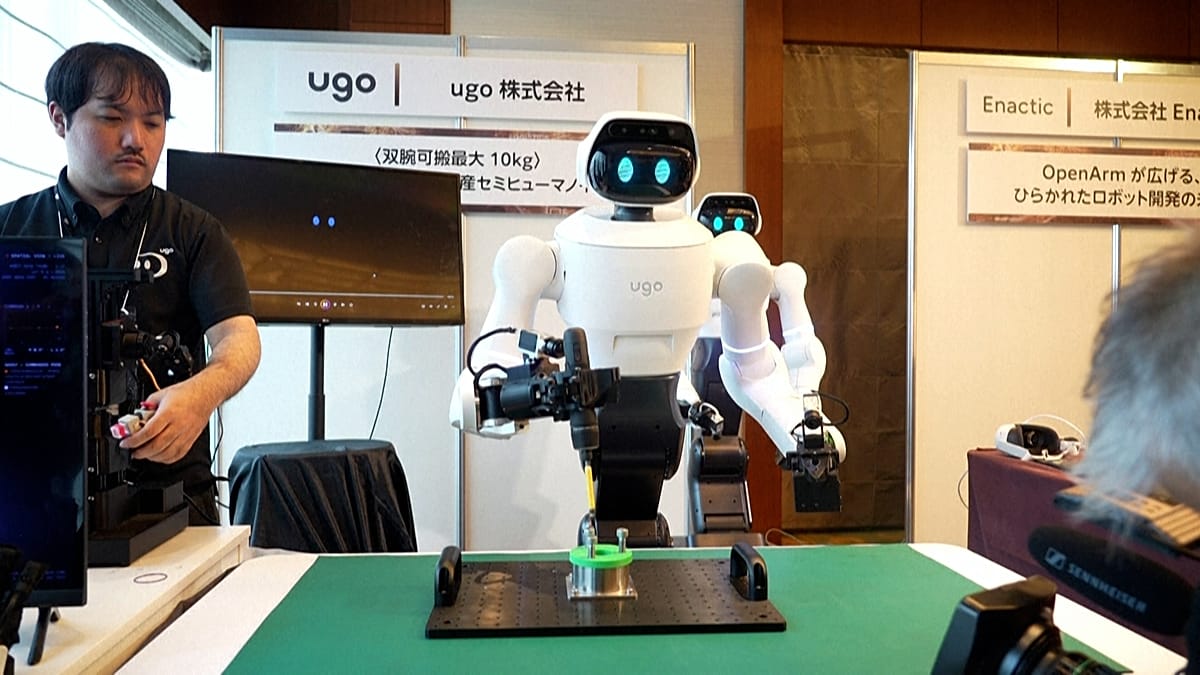
ugo showed ugo Nova, a semi-humanoid with two seven-axis arms plus extra joints in the head and waist. In the demonstration it drills a fixture on a bench under remote control. The booth banner in the still puts dual-arm payload at a maximum 10 kg. Euronews says the machine is meant for rooms built for people and is designed to collect real-world data for physical AI models.
Other benches in the same room
THK brought a dual-arm cell that picks up bottles, bags, and boxes under one operator, then hammers a nail into wood. Nachi and HatsuMuv showed systems as well. Euronews does not list payloads or cycle times for those booths beyond the tasks in the video.
The through-line is the limit, not the hype. “Many of the robots still depend on human operators,” Euronews reports, “with developers now working to give them greater autonomy as investment in AI-powered machines grows in Japan.”
Nova’s extra waist and head joints are the interesting hardware choice. A drilling task in a human-height cell cares about aiming the tool and keeping the camera on the hole, not about a backflip. Teleop first, log the traces, train later. That is a data-collection robot wearing a humanoid torso.
A Human’s Take
I like a demo that admits the joystick is still in the shot. A seven-axis pair that can hold a drill and a 10 kg claim on the banner is a real product shape, even if autonomy is next year’s problem. The useful test is whether ugo publishes how many hours of that drill data actually train a policy that can start the hole without the operator.
Sources
- Euronews — From nail hammering to drilling, Japan’s new robots push physical AI forward
- Euronews video page for the same summit report