ULOHA Is ALOHA in a Tank, Bubbles and All
ALOHA made bimanual imitation cheap in air. ULOHA is the same idea with the followers in water. Masato Kobayashi (Osaka / Kobe) and Takeru Tsunoori posted arXiv:2609.19200 on 16 September 2026, with a project stub the same day.
Two dry leader arms drive two waterproof followers. Three cameras watch. LeRobot does record, train, and rollout. The authors say they will release the hardware designs.
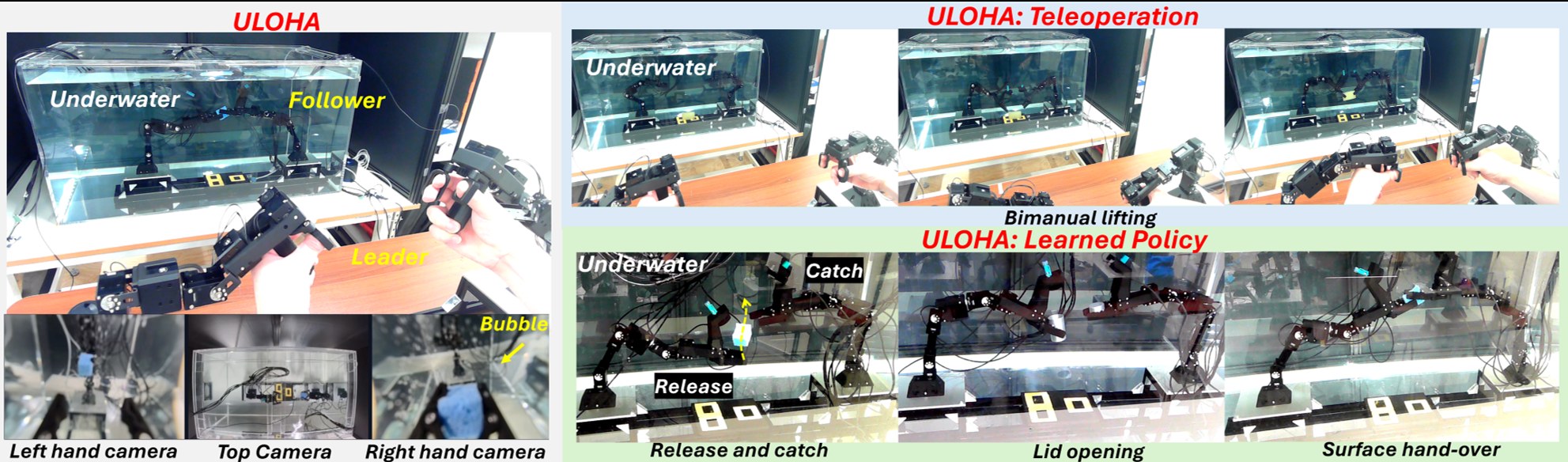
Waterproof cables are the design constraint
Leaders use DYNAMIXEL XM430-W350. Followers use XW430-T333, IP68 in fresh water to 1 m for 24 h. Each follower motor needs its own waterproof cable, so there is no daisy-chain. Custom 3D-printed structure leaves clearance at J6 and a hard stop at J4 so the connector does not get hit.
Costs in the paper: about USD 2,600 per leader and USD 7,000 per follower. The tank is 1.2 × 0.6 × 0.6 m. Cameras are TIER IV C1-120, captured at 1920×1280 and resized to 480×320 at 30 fps.
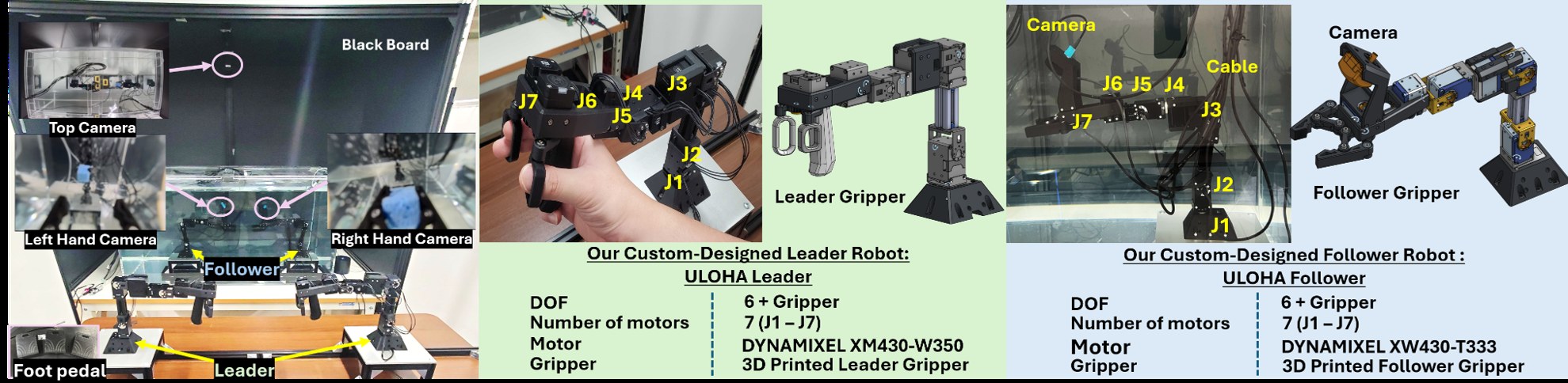
Nine underwater tasks
ACT is the workhorse. Ten demos on seven tasks, fifty on the two sponge tasks. Ten evaluation trials each:
| Task | ACT |
|---|---|
| Block hand-over | 10/10 |
| Sequential transfer | 10/10 |
| Bimanual lifting | 10/10 |
| Block stacking | 9/10 |
| Cooperative insertion | 9/10 |
| Lid opening | 7/10 |
| Hand-over then place | 6/10 |
| Surface hand-over (sponge) | 4/10 |
| Release and catch (sponge) | 3/10 |
| Total | 68/90 |
On block hand-over, ACT, Diffusion Policy, and SmolVLA all hit 10/10 from the same ten demos.
Bubbles are the cheap robustness test. Two aerators in the workspace, same checkpoints: sequential transfer falls from 10/10 to 3/10. Bimanual lifting stays 10/10.
Release-and-catch cares about how many actions you commit. The same ACT checkpoint is 3/10 at a 100-step execute horizon, 6/10 at 30 steps, and 3/10 again at 15. SmolVLA with real-time chunking is 6/10 versus 4/10 synchronous.
A separate single-arm pick-and-place: train in air, test in water (or the reverse) is 0/10. Mix five demos from each medium, keep the total at ten, and the same ACT policy is 10/10 in both. An unseen black rubber block underwater: 7/10.
A Human’s Take
The sponge numbers are the honest part of the paper. A block hand-over at 10/10 is a tank toy. Catching a rising cellulose sponge at 3/10, then 6/10 when you stop replaying a three-second chunk, is the actual underwater problem: the object does not sit still after you let go. I would not call this OceanOne. I would call it the first ALOHA-shaped kit that lets you measure how badly bubbles wreck a policy you trained in clear water.