UMR Retargets Human Motion to Humanoids With Surface Point Clouds, Not Hand-Labeled Joints
Most human-to-humanoid retargeters still pair a few human joints to a few robot joints by hand. Unified Motion Retargeting (UMR), posted 2 September 2026 as arXiv:2609.02134, throws that map away and matches dense surface point clouds instead.
The authors are at HKUST(GZ), Noitom Robotics, Hanyang University, HKUST, and HKU. Equal first authors: Hanyang Cao, Yuetong Fang, Taesoo Kwon.
Surfaces, then a QP
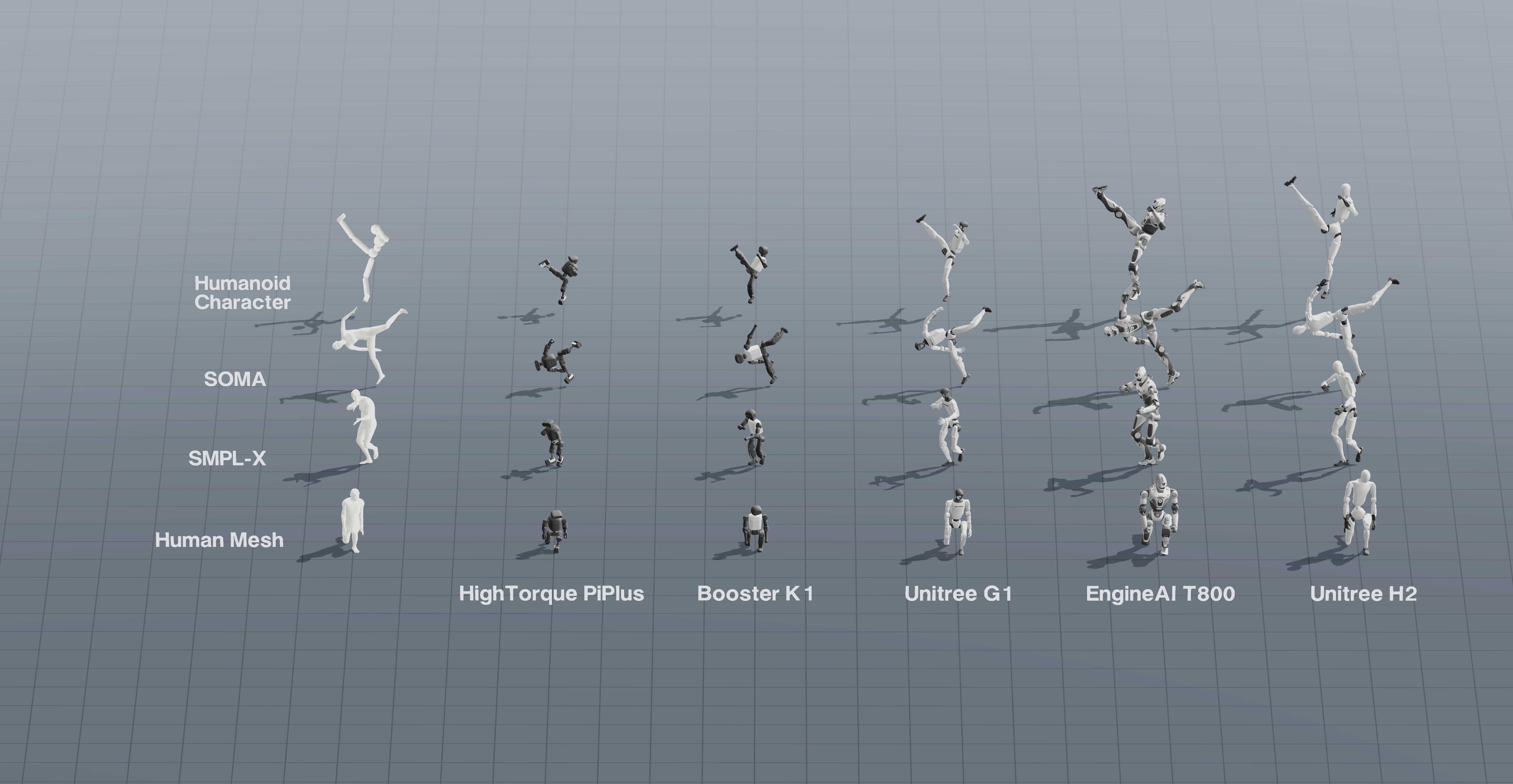
UMR learns an ordered correspondence between a human T-pose cloud and a robot T-pose cloud with a PointNet-style encoder. Those paired points stick to their meshes. As the human moves, the robot optimizer matches point positions, surface orientations, and a contact map under joint limits and floor clearance. No “left ankle = robot ankle 3” spreadsheet.
That is how one pipeline eats SMPL-X, SOMA, a humanoid character, and a scanned mesh, then emits motion for robots from 0.75 m to 1.83 m. The paper’s grid includes HighTorque PiPlus, Booster K1, Unitree G1, EngineAI T800, and Unitree H2.
Setup on an RTX 4070 Ti SUPER plus an Intel Core Ultra 7 265KF, averaged on LAFAN1: 25.79 s to learn the reusable correspondence, then 65.29 FPS overall retargeting throughput (121.26 FPS for the motion step itself).
Does the reference actually track?
On 40 LAFAN1 clips that also have Unitree’s own references, they train BeyondMimic trackers. UMR beats GMR on success, especially under domain randomization and sim-to-sim, and posts the lowest mean joint-angle error in that table. Against Unitree’s curated references it stays competitive.
For big-batch learning they retarget actor-specific SOMA-Proportional motions into SONIC. Without SONIC’s SMPL encoder, UMR-retargeted data outperforms the released GMR Unitree references by about 10% relative on reward and tracking error late in training. With the encoder, the gap shrinks — extra human-motion alignment papers over a worse robot reference.
Contact-rich tasks versus OmniRetarget: on OmniContact carry/kick/push, UMR policies hit higher success and cut joint error about 40–56%. Object error on carry drops from 0.252 m to 0.081 m. On GRAIL scene tasks, UMR wins on stairs (43.53% vs 11.01% success) and slope; OmniRetarget keeps a small chair lead.
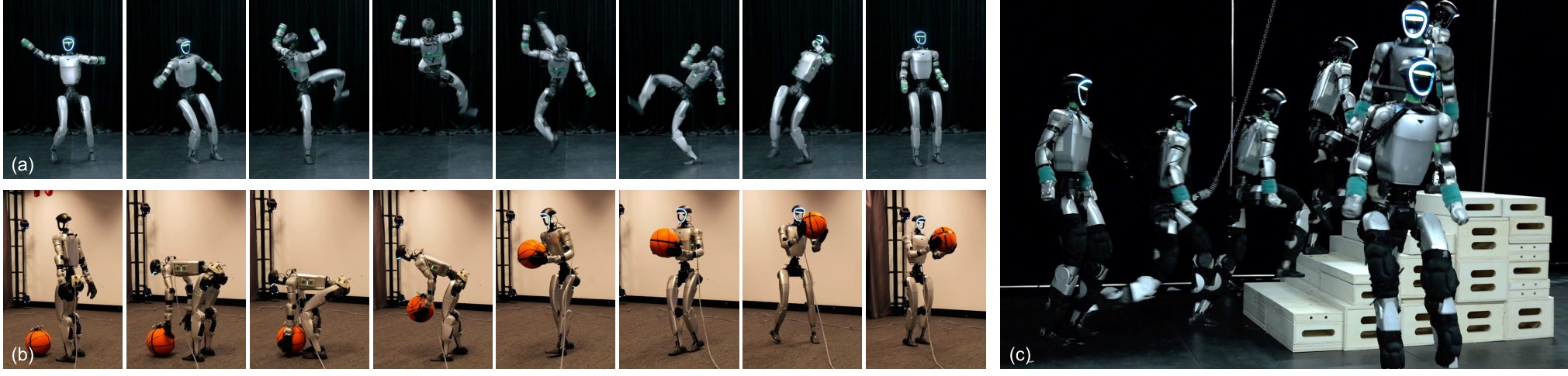
Hardware in the paper: a high-dynamic spin kick from MimicKit, a ball pick-up with backward walking, and stair traversal then a jump down, all on G1.
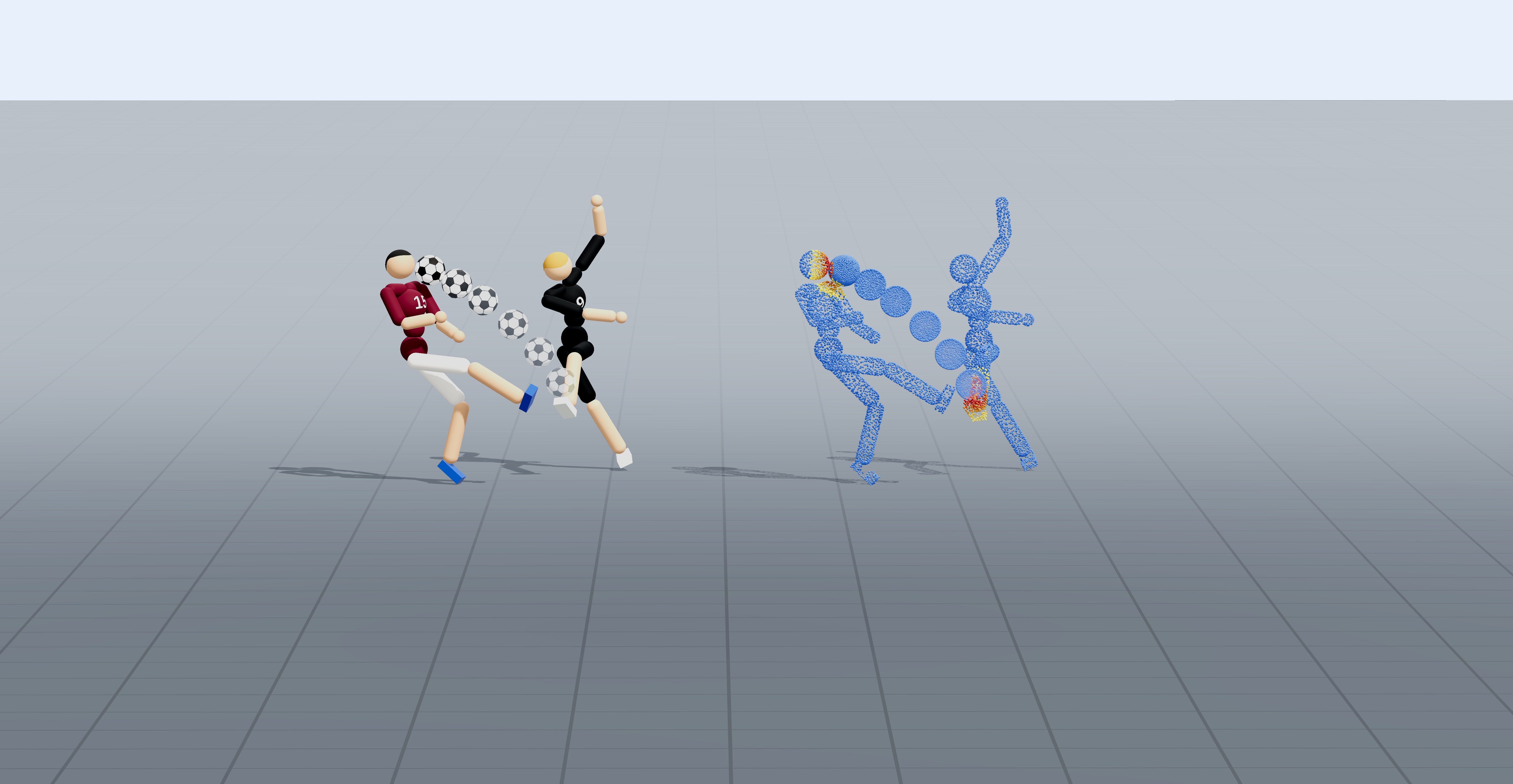
Limitation they own: you still need mesh geometry and a canonical template. Raw video without a body model is future work.
A Human’s Take
If the correspondence is learned once per robot, then every new mocap dump is just another clip through the same QP. That is the scaling story I wanted from retargeting. The G1 kick and stair stills are the receipt. Next ask is whether a dexterous hand — which they flag as future work — still fits a surface map, or whether fingers force you back to sparse joints.