UniDex-ViTac Turns 50 Human Videos Into a Grasping Policy
Human videos show how people pick things up. They do not give a robot joint targets or fingertip contact. Hyesung Lee, Si-Hwan Heo, and Sungwook Yang at KIST’s Center for Humanoid Research posted UniDex-ViTac on 15 September: annotate the videos, adapt them in simulation, then deploy a single policy that never saw a real-robot demonstration.
The hardware is a Franka Emika Panda, a 16-DoF hand, barometric fingertip sensors, and an Intel RealSense L515.
Specialists first, then one generalist
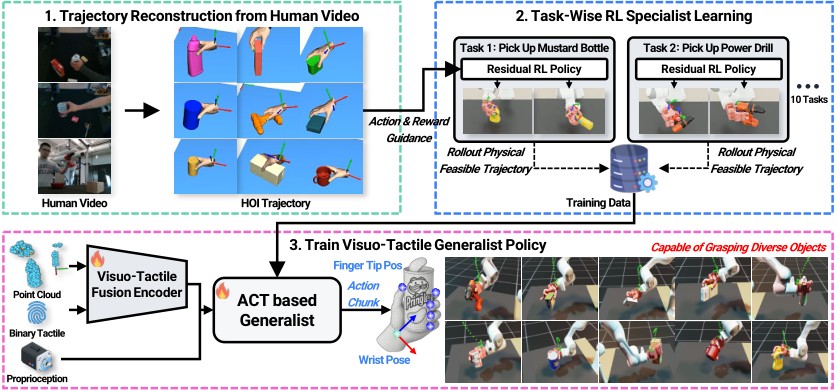
They start from DexYCB. Five annotated grasp-and-lift clips each for ten objects — mustard bottle, power drill, bleach cleanser, mug, and six more — for 50 human demonstrations. MANO hands and object poses become a wrist-plus-four-fingertip reference.
Each object gets its own residual PPO specialist in Isaac Lab. The actor adds a bounded correction: ±0.1 m on wrist translation, ±40° on wrist orientation, ±0.05 m on fingertip offsets. A trial counts as success if the robot lifts the object 20 cm and holds it 3 s. After five extra verification rollouts, they keep the trajectory. The offline set is 10,000 sequences, 1,000 per object.
Those rollouts train one ACT generalist. The observation is a 512-point cloud (508 camera points plus four forward-kinematics fingertips), 42-D proprioception, and four binary contact bits. Contact labels the fingertip points and also arrives as its own token. The transformer predicts a 30-step chunk of wrist pose and fingertip targets. Arm IK and analytical hand IK track them at a nominal 20 Hz.
Contact bits actually move the needle
In simulation, 500 evaluation trials per object, the specialists sit at 94.3% macro success. The sensory generalist lands at 68.3%. Point-cloud-only ACT is 55.5%. Adding the four contact bits as a token or as point labels barely helps on their own (56.4% and 56.8%). Using both paths is what produces the full 12.8-point jump.
On the bench, ten trials per object per policy, no extra fine-tuning:
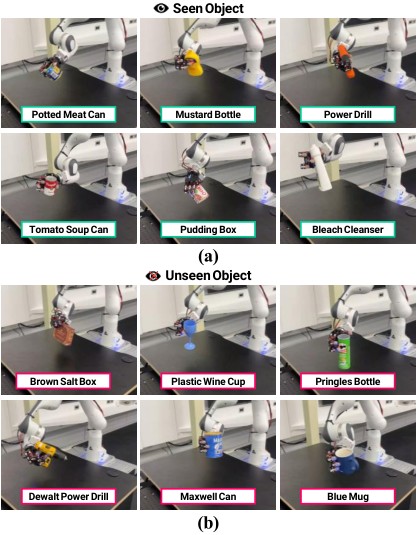
- Seen (six objects): 42/60 with contact versus 33/60 without (70.0% vs 55.0%)
- Unseen (five objects): 31/50 versus 27/50 (62.0% vs 54.0%)
- Overall: 73/110 (66.4%) versus 60/110 (54.5%)
Pudding box, potted meat, and tomato soup can pick up the most from contact. Bleach cleanser and a plastic wine cup each lose one trial. A blue mug is still ugly: 2/10 with contact, 0/10 without.
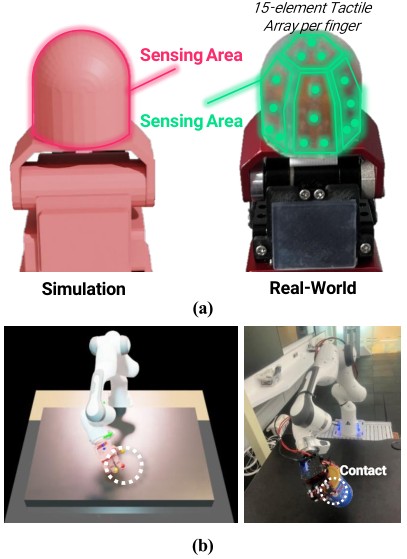
The real sensors are calibrated at a constant 1.0 N for 10 s. Simulation uses the same 1.0 N pad-force threshold. The paper is blunt that the simulated pad and the physical sensing region do not match spatially.
A Human’s Take
Fifty clips in, a policy out, and no teleop on the Franka is the part that matters. The contact story is narrower than the name: four bits, no force magnitude, and a sim-to-real mismatch the authors already flag. I’d still take a 12-point lift on cans and boxes over another RGB-only ACT. Next receipt is a skill that is not just grasp-and-lift, and a mug that does not look like it wandered in from a different paper.