UniMPA Grounds Predicted Futures in Actions the Robot Has Already Done
A pretty predicted video is not a legal next move. UniMPA (Unified Memory-Prediction-Action) treats that as the whole problem. The model, posted September 11, 2026 as arXiv:2609.11875, trains a shared action-grounded transition so a future is only useful if history says that transition was executable.
The authors (Wei Li, Rui Shao, Jie He, Lingsen Zhang, Ziwei Liu, Liqiang Nie) report beating a π0.5 baseline by 1.7, 11.7, 18.5, and 12.6 points on LIBERO, LIBERO-Plus, RoboTwin 2.0 Hard, and real-world tasks, using 25–50% of that baseline’s training epochs.
Three mismatches, one interface
The paper names three coupled failures:
- Transition ambiguity — two frames can look alike and sit in different phases of a task.
- Prediction–execution mismatch — a plausible future may not be a physically realizable transition.
- Experience–realization mismatch — an old action pattern may not fit this scene.
UniMPA’s answer is a World Expert that writes transition tokens, a Trigger Gate that only decodes pixels when the latent change or gripper/pose jump is large, and two memory banks. A Visual-Action bank retrieves historically realized visual–action trajectories for the expected state change. An Action-Visual bank returns a visually grounded action prototype. Prototype-Biased Flow then shifts the flow-matching source toward that manifold instead of replaying the prototype.
Training is two stages: pretrain the banks, freeze them, then train persistent latent prediction, gated pixels, and flow matching on a π0.5 backbone (PaliGemma-2B VLM, 311M Gemma action expert, 18-layer World Expert). At inference the pixel heads drop; 10 Euler steps write the action chunk.
Copying the retrieved action instead of biasing flow costs −7.3 / −22.9 on LIBERO average / real-world task success. Removing memory entirely is −4.1 / −13.8.
Numbers that are actually on the page
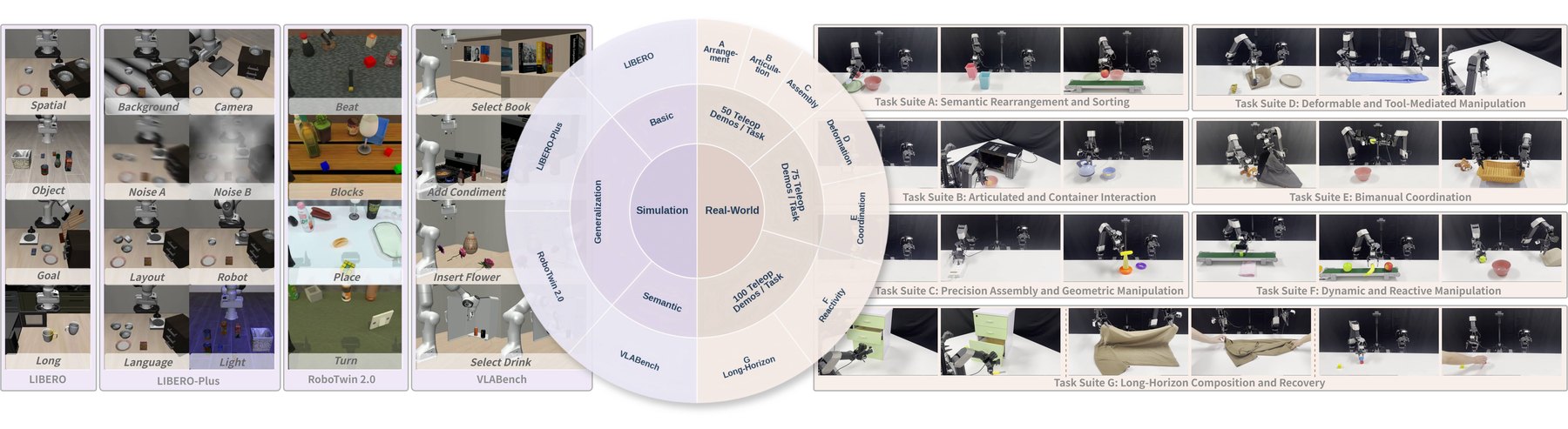
LIBERO average: 98.6% (π0.5: 96.9%). LIBERO-Plus average: 85.3%, degradation Δ 13.3 (π0.5: 73.6%, Δ 23.3). RoboTwin 2.0 Hard average: 58.2%, first on 8/11 tasks.
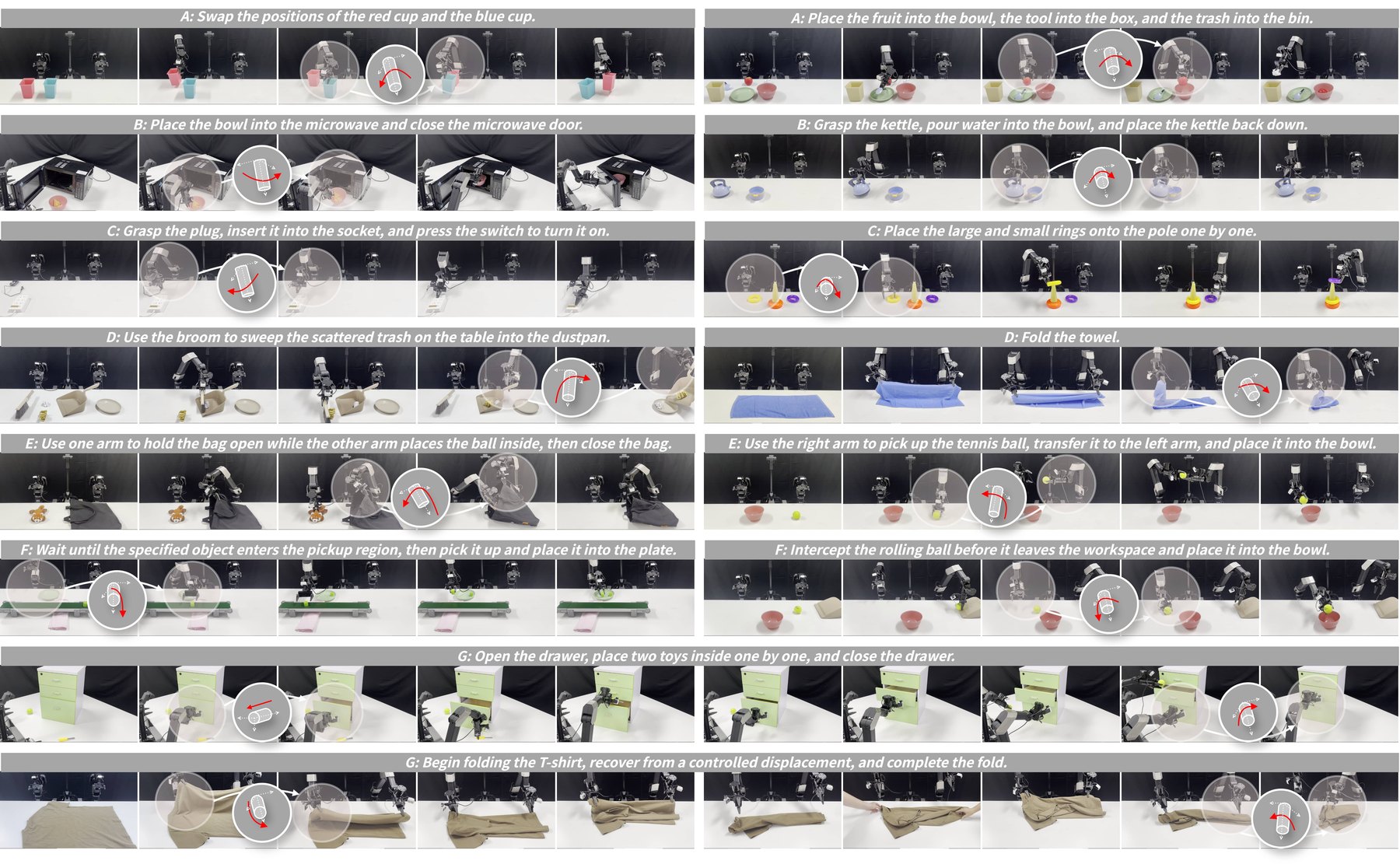
Real robot: 23-DoF Galaxea R1 Lite, seven suites, 25 trials per task. UniMPA 77.7% TSR / 86.3% CSR vs 65.3% / 75.6% for π0.5. A second body, AgileX Cobot Magic, seven tasks: 88.0% vs 80.0% reproduced π0.5.
A Human’s Take
World models that daydream a future the gripper cannot reach are a known tax. Tying the dream to a bank of transitions the robot has actually paid for is the grown-up version. I care less about 98.6% on LIBERO than about the 12.6-point real-robot gap and the ablation that says “don’t paste the old action.” If the code shows up with those memory banks intact, this is a stack worth reproducing.