UniReflex Adds Force Control to Frozen Robot Policies
Generative imitation policies are good at drawing a path and bad at holding a contact. UniReflex, from Tsinghua Shenzhen, NTU, X Square Robot, and Xspark AI, is a plug-in that leaves those policies frozen and trains only a fast reflex.
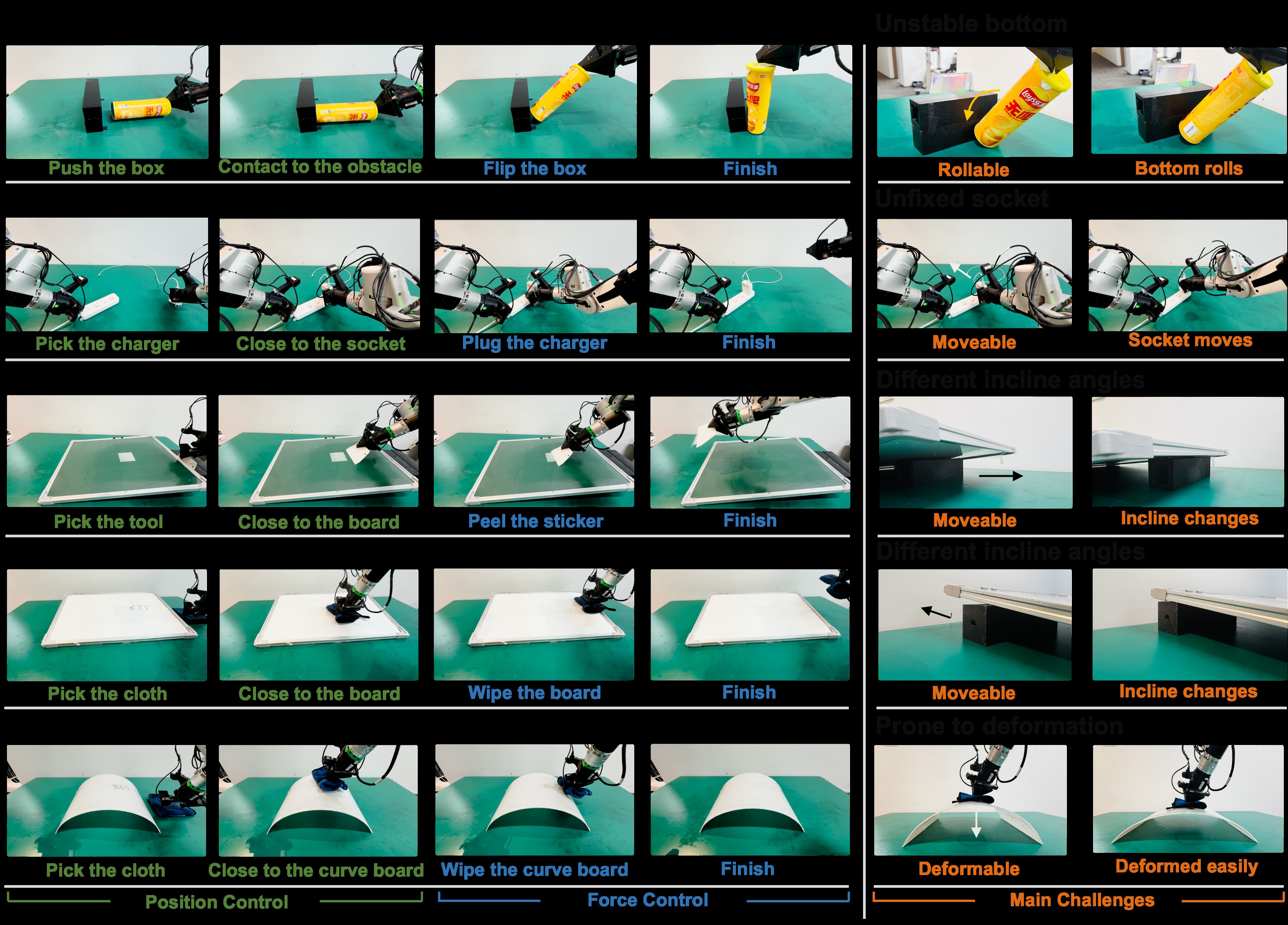
On five contact-rich bimanual tasks, adding UniReflex to Diffusion Policy, π0, and DreamZero changes the approach (Phase I) by at most 10 points and lifts the contact stage (Phase II) by 20–60 points. Training the reflex only is about 25–66× cheaper per backward step than joint fine-tuning on the backbones they measured.
Hook the latent, don’t retrain the brain
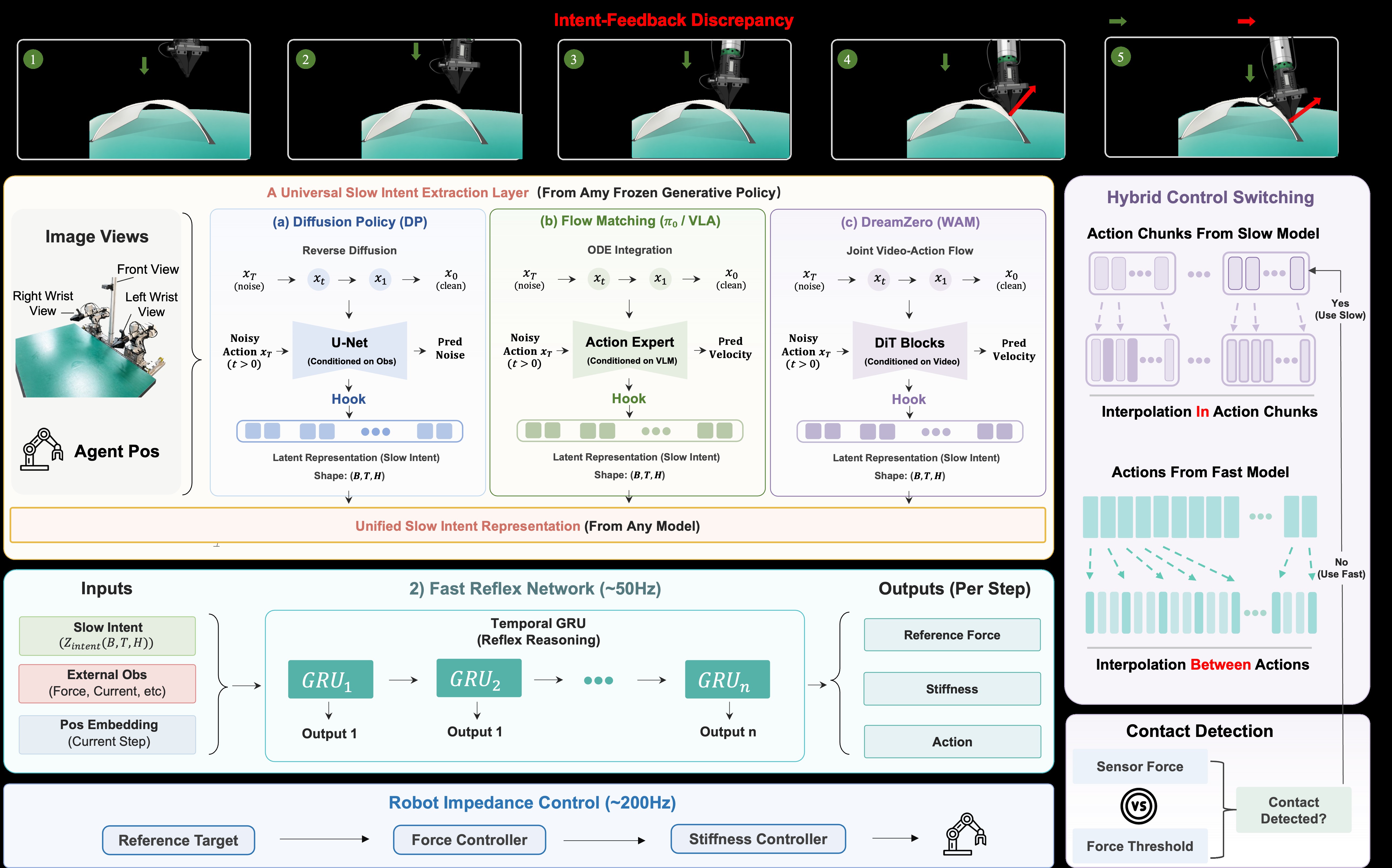
Near the end of denoising or flow integration, the action head still holds a fat hidden state. UniReflex reads that tensor with a forward hook, concatenates proprioception, and runs a GRU. Each control cycle it emits a pose residual, a reference wrench, and anisotropic stiffness for variable impedance control. A gate keeps the frozen planner in charge until contact, then shifts toward force.
They label stiffness from teleoperation mismatch: push harder along the master–slave error axis, keep a small isotropic floor so the stiffness matrix stays positive definite. No extra hybrid force-position hardware, wrist F/T only.
The numbers that stuck
200 teleop trajectories per task. UniReflex + π0 hits 80% on curve wipe and incline wipe in Phase II, versus 30% for vanilla π0. Peel-note Phase II goes from 30% (DP) to 90% with UniReflex. Plug charger does not clearly improve; the paper says brief insertions leave less room for sustained force regulation.
Ablations under frozen DP: drop stiffness modulation and peel success falls to 50% with force error jumping from 5.8% to 32.4%. Ungate the reflex through free space and Phase I collapses. Under disturbances (tilting the peel board, deforming the wipe surface, bumping the chip box), UniReflex recovers 80–100% of trials in 0.87–1.28 s; frozen DP recovers 10–20%.
Trainable reflex parameters are 0.188–0.375% of the backbone. DP: 452.3M / 1.70M. π0: 3.50B / 6.60M. DreamZero: 22.92B / 62.2M.
The authors flag three limits: long-horizon world-action models such as DreamZero refresh chunks too slowly, high-impulse insertions are a weaker fit, and the reflex cannot outrun bad force sensing.
A Human’s Take
Leaving a giant VLA frozen and teaching a small network when to go squishy is the practical move. The peel and wipe jumps are the evidence. The charger task is the reminder that not every contact is a sustained press.
If you already paid for a visuomotor policy that can find the board, this is how you stop it from skating on the surface. I want to see the same hook on a humanoid wrist, not just tabletop bimanual.