UVT Trains VLAs on Unified Visuomotor Targets, Not Just Actions
VLAs usually learn to predict robot actions from vision and language. That creates a mismatch: vision-language models encode rich scene and goal structure, while motor commands are low-level. Unified Visuomotor Targets (UVT) (arXiv:2608.03563, accepted IROS 2026, posted Aug 4, 2026) asks whether changing what the policy predicts — not the architecture — improves training.
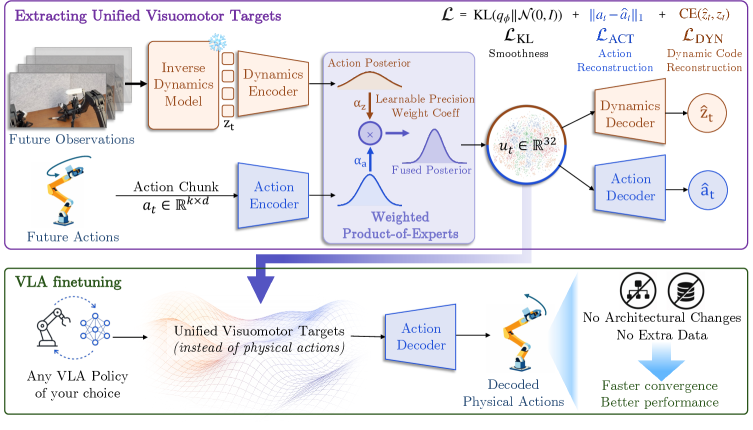
The idea
UVT is a unified latent prediction target that jointly encodes:
- Motor control information
- Visual scene transition information
Requirements called out in the abstract: no architectural changes and no additional data. Any VLA can be finetuned to predict UVTs; an action decoder recovers physical commands.
Where it was tested
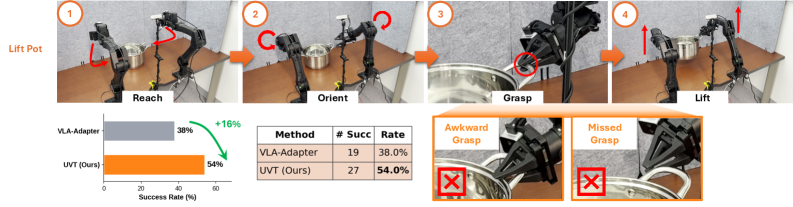
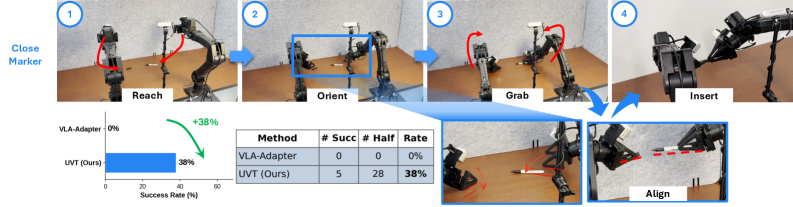
The authors apply UVT to two representative VLA systems across simulation benchmarks and real bimanual manipulation. They report improved:
- Training efficiency
- Final task performance
- Policy robustness
with particularly strong gains under limited training budgets and challenging environmental conditions. Rollouts live on the project page: unified-visuomotor-targets.github.io.
A Human’s Take
Predicting only torques and deltas is like teaching someone a craft by listing muscle twitches. UVT’s “what should the world look like after you move?” target is closer to how you brief a human. Drop-in targets without a new backbone are the kind of idea small labs can actually try this week — that’s why it lands on my watch list.