Vid2WAM Distills Video Diffusion Into a Compact World-Action Student
World Action Models get their edge from predicting futures — but those futures usually have to come from expert robot demos. That ties WAM quality to teleop cost.
Vid2WAM (arXiv:2608.08558, Aug 9, 2026) asks a sharper question: can a large video foundation model supply future supervision offline, so a compact WAM student never needs the teacher or an inverse-dynamics model at runtime?
Method in plain terms
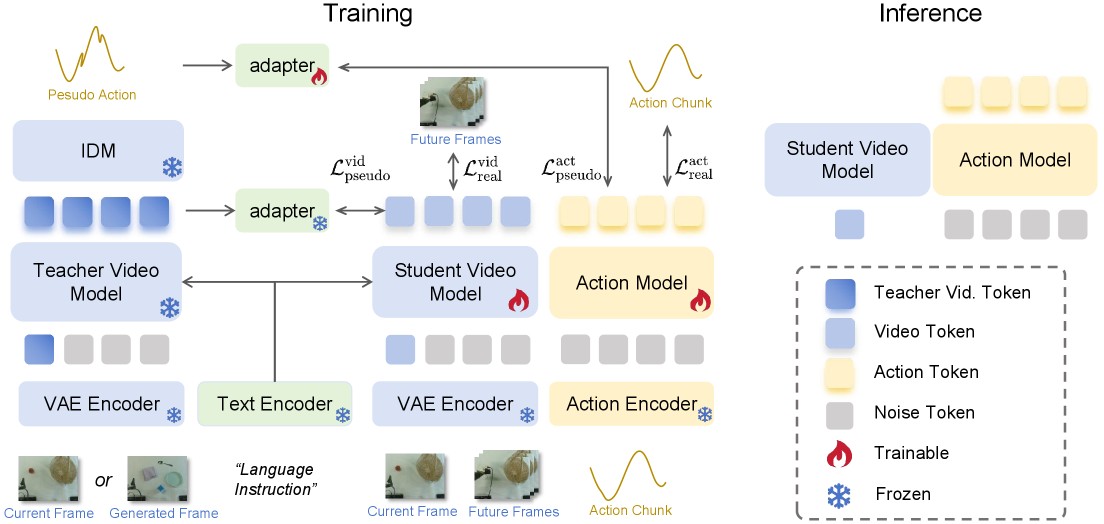
- Fine-tune a video teacher (Wan2.1-14B LVP checkpoint) on limited embodiment video.
- Generate task-conditioned rollouts from cheap initial observations + language.
- Re-encode futures into the student VAE space; run an IDM for pseudo-actions.
- Train the student with source-aware residual adapters so noisy pseudo-actions do not wreck the real-demo backbone.
- At inference: student only.
Project site: qch-fa.github.io/vid2wam-website.
Results
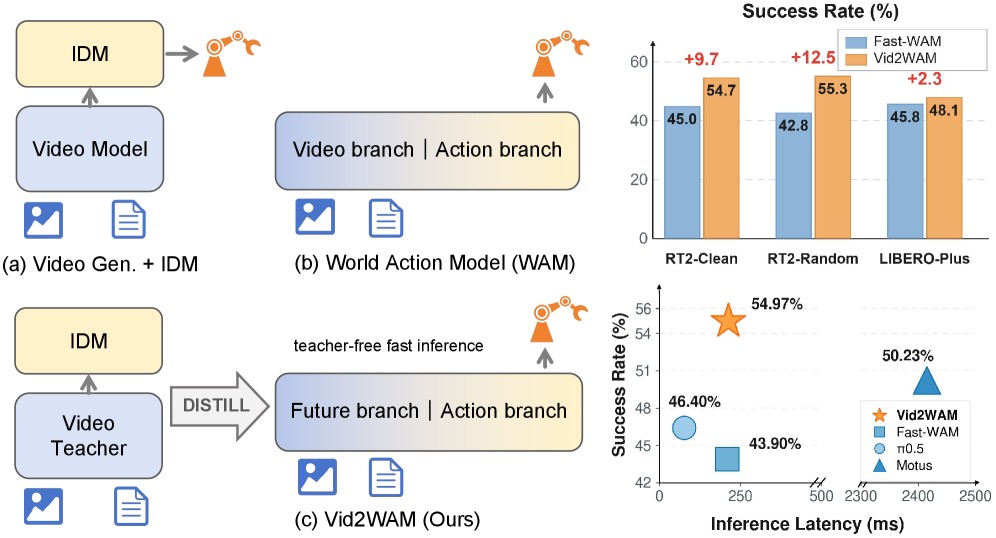
On RoboTwin 2.0 novel-task subset, Vid2WAM reaches 54.7% / 55.3% (clean / randomized) vs Fast-WAM 45.0% / 42.8% — gains of about +9.7 / +12.5 points. Overall low-data and novel-regime averages also lead the reported baselines (π0.5, Motus, Fast-WAM).
On LIBERO low-data, Vid2WAM averages 89.7% and is best or tied-best on every suite. LIBERO-Plus overall is highest among the four methods under both low-data and novel regimes in the paper’s tables.
Real dual AgileX Piper arms: six seen tasks (60 real demos each) plus three held-out novel tasks with no real trajectories — only initial observations and teacher-generated pseudo data. Vid2WAM is best or competitive across the nine tasks; qualitative frames show tissue pull and test-tube extraction without action-labeled demos for those skills.
Inference on RTX 4090 stays near Fast-WAM latency (~209–212 ms class in Table 6), far below online teacher+IDM composition (~4.9 s).
A Human’s Take
The interesting claim is that future supervision does not have to be a logged expert trajectory. If that holds outside the authors’ teacher finetune, video models become offline data factories for policies instead of online planners that are too slow for the loop. I still want open checkpoints and a clear failure gallery for IDM-labeled garbage rollouts — residual adapters help, they do not erase bad physics in the video.