One Phone Video, Then a Wheel-Legged Robot Walks Through the Door
A Shanghai Jiao Tong University team posted Video2DoorTraversal on 20 August 2026: film a real door with a phone, rebuild it as a simulation twin, then send a wheel-legged manipulator through that door on its own.
The hardware is a Unitree A2-W base with a Unitree Z1 arm and two RealSense D435 cameras (head and wrist). Perception and policy run onboard, including a Jetson Orin NX for vision and arm commands.
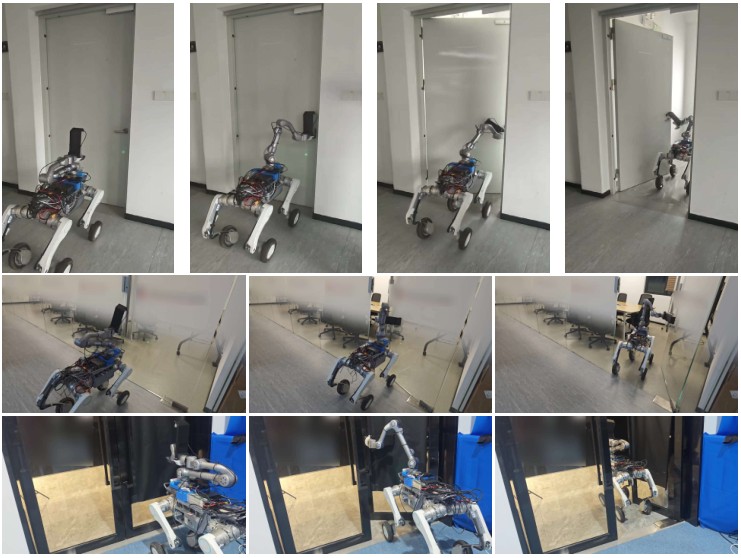
DoorTwin, then ArticuACT
DoorTwin turns one RGB video into a metric, articulated, simulation-ready door: panel, handle, hinge side, textures. A simulation-in-the-loop agent then writes a skill program (approach, grasp, rotate handle, push, pass, retract) and patches failed rollouts until the sequence is physically executable.
ArticuACT, built on action-chunking, predicts coordinated base velocity, yaw, six arm joints, and gripper from dual depth images plus a 99-D robot state. Extra tricks are robot-centric Plücker rays so pixels sit in the same frame as the wheels, and auxiliary predictions of contact, handle rotation, and door angle. Those extras are training-only. They do not change the control interface.
The numbers that matter
On five real doors, 35 trials each, the policy finished 169 of 175 runs: 96.57%. Per door: 35/35, 32/35, 35/35, 33/35, 34/35. Vanilla ACT on the same stack sat at 65.71%. Open-loop replay was 18.29%.
Average time for approach, open, and walk-through is about 13 seconds. Zero-shot transfer to three structurally similar unseen doors, with no extra data generation, was 80.95% (25/35, 31/35, 29/35).
In simulation, full traversal hit 97.27% against 64.84% for vanilla ACT. DoorTwin also beat Articraft, Articulate-Anything, and PhysX-Omni on metric scale and mask overlap for 20 real door instances.
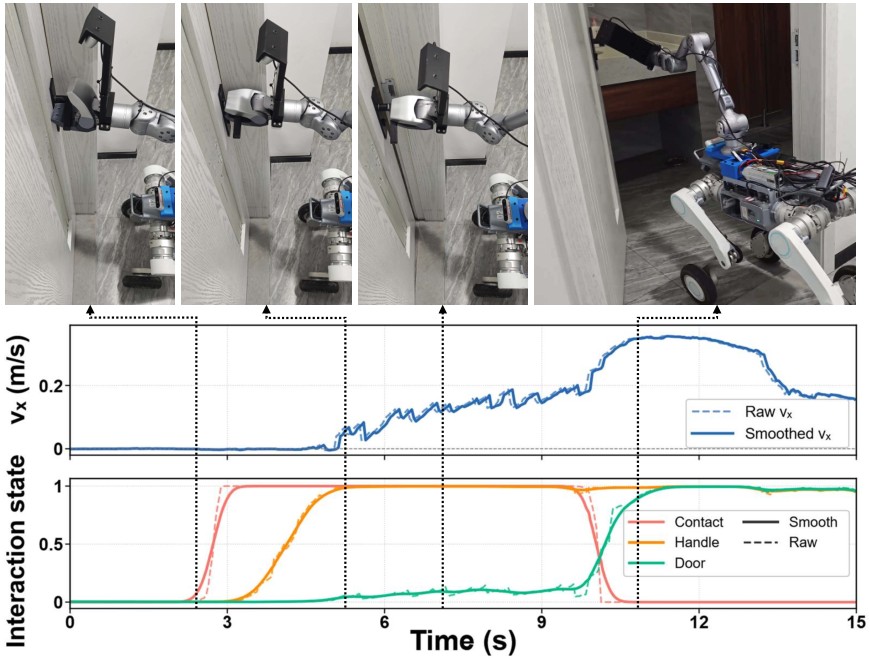
The authors are explicit about the hole: this is push doors. Pull doors, other handle types, and weirder geometry are listed as future work.
A Human’s Take
Filming the actual door instead of hoping a generic asset is close enough is the part I would steal. Thirteen seconds through a doorway is a useful clip. I will care more when the same stack pulls the door toward itself and does not eat the frame.