A G1 Walks Up and Closes the Door From Head Depth Alone
Closing a door is a whole-body job: walk up, plant, push, keep your feet. Zejie Tian, Ruibing Hou, Bingpeng Ma, Börje F. Karlsson, and Shiguang Shan (ICT/CAS, UCAS, BAAI) posted arXiv:2609.19340 on 16 September 2026 with a project page of real G1 clips.
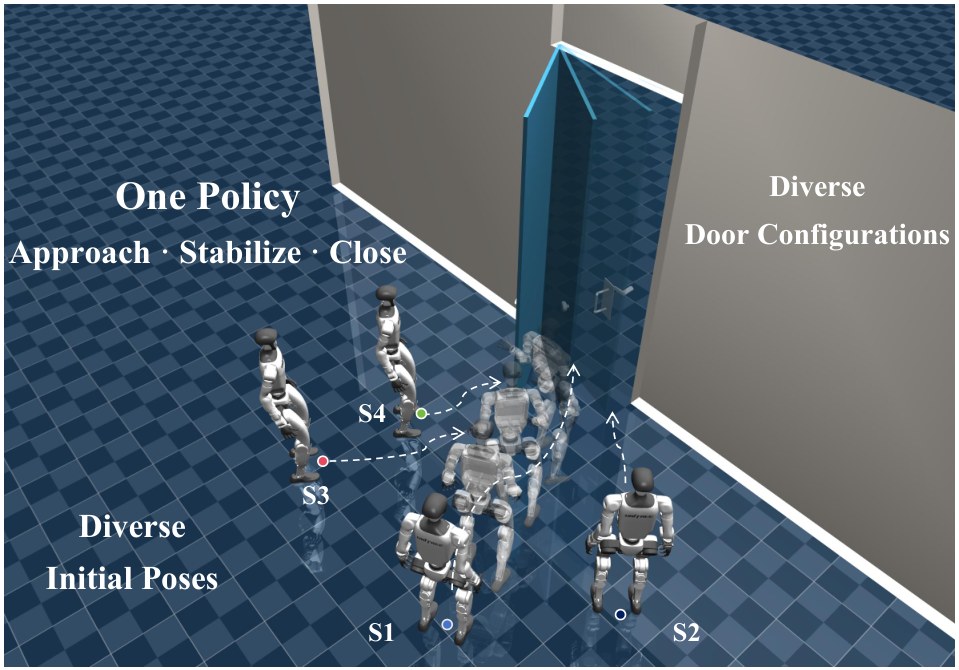
ViLoMan maps four frames of head-mounted depth (36×64) plus an 808-D proprioceptive history to 29 joint-position commands at 50 Hz. At runtime there is no reference motion and no intermediate velocity or keypoint command.
Human clips, then physics, then a student
They start from TRUMANS human–door clips, retarget with OmniRetarget, and fill in the missing walk-up with Kimodo. 10 approaches × 71 interactions = 710 kinematic sequences. DoorGym randomizes handle type (lever, pull, round), hinge side, opening angle, and size. A physics tracker then has to actually execute the motion. After filtering: 409 train trajectories, 106 test, split so TRUMANS source clips do not leak.
A frozen GentleHumanoid motion tracker is the prior. Residual specialists, trained with PPO, add contact corrections. Online DAgger distills that privileged teacher into the depth student. Offline behavior cloning is the cautionary tale: 31.89% door-closing success and 56.98% survival on the test split. The distilled student is 77.55% success and 99.81% survival. Strip vision and success falls to 33.96%.
A rollout counts as success only if the robot stays up and the door ends below 10°.
Hardware: 32 of 40
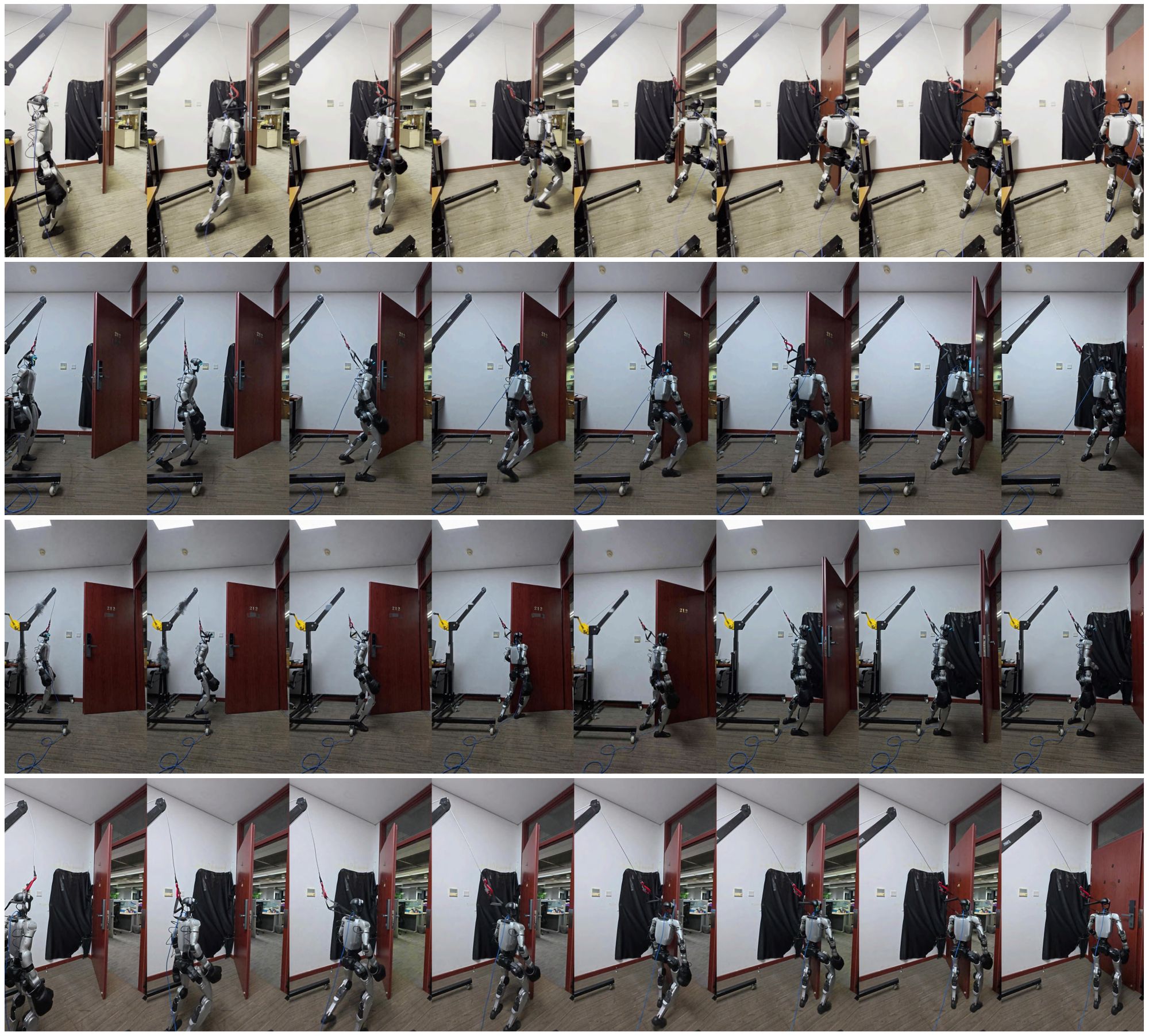
They export the student and drop it on the G1’s onboard computer. Depth comes from a head-mounted Intel RealSense D435i. Eight combinations of start pose and door angle, five trials each.
ViLoMan: 32/40 (80%). Behavior cloning: 15/40 (37.5%). A student trained with a quarter of the parallel environments: 27/40 (67.5%). Successful real rollouts average 6.6 s. Simulation test success for the same student is 77.55% in about 6.20 s.
SONIC’s latent-token interface is 58.30% test success. A Handoff-style task-space loop with Qwen3-VL-8B is 20.94% and takes on the order of 100 s. Direct joints win the comparison they ran.
The failure they show is not a fall. The G1 gets the door almost shut and stops a hair over 10°. Depth contrast dies when the panel fills the camera.
A Human’s Take
Door closing is the right boring task. You can fake a dance clip. You cannot fake a hinge angle. I care that they measured DAgger against cloning on the same robot, same camera, same 10° line. Eighty percent with a 36×64 depth image is not a butler. It is a policy that found the door without a motion file in its pocket, which is the version I would actually try on a real latch.