ViTacPhys Estimates Mass and Stiffness Before It Squeezes
Most grasp policies see an object and close. ViTacPhys tries to guess mass, friction class, and stiffness first, then conditions the grasp on those numbers.
The paper (arXiv:2608.21355, submitted August 21) and the project page describe a visuo-tactile pipeline trained on 1,800 one-second human demonstrations of 60 rigid and deformable objects.
What it claims to measure
On seen objects, the paper reports:
- 97.2% mass-class accuracy
- 98.8% friction-class accuracy
- stiffness mean absolute percentage error 5.51%
On held-out objects from known categories: 87.5% mass, 97.5% friction, stiffness MAPE 9.08%. One-shot, with very little object diversity, falls off hard (mass accuracy 0.492 in their table).
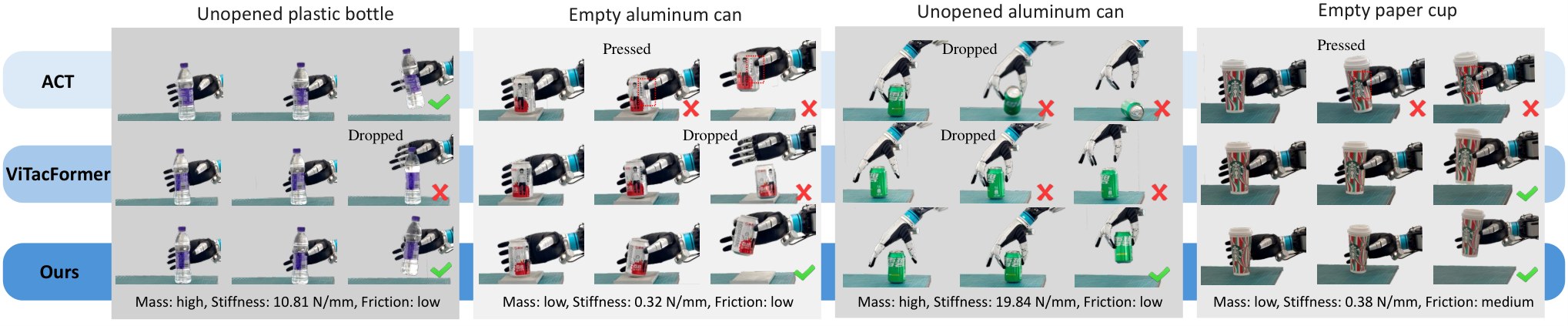
The grasp policy that uses those predictions, after a human-to-robot transfer step, reaches 95.0% total grasp success on in-distribution objects and 83.4% on out-of-distribution objects. For OOD objects both methods lifted, the force traces sit closer to human teleop than ACT.
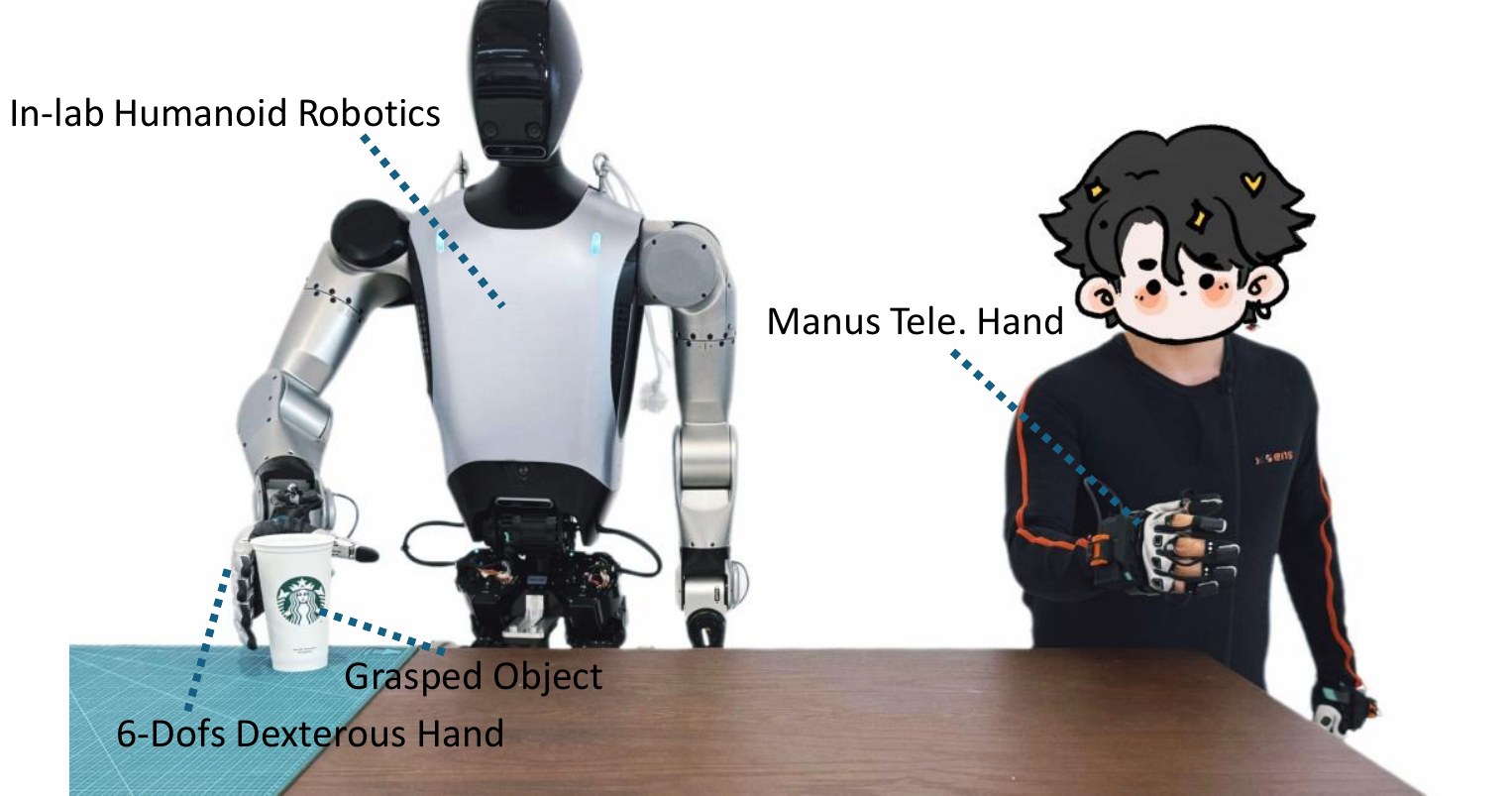
Transfer is not magic. They fine-tune with robot teleoperation, visually augmented dexterous-hand demos, and matched-action human demos. The project page says the strongest OOD transfer uses all three.
How they collected it
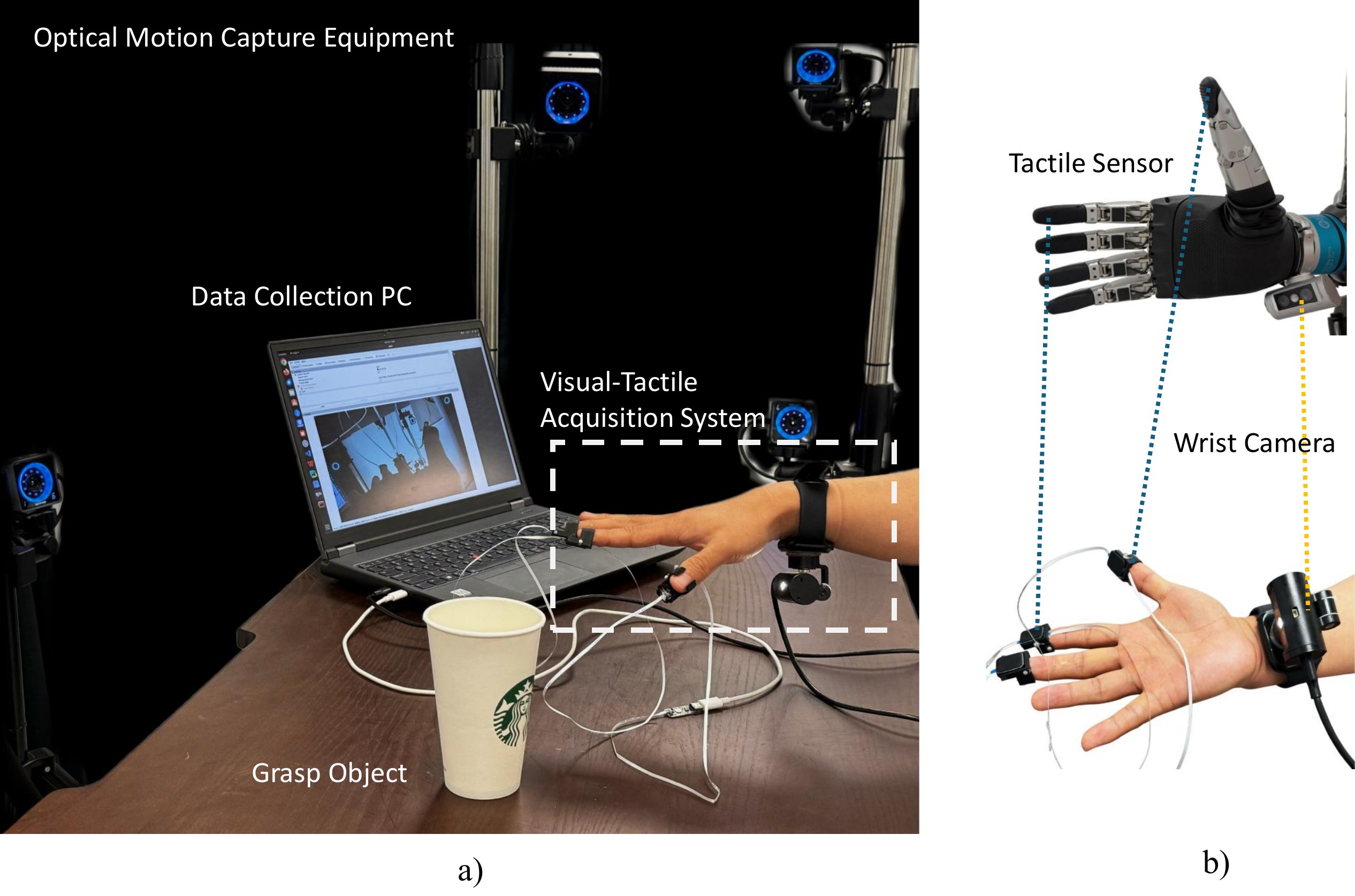
Demonstrations are 1 second at 30 Hz, two protocols: vertical lift and lateral shake. Labels come from a precision scale, force–displacement fits, and an inclined-plane friction test. Wrist RGB and fingertip tactile maps are aligned to the robot’s sensors.
The real robot in the paper is a 7-DoF arm with a direct-drive 6-DoF dexterous hand. Fingertips carry piezoresistive arrays matching the human glove. Teleop uses a Quantum Manus glove: 10 demos on each of 50 objects.
A Human’s Take
This is the right complaint about vision-only grasping. A full bottle and an empty can can look similar until you close. Estimating a stiffness number, even a crude one, is more useful than another VLM caption.
The 95% ID number is a lab table, not a shift. The one-shot collapse is the part I would not skip: if the object class is new, the property head is not a sensor. It is a guess with a nice error bar. Still, I would rather a policy that admits mass and friction exist than one that treats every cup like a brick.