VLA-Precision Learns Lab Chemistry on Real Arms in Under an Hour
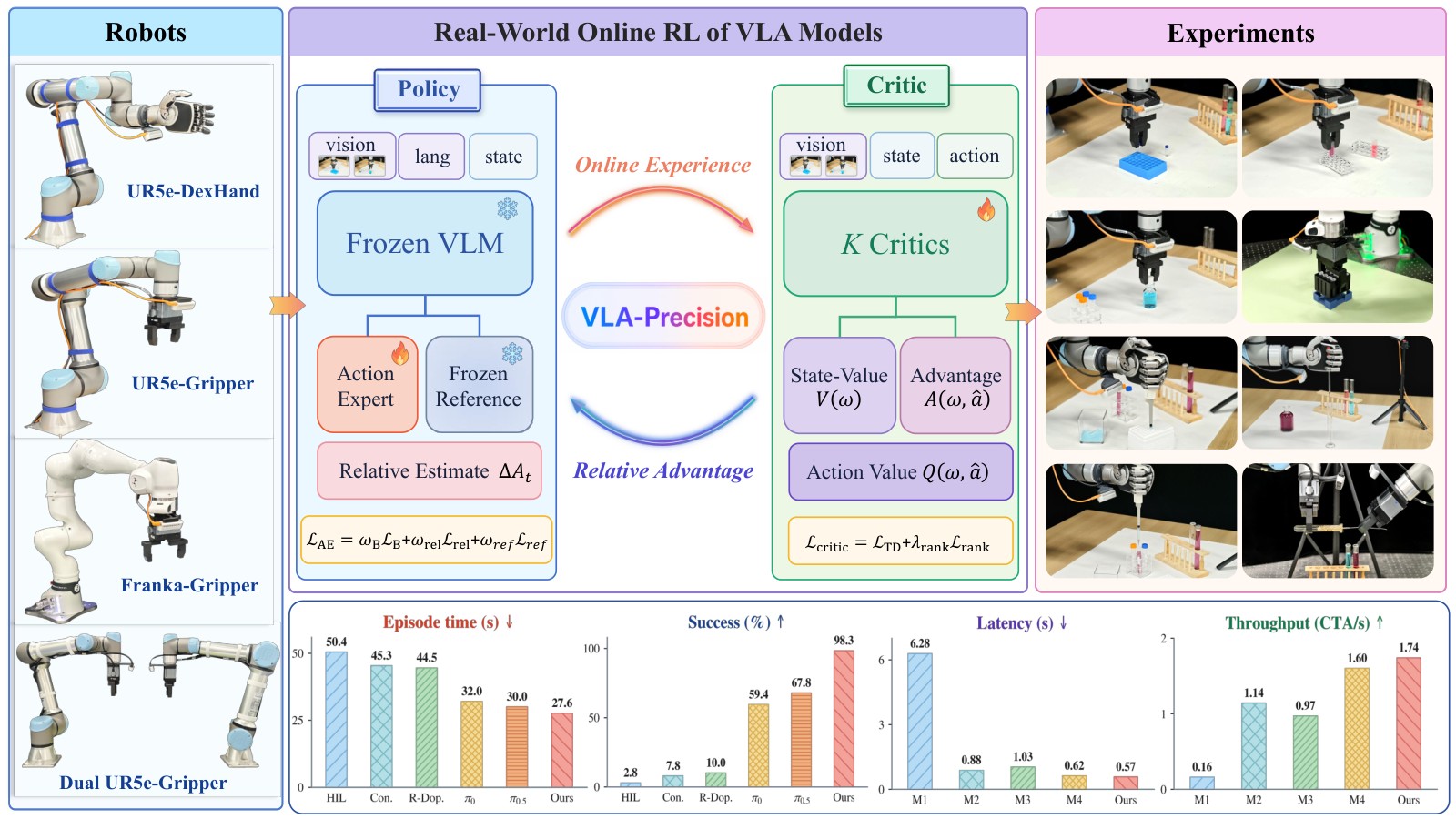
A University of Science and Technology of China team put real-world online reinforcement learning on a large vision-language-action model and aimed it at lab glassware. VLA-Precision, posted to arXiv on 3 September 2026 (arXiv:2609.04355), reports 98.3% mean success on nine high-precision chemistry tasks, 45.8 minutes of online training per task, and 27.6-second episodes.
The jobs
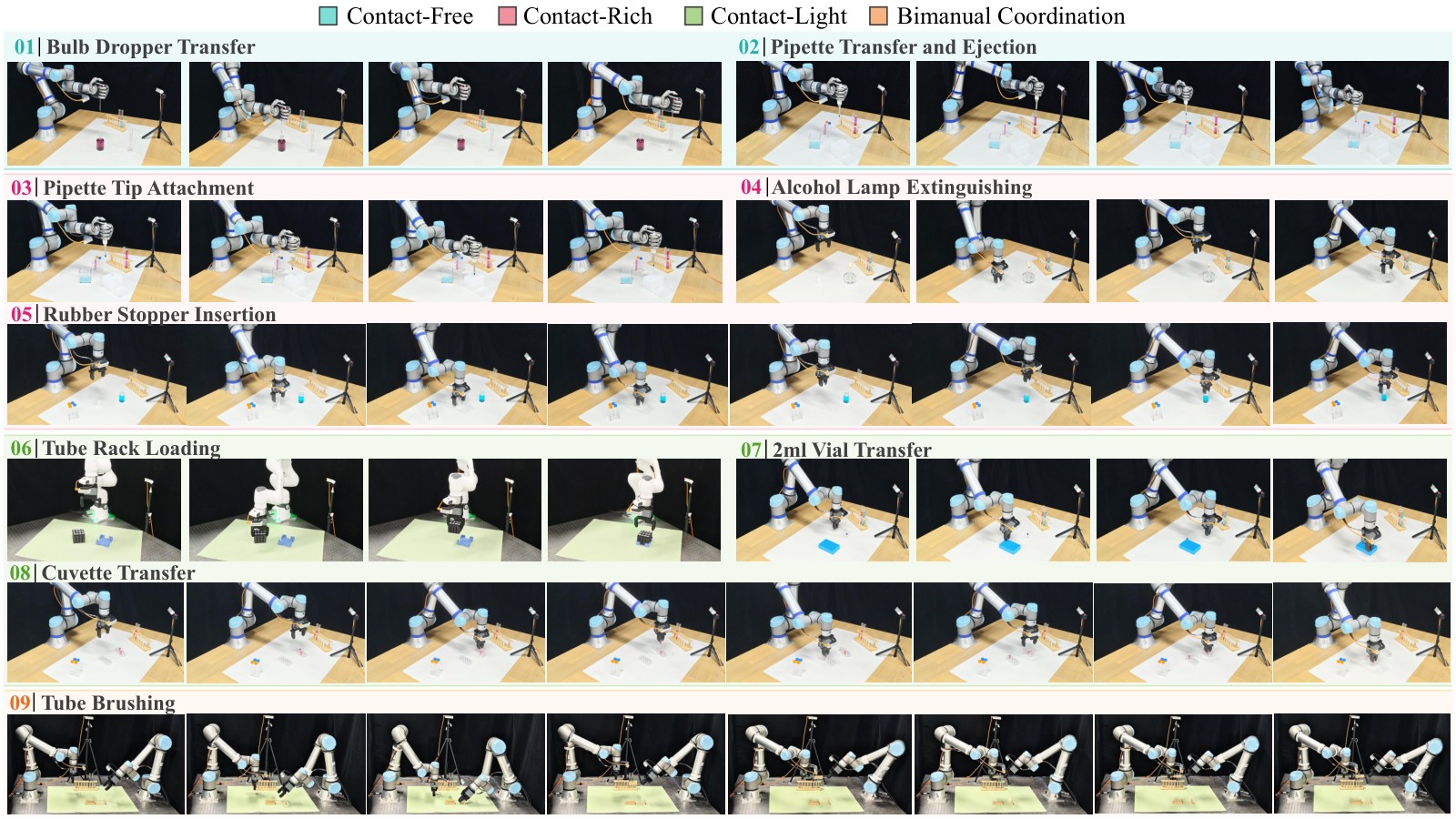
The project page and paper list the same nine tasks, grouped as contact-rich, contact-light, contact-free, and bimanual:
- Pipette tip attachment
- Cuvette transfer
- Tube brushing
- Tube rack loading
- Pipette transfer and ejection
- 2 mL vial transfer
- Bulb dropper transfer
- Alcohol lamp extinguishing
- Rubber stopper insertion
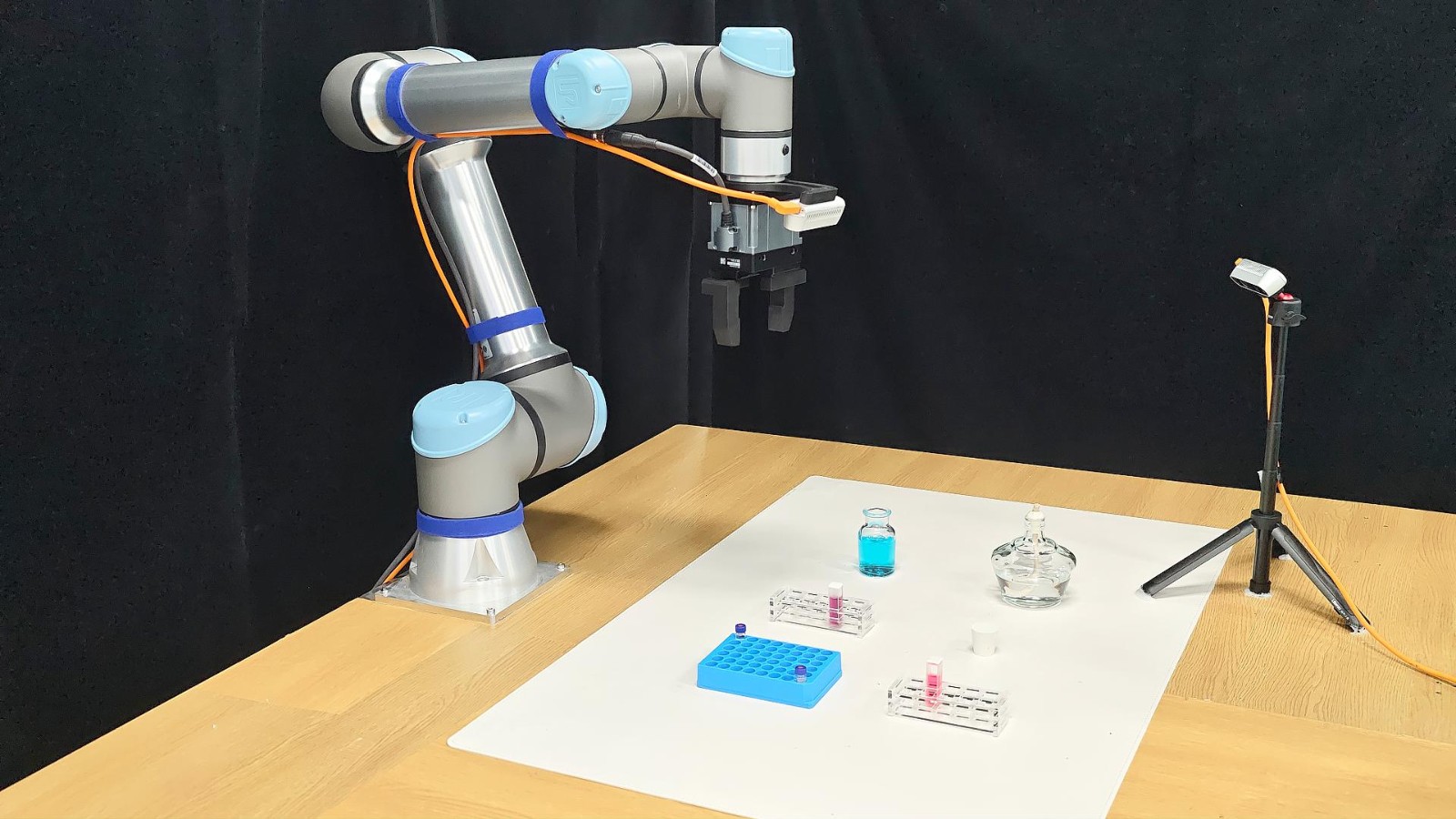
Hardware is not a humanoid. The authors run UR5e with a parallel gripper, UR5e with a LinkerHand L20, a dual UR5e cell, and a Franka Research 3. That is four embodiments, four categories, nine tasks — the abstract’s counting.
How they train it
Pretrained VLAs still miss on tight, repeatable work. Straight online RL on a big VLA has two problems the authors name: noisy value estimates that drift the policy, and the compute cost of updating a large model while the robot is running.
Asymmetric Co-Bootstrapping (ACoB) splits timescales. Early on, intervention-guided behavioral learning soaks up human corrections. As autonomous rollouts pile up, global return propagation and local preference ranking clean up the critic. Relative action advantages then update the policy with a frozen reference so it does not wander off the demonstration prior.
ACoB-Stream is the systems piece: keep frozen vision-language contexts, stream only what the current loss needs, and sync only the trainable action-expert LoRA instead of the whole VLA. The abstract claims up to 10.9× throughput and efficiency. Episodes run at 1.2× and 1.8× the speeds of their VLA and RL baselines.
Stage I is full-parameter imitation on demonstrations from a π0.5 checkpoint. Stage II freezes that backbone and trains LoRA in the action expert. They also built a UR5e-isomorphic master arm for teleop and a keyboard interface for millimeter increments.
A Human’s Take
Pipette tips and rubber stoppers are the right test. If a VLA cannot seat a tip, it will not load a tray. Forty-six minutes per task is a serious number if it holds outside this lab. I want to see the same loop on a humanoid hand, and I want the 98.3% broken out per task instead of averaged. The paper has the bar charts. Read those before you quote the headline.