VLAff Learns Where, How, and Which Way From Ego Video
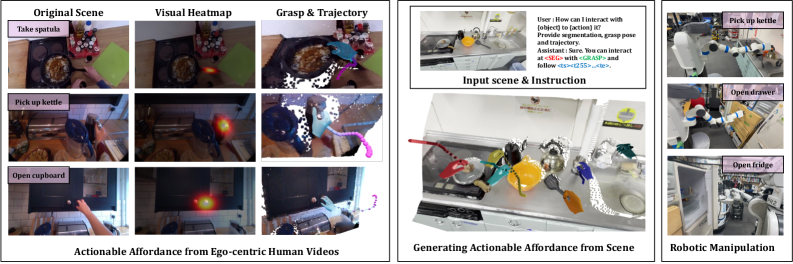
Human video is plentiful. Robot action labels are not. VLAff, accepted at IROS 2026 and posted on arXiv August 5, 2026 (arXiv:2608.05215) from the University of Tokyo’s JSK lab, bets that object-centric actionable affordances — where to touch, how to grasp, how to move — can bridge that gap without cloning human joints onto a gripper.
EgoAffordance + one model
The pipeline runs SfM, hand-object detection, segmentation, MANO hand reconstruction, ego inpainting, and 3D hand tracking on egocentric footage. The resulting EgoAffordance set holds 204K episodes, about 5.6M visual heatmaps and 11.6M grasp/trajectory affordances (paper abstract; Table I also lists 5.78M heatmaps and 11.61M trajectories).
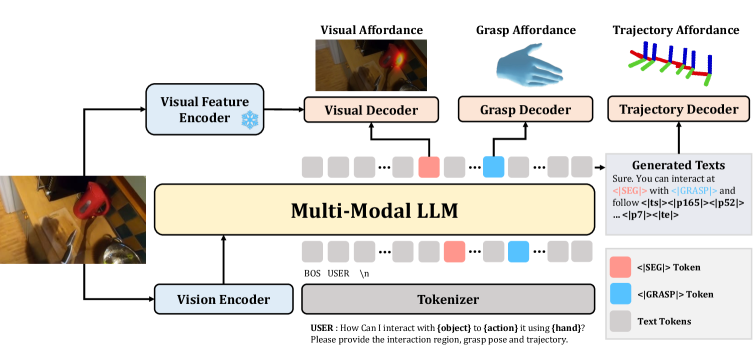
VLAff extends a Qwen2.5-VL backbone with special tokens: <SEG> for heatmaps (plus DINOv2 features), <GRASP> for 96-D MANO-style parameters, and discrete trajectory bins for autoregressive 6D waypoints. Object-centric transforms pin grasp and path to a 3D anchor from the heatmap peak so outputs stay embodiment-agnostic.
What the numbers say
On visual affordance metrics, VLAff leads the paper’s comparison (IoU 0.121, NSS 1.542, SIM 0.142, KLD 2.517 vs LISA, UAD, VRB, 3DOI).
Zero-shot manipulation: 83.0% average on 10 sim household tasks vs 85.0% for VidBot (strongest sim baseline in the table). Real kitchen tasks on Fetch and PR2: 68.0% average for VLAff vs 52.0% for VidBot across five tasks (10 trials each). Affordance-guided real RL on Open Fridge learns fastest when all three modalities stay in the reward; drop the visual heatmap and learning collapses.
A Human’s Take
I’m excited when “see / grasp / move” comes out of one model trained on kitchen ego video, not another 10k teleop hours. The real-robot gap over VidBot is the money shot; the remaining miss mode — bad first trajectory direction — is exactly the kind of bug you can hunt with better scene priors. Code and weights are listed as coming soon on the project page, so I’m watching that drop.