W²-VLA Predicts How the Wrist Will Move Before It Moves
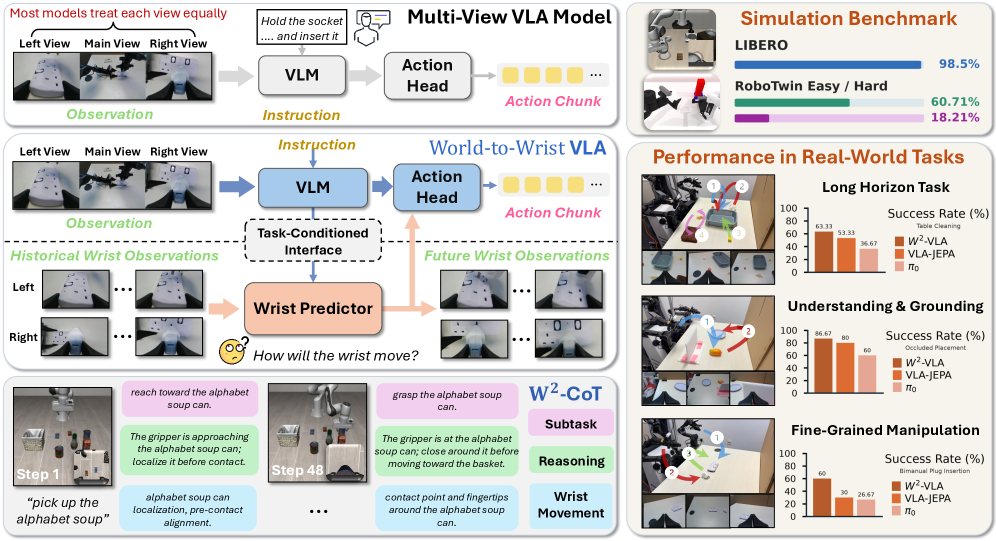
Most multi-view VLAs treat the main camera and the wrist camera as two equal streams. World-to-Wrist VLA (W²-VLA), posted August 5, 2026 (arXiv:2608.05369) with a project page, code, and datasets, treats the wrist differently: it forecasts future wrist latents under the global task, then uses that foresight for actions.
How the pathway works
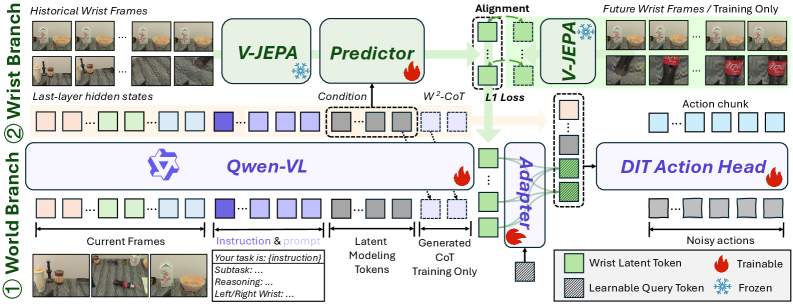
A VLM (Qwen3-VL-4B-Instruct in their build) contextualizes 16 latent modeling tokens from multi-view frames and the instruction. Those hidden states form a fixed-length task interface. Conditioned on that interface plus wrist history encoded by a frozen V-JEPA 2.1, a predictor forecasts future wrist latents. A lightweight adapter turns them into context for a DiT flow-matching action head.
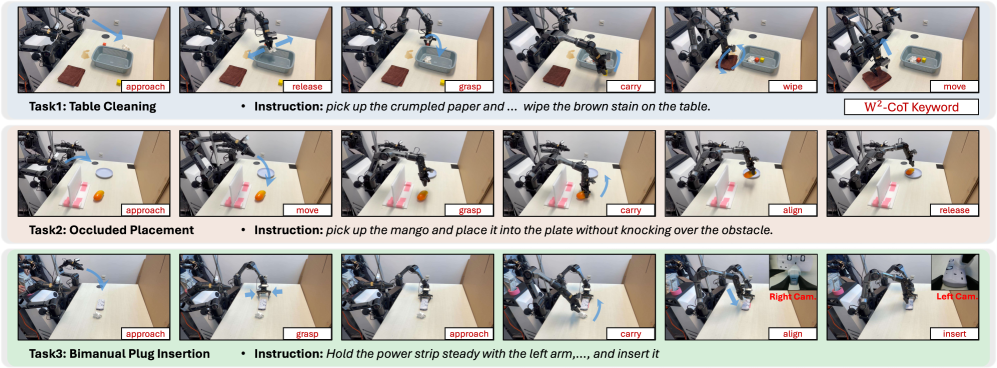
W²-CoT is an offline synthesis pipeline that labels subtask progress, physical transitions (approach, grasp, transport, release), and wrist-local evidence. That text shapes the latent interface during training. At inference, no CoT decoding is required — which is how they keep real-time rates.
Scores that stuck
On LIBERO, W²-VLA reports 98.5% average success (Spatial 99.6%, Object 99.8%, Goal 99.2%, Long 95.2%). On RoboTwin 2.0, averages are 60.71% Easy and 18.21% Hard.
On a CoBoT Magic (Mobile ALOHA-style) platform with three real tasks — table cleaning, occluded placement, bimanual plug insertion — standard success averages 70.00%, beating VLA-JEPA and π₀ under the same protocol. OOD success averages 52.22%. A 16-step action chunk takes 183 ms (87.43 Hz) in real deployment; the abstract also states action generation above 80 Hz.
A Human’s Take
I’m so here for “predict the fingertips, not the whole room.” Plug insertion and wipe cloths live or die in the last centimeters; giving the action head a wrist-future prior is the kind of boring-smart bias that actually ships. Next receipt I want is third-party code on a non-Magic dual arm without their CoT generator.