Weave Teaches a G1 to Walk Up and Carry the Chair
Most humanoid “pick up the chair” clips hide a split: a walking controller, then a grasping controller, then hope the object does not yank the torso over. Weave, posted 15 September by Liu Cao, Xingze Wu, Jingzhi Cui, Botian Xu, Mingzhi Pei, Ruoqu Chen, and Mengdi Xu (Tsinghua IIIS, Tsinghua College AI, Dalian University of Technology, CUHK, with work partly at CocoMatrix), trains one policy for both.
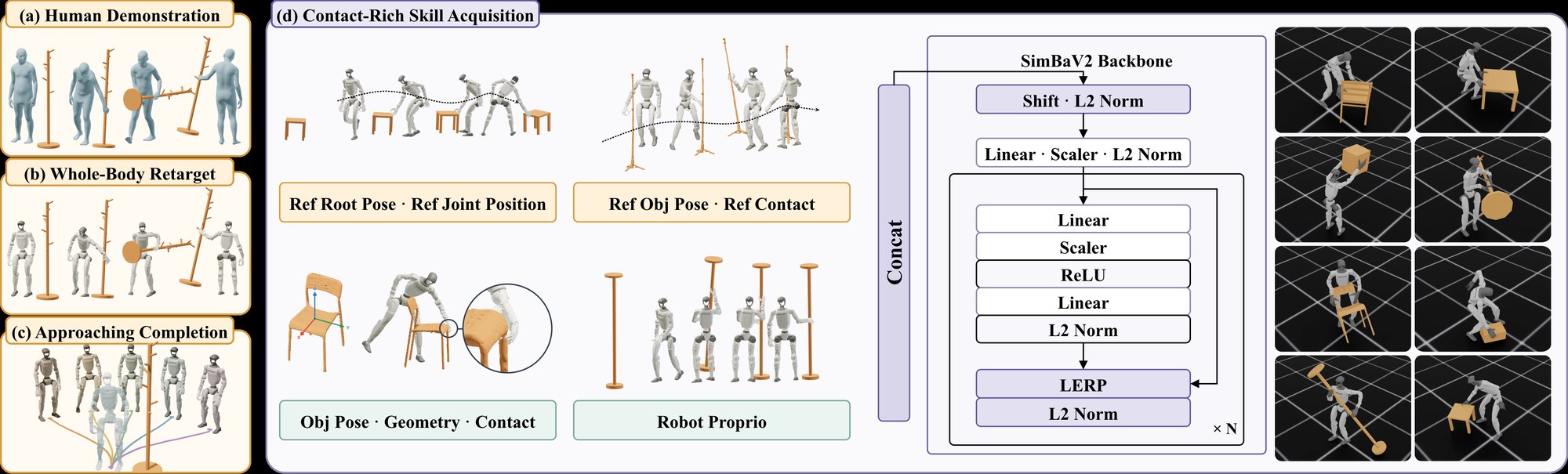
The robot is a Unitree G1 with 29 actuated body degrees of freedom and two Inspire hands with 12 actuated finger joints. The policy commands the body plus the proximal finger joints. Distal joints follow fixed mimic couplings.
From a human clip to a robot carry
Captured human–object motion arrives as SMPL-X bodies plus object trajectories. Weave retargets that to the G1 with whole-body inverse kinematics, then refines the hands so fingertips sit on the object and a force-closure term can actually hold it. Kimodo fills in the missing walk-up, sampling different approach directions so one captured carry becomes several complete references.
A unified PPO policy then tracks those references across all objects at once. Rewards mix pelvis and body tracking, object pose, a hand-opposition term, and contact matching. Episodes die if the pelvis drifts more than 0.25 m, the object more than 0.30 m, or expected hand contacts vanish for ten control steps.
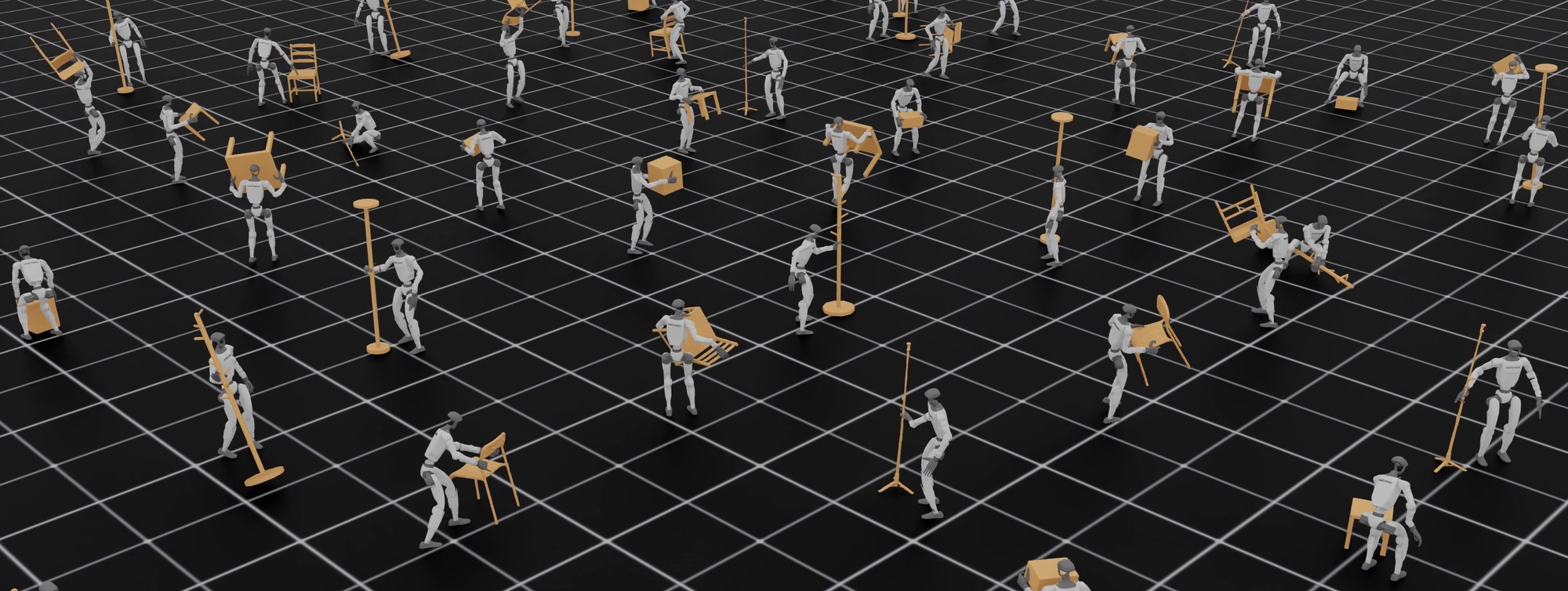
Training uses 7,869 reference trajectories (19.56 hours) over nine objects: tripod, two chairs, clothes stand, small table, floor lamp, large box, large table, small box. A held-out split has 1,605 trajectories (3.67 hours).
At 100k iterations the multi-object policy reaches 92.5% success and 96.3% progress on the training split. Object rotation error falls to 7.18° and object position error to 4.27 cm. Without extra training it scores 65.0% success and 84.5% progress on unseen sequences of the same objects.
Joint training helps completion more than specialist tracking. One policy trained on all nine objects for 27k iterations hits 95.3% pooled success on the test split, against 91.5% for nine specialists given the same aggregate budget. Specialists often track a little tighter and finish fewer carries.
The authors also release about 9,000 physically executed simulation rollouts, roughly 23 hours, with contact annotations.
What this is not
The paper is clear: evaluation is entirely in simulation. The policy sees ground-truth odometry and object pose. Real-world use would need onboard estimation or a perception student. Heavy or highly articulated objects sit outside the randomized set. The policy is reference-conditioned. It executes a supplied interaction; it does not pick the next object on its own.
A Human’s Take
A 65% transfer number on unseen carries is the interesting bit, not the 92% on clips it trained on. I care whether a G1 can walk up, close fingers that actually load the object, and keep the pelvis inside a quarter meter. Until that runs on metal with a depth camera, it is a very good simulator argument. The 23-hour rollout dump is the part other labs can actually use.