WetRobo Lets a Coding Agent Open Incubators Instead of Training a VLA
A lot of lab-robot papers assume you will collect teleop in this room, fine-tune a VLA, and hope the next bench looks the same. WetRobo takes the other fork: ship a kit, write an AGENTS.md, and let a coding agent look at the cameras and emit Python.
The paper is arXiv:2609.18435, dated 16 September 2026. Authors span the University of Tokyo, RIKEN, NYU, Google DeepMind, and NIMS. Code and demos sit at github.com/tsudalab/WetRobo. They ran OpenAI Codex on gpt-5.6-sol.
What is in the box
The kit is one AgileX Piper 6-DoF arm (right arm in every trial), head and wrist cameras (iPhone RGB-D through Record3D), and three pieces of gear the authors actually tested:
- EYELA LTI-300 incubator with a recessed horizontal handle
- 500 mL Nacalai D-PBS(−) bottle with a white screw cap
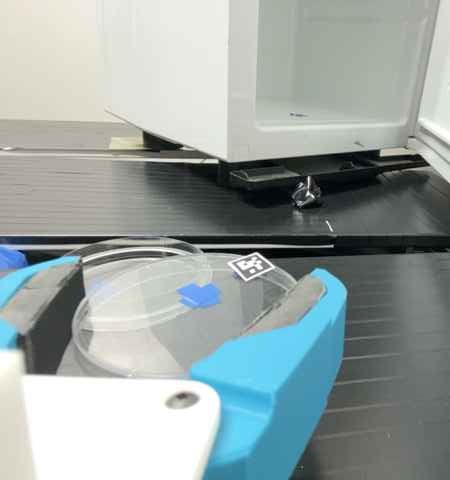
- TPP 93100 Petri dish and lid
Fifteen Quest teleop demonstrations per task ship with the repo. The agent does not have to use them. On the cap task, it did not.
The skill file tells the agent to keep jaws level around open containers, pause for an image check before contact, and measure home poses in the local lab instead of copying another room’s lighting.
Three tasks, two labs, one VLA that did not travel
Codex lifted a Petri lid, unscrewed a bottle cap, and opened the incubator door on real benches.
The useful comparison is the cap. Lab X and Lab Y differed in gripper (NYU string-driven Dynamixel vs Piper native), camera count, bench color, and lighting. The coding agent succeeded in both. A π0.5 VLA fine-tuned 100k steps on 25 Lab X videos succeeded in Lab X and failed in Lab Y.
Token burn was not free. Lab X used 41.4 million tokens and 1 h 02 min to first grasp. Lab Y used 23.0 million tokens and 48 min 43 s. After the Lab X door program existed, a repeat opening in the same setting took 3 min 27 s.

On the door, the agent stopped trusting shadows, fit a RANSAC plane to RGB-D, and used a 5 mm proof pull plus aperture checks to tell an empty close (~0.005) from a handle hold (0.3–0.4). Lab Y’s door trial stopped after a bad head-camera alignment and went home with the door still shut.
The authors are clear about what they did not show: one agent, one model, successive attempts rather than independent replications, lid lift not dish transport, and a lot of tokens.
A Human’s Take
I like this because the failure mode is readable. When the VLA eats a new bench, you get a shrug. When Codex misses the cap, you get a file that tried optical flow, then a wrist-hold, then an effort reading of −1.05 N·m against an empty close of −0.1 to −0.2. That is a lab notebook, not a checkpoint. The bill is the million-token first grasp. If AGENTS.md actually accumulates across labs, this becomes a kit. If every install burns another 40 million tokens, it is a demo with a GitHub URL.